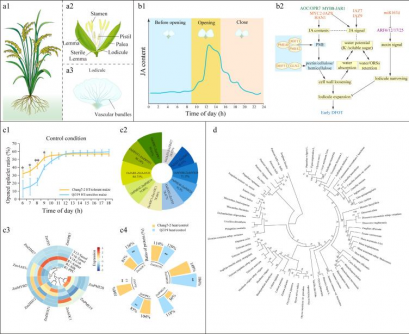
A recent study has unveiled a promising strategy for enhancing crop resilience against rising temperatures by identifying “early-morning flowering” (EMF) as a natural method for plants to avoid heat stress. Researchers from the China Agricultural University, led by Xin Wang, Fen Mao, and Shoubing Huang, examined the diurnal floret opening time (DFOT) of over 100 plant species alongside global temperature trends. Their findings indicate that crops like sorghum, pearl millet, and indica rice can significantly improve seed set and reproductive success by shifting reproductive events to cooler early hours.
Climate-induced heat stress has intensified over the past fifty years, with projections indicating further increases by the century’s end. Staple crops, including maize, rice, and soybean, often flower during peak summer heat, exposing their reproductive processes to damaging temperatures. Traditional adaptation methods, such as altering sowing dates or enhancing biochemical tolerance, have proven inadequate in rapidly warming regions or multi-cropping systems.
The study, published in Seed Biology on August 28, 2025, provides a blueprint for developing climate-resilient crop varieties capable of maintaining stable yields in hotter environments. The research team utilized global climate records, field data, and molecular analyses to explore how rising temperatures impact crop reproduction and how specific flowering habits can mitigate heat stress.
By analyzing temperature data from as early as 1850, focusing on the hottest months across 50 cropland sites in Asia, Africa, Europe, and the Americas, the researchers discovered a significant rise in daily maximum temperatures. From 2004 to 2023, daily maximum temperatures during hot seasons increased by an average of 1.25°C, while the duration of midday heat episodes extended by an average of 1.08 hours. In 2023, Africa recorded the highest mean maximum temperature at 34.0°C, with North America showing the most rapid warming and lengthening heat episodes.
To assess biological adaptation, the researchers compiled DFOT data from 102 flowering species, categorizing them into morning, midday, and night-flowering groups. They observed notable differences in optimum flowering temperatures among cereal crops: morning-flowering species preferred 26.1°C, while midday species thrived at 22.3°C, and night-flowering species at 29.3°C. Within cereal crops, maize and indica rice, which flower in the early morning, showed higher temperature thresholds for seed set (37.5°C and 37.4°C, respectively) compared to japonica rice, which had a threshold of 36.7°C. Sorghum and pearl millet, exhibiting night-flowering habits, demonstrated even greater resilience with thresholds of 38°C and 42.4°C.
Controlled experiments confirmed that EMF varieties of wheat and rice consistently achieved higher seed set under heat stress, with maize also benefiting from earlier pollination. At the molecular level, genes such as OsMYB8 and EARLY MORNING FLOWERING 1 were identified as key regulators of DFOT by modifying lodicule cell wall structures, with homologs found in over 60 plant species.
These findings underscore EMF as a robust mechanism to safeguard crop reproduction in the face of increasing climate-induced heat stress. By aligning flowering times with cooler hours, plants can avoid issues such as pollen sterility and grain loss during heat episodes. Beyond breeding, integrating EMF traits with crop management strategies—such as precision sowing or drone-assisted morning pollination—could enhance effectiveness. This adaptation strategy also benefits insect-pollinated species, as pollinators are more active in cooler morning conditions.
Unlike traditional biochemical tolerance breeding, which struggles to keep pace with climate change, DFOT manipulation offers a timely adaptation rooted in natural plant rhythms. The study highlights the potential of early flowering as a key strategy for ensuring food security in a warming world.
The research was supported by several funding bodies, including the National Key Research & Development Program of China and the National Science Foundation of China.
For further details, the study can be accessed via this link: https://doi.org/10.48130/seedbio-0025-0013.