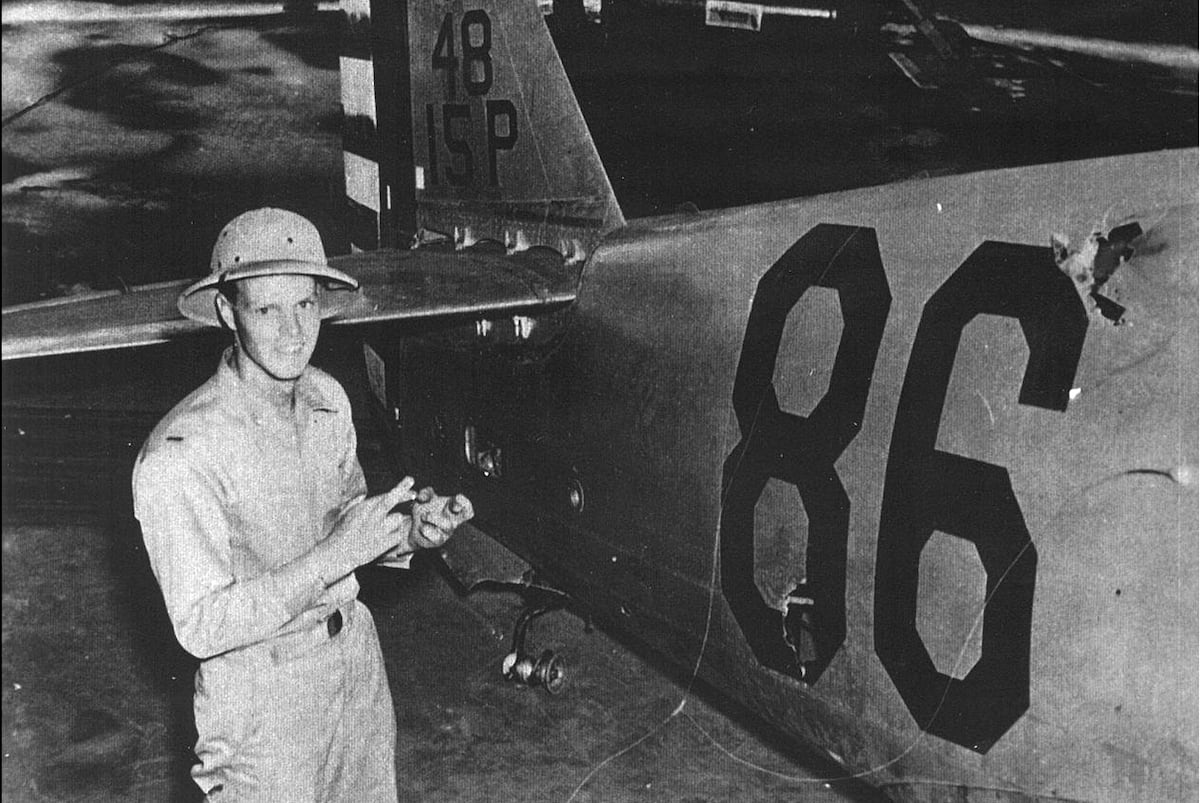
On the morning of December 7, 1941, as Japanese planes mounted a surprise attack on Pearl Harbor, Philip M. Rasmussen emerged as a remarkable figure in American aviation history. At just 23 years old, he was a second lieutenant in the U.S. Army Air Corps, serving with the 46th Pursuit Squadron at Wheeler Field on the island of Oahu. Rasmussen’s quick actions on that fateful day earned him the Silver Star for bravery, marking the beginning of a storied military career that spanned several theatres of World War II.
Rasmussen entered flight training in September 1940 and completed it by April 1941. His mission was clear: to defend Hawaii against potential aerial threats. While there were no direct indications of an imminent attack, he sensed that tensions with Japan were escalating. He recorded in his diary on December 2 that his father believed trouble was brewing, and just days later, he noted the failure of diplomatic efforts between the United States and Japan.
As the sun began to rise on the morning of the attack, Rasmussen was in the barracks when he spotted a Japanese aircraft diving towards the hangar. The plane released a bomb that detonated in a massive explosion, igniting his instinct to alert his fellow officers. Still clad in his pajamas, he shouted that they were under attack and quickly armed himself before rushing to the flight line.
With enemy planes flying overhead, Rasmussen witnessed the devastation as Japanese bombers targeted American aircraft lined up on the ground. He sprinted towards a Curtiss P-36, the only aircraft that remained somewhat intact. As he climbed into the cockpit, an armorer joined him, bringing ammunition necessary to defend their base. Under the pressure of the ongoing attack, Rasmussen managed to taxi the aircraft to safety before loading it with ammunition.
Once airborne, he joined his fellow pilots to confront the attacking forces. The squadron’s immediate goal was to reach Kaneohe Bay, which was also under assault. Upon arrival, they spotted several Japanese planes preparing for another strike and engaged them in combat. Rasmussen successfully shot down an enemy aircraft but faced a harrowing moment when another Japanese fighter attempted to ram him.
The encounter left him momentarily disoriented, resulting in damage to his plane that rendered his rudder inoperable. Despite the chaos, he relied on his training to maneuver the aircraft, popping in and out of clouds to evade further attacks. After managing to stabilize his aircraft, he realized he had sustained no injuries, only remnants of shattered Plexiglas from his canopy in his hair.
Rasmussen’s focus remained on flying as he headed back to Wheeler Field, where friendly forces had begun to organize themselves. Fortunately, they recognized him as one of their own, allowing him to land safely despite the severe damage to his plane. His successful return marked not only a personal victory but also a testament to his training and instincts under pressure.
After the attack, Rasmussen continued to serve in various capacities throughout the war, including a bombing mission over Japan that earned him the Distinguished Flying Cross. He later held the position of chief of operations at Eglin Air Force Base and retired in 1965 with the rank of lieutenant colonel.
Rasmussen passed away in 2005 at the age of 86, and he is laid to rest at Arlington National Cemetery. His oral history, captured in a 1991 interview, not only recounts his experiences but also provides insight into the mindset of a young pilot caught in the whirlwind of a pivotal moment in history.
As we reflect on Rasmussen’s actions that day, we remember the bravery and quick thinking displayed by those who defended their homeland. His story serves as a reminder of the human spirit’s resilience in the face of adversity and the enduring legacy of those who served during World War II.