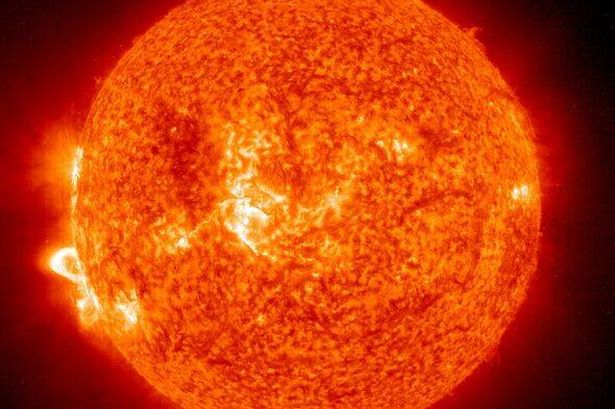
A substantial cluster of sunspots, designated AR 4294-4296, has rotated into a position on the sun’s Earth-facing side, raising concerns about potential solar activity. Although this formation is comparable in size to the sunspot that caused the most powerful solar storm on record, experts are advising caution rather than alarm. They emphasize that while minor technological disruptions and beautiful auroras may be on the horizon, the likelihood of another event akin to the Carrington Event of 1859 remains low.
The sunspot cluster, visible as of November 28, 2023, consists of two magnetically linked groups, AR 4294 and AR 4296. NASA’s Perseverance Mars rover had previously detected these regions on the sun’s far side about a week before they became visible from Earth. The new sunspot group measures approximately 90% of the area of the historic Carrington sunspot, which was documented by British astronomer Richard Carrington in September 1859.
Sunspots can produce intense solar flares and coronal mass ejections (CMEs), which have the potential to disrupt electronic systems on Earth. When the magnetic field lines within a sunspot twist and break, they can emit powerful bursts of radiation, resulting in solar flares. These bursts can cause temporary radio blackouts and send fast-moving clouds of plasma towards Earth, which can disrupt the planet’s magnetic field.
According to Spaceweather.com, the newly observed sunspot group is “one of the biggest sunspot groups of the past 10 years” and has the potential to unleash supercharged X-class flares. The National Oceanic and Atmospheric Administration (NOAA) classifies these as the most powerful type of solar flare. If a CME is released, it is expected to be “geoeffective,” which means it could have a significant impact on Earth.
The Carrington Event, noted for its record-breaking X45 solar flare, remains a critical point of reference for understanding the potential impact of such solar activity on modern infrastructure. A similar flare today could devastate satellites in orbit and disrupt electrical grids, with estimated damages exceeding $1 trillion. Although the size of sunspots is a factor in their potential to produce solar flares, the configuration of their magnetic fields and the frequency of eruptions are also crucial determinants.
While the magnetic fields of AR 4294-4296 appear to be closely intertwined, suggesting the possibility of flares, experts remain optimistic about the situation. They have detected a potential X-class flare from this cluster while it was still on the sun’s far side. Nevertheless, scientists affirm there is no immediate indication of a solar storm on the scale of the Carrington Event in the near future.
Researchers will continue monitoring the magnetic fields of AR 4294-4296 for signs of increased activity. If this sunspot cluster passes Earth without significant eruptions, it is large enough that it could remain viable for future solar activity, possibly re-emerging around Christmas.
As AR 4294-4296 positions itself directly toward Earth, specialists continue to encourage the public to stay calm. While some minor disruptions and breathtaking auroras could occur over the coming week, the prospect of another Carrington Event remains minimal. Scientists will keep a vigilant eye on the evolving situation, ready to evaluate its potential impacts on our planet.