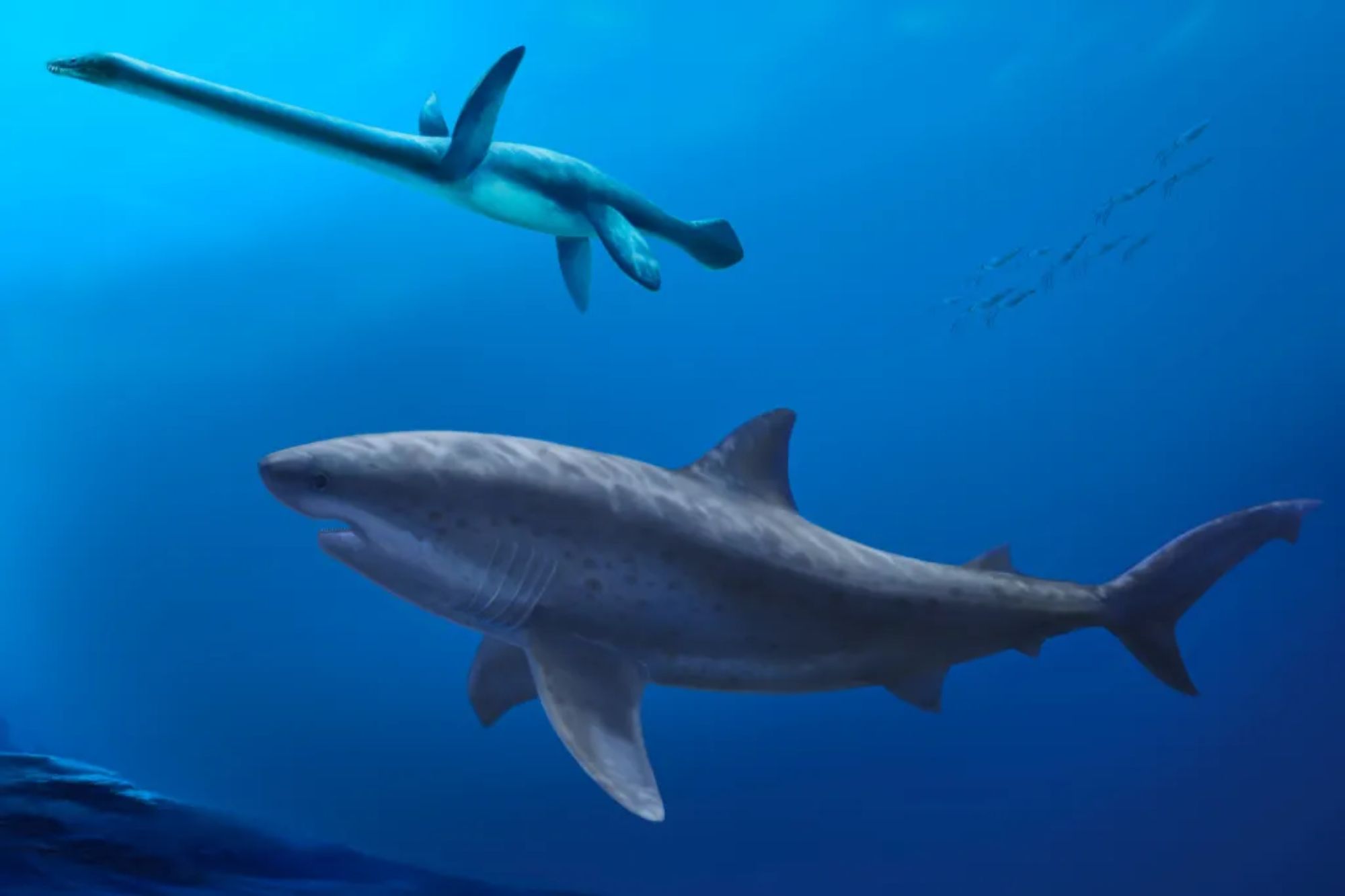
BREAKING: Researchers have just unveiled a groundbreaking discovery revealing that a monstrous shark, known as a cardabiodontid, ruled the ancient seas **15 million years earlier** than the formidable megalodon. This ancient predator prowled the waters off **northern Australia** during the Cretaceous period, far before the rise of today’s great white sharks and whales.
The findings, published in the journal **Communications Biology**, highlight fossilized vertebrae unearthed near **Darwin** that measure **4.7 inches** across, indicating that this ancestor of the modern **20-foot** great white shark could have reached an astonishing length of **26 feet**. Senior curator in paleobiology at the **Swedish Museum of Natural History**, **Benjamin Kear**, stated, “This pushes the time envelope back of when we’re going to find absolutely enormous cardabiodontids.”
The vertebrae, originally discovered in the **1980s and 1990s**, had been largely overlooked until recent studies reignited interest. Kear emphasized the rarity of shark bones, noting that their skeletons are primarily composed of cartilage, which makes such discoveries vital for understanding their size. “The importance of vertebrae is they give us hints about size,” he added.
With a history spanning **400 million years**, sharks have long been a topic of fascination. However, this latest revelation indicates that **lamniforms**, the ancestors of today’s great whites, were already evolving into gigantic forms much earlier than previously believed. The international research team utilized advanced techniques, including **CT scans** and fisheries data, to estimate the size and shape of these ancient predators.
Kear described the ancient cardabiodontids as resembling a modern, gigantic shark, marking them as an evolutionary success story. “This is a body model that has worked for **115 million years**,” he said.
The implications of this study extend beyond mere curiosity; they offer insights into the evolutionary history of sharks and their adaptability to changing environments. Kear noted that this discovery could encourage scientists to explore similar ecosystems worldwide, suggesting that other prehistoric mega-predators may yet be uncovered.
“This is where our modern world begins,” Kear stated, emphasizing the importance of studying these ancient ecosystems to predict how current species might react to ongoing environmental changes. By examining past climate shifts and biodiversity events, researchers aim to gain better insights into the future of marine life.
As these findings circulate, the scientific community is urged to continue investigating the ancient seas. The evolution of sharks could provide critical context for understanding today’s marine ecosystems and their resilience against climate change.
Stay tuned as more details emerge from this exciting discovery that reshapes our understanding of prehistoric marine life and its connection to modern species.