A recent study has revealed unprecedented details about magnetic activities on the Sun, thanks to the Parker Solar Probe. During its closest approach in December 2024, the probe captured striking images of massive magnetic structures, referred to as “tadpoles,” that play a crucial role in understanding solar dynamics. These findings are documented in a paper authored by Angelos Vourlidas from Johns Hopkins University and his colleagues, published in The Astrophysical Journal Letters.
Significant Discoveries in Solar Dynamics
The Parker Solar Probe’s recent perihelion, approximately 4 million miles from the Sun, provided a unique vantage point to observe phenomena within the solar atmosphere. The probe’s advanced imaging technology allowed scientists to confirm the existence of “tadpoles,” dark shapes found in magnetic loops that appear to be swimming back toward the Sun. This phenomenon marks the first time these magnetic “inflow swarms” have been observed in such detail.
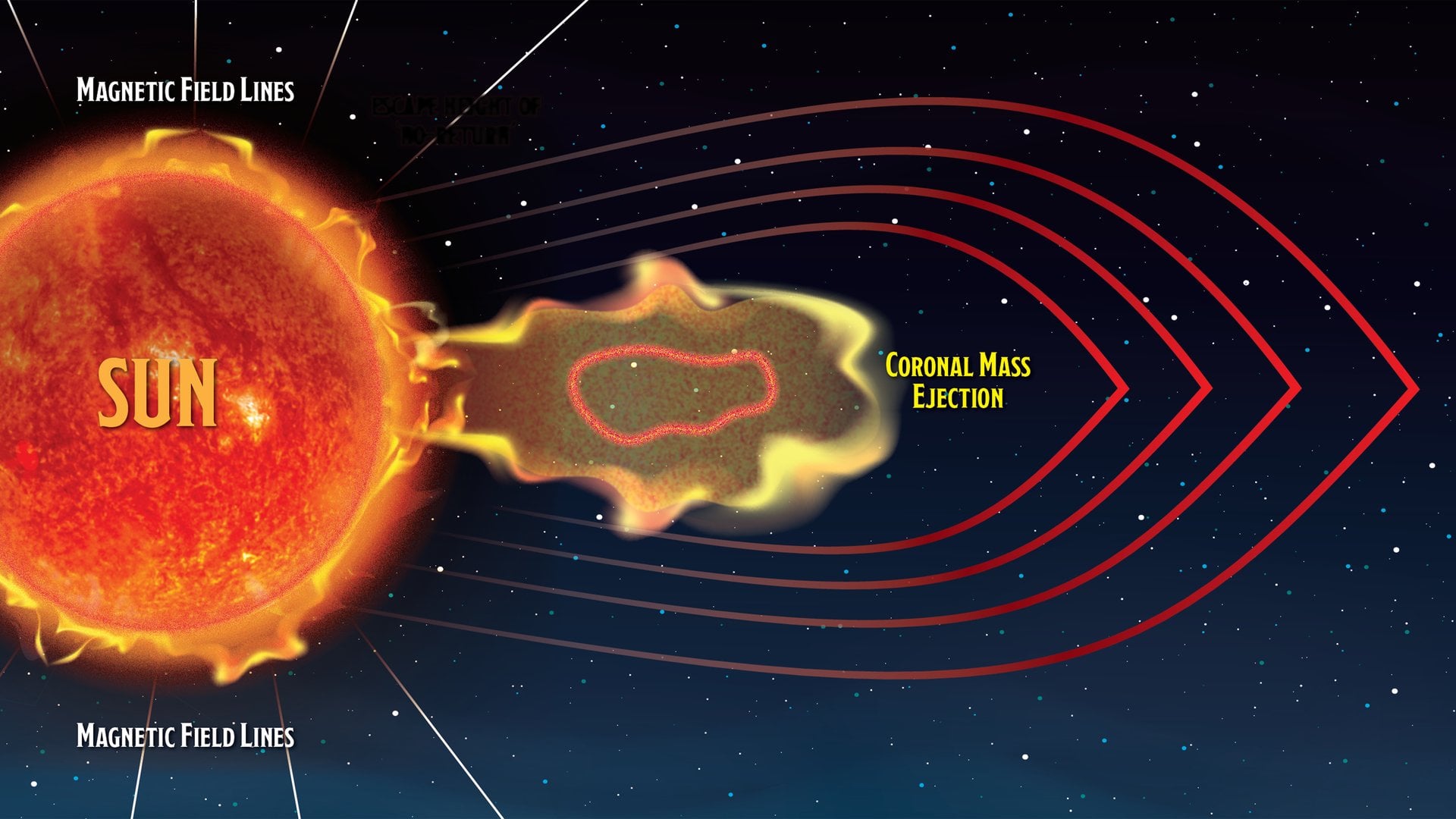
These structures are part of a magnetic loop that experiences a break, redirecting energy back to the Sun while sending other parts into space, creating a visual resemblance to a tadpole’s tail. Although these swarms can be relatively small—some too tiny to be detected from Earth—they are still significant, measuring about twice the diameter of our planet. Solar physicists believe that understanding these inflow swarms is essential for predicting solar storm activity, which can impact Earth’s space weather.
The study also highlighted the behavior of the Heliospheric Current Sheet (HCS), a critical component of the Sun’s magnetic field. The Parker Solar Probe observed this sheet being stretched and torn apart, a phenomenon known as “tearing-mode instability.” This event, likened to a flag fluttering in a storm, was observed as a solar storm exerted pressure on the sheet, causing it to break into separate pieces.
Observations of Magnetic Structures and Solar Storms
One of the most exciting findings was the observation of a large tadpole expanding at an astonishing 5,000 km/minute for over two hours. The tadpole grew in size by over 185 kilometers before it eventually disappeared. Such observations provide invaluable data for heliophysicists, allowing them to refine their models of solar behavior.
Perhaps the most intriguing discovery from the probe’s observations was the “birth” of in/out pairs of magnetic structures. The Parker Solar Probe captured the moment when a single structure in the Sun’s corona was pinched in the middle, resulting in two separate segments. One segment was pulled back towards the Sun, while the other was ejected into space at a speed estimated at 560 km/s, surpassing previous models’ predictions. This “pinch off” process is crucial to understanding how solar storms, particularly coronal mass ejections (CMEs), unleash potentially hazardous particles towards Earth.
The detailed imaging of these processes is set to enhance current models of solar activity, as scientists integrate this new information to improve their predictions.
Moving forward, the Parker Solar Probe continues its mission, with its primary objectives extending beyond June 2024. The probe will conduct additional perihelion passes, approximately four times a year, until it exhausts its fuel. As it ventures closer to the Sun, it promises to deliver more vivid and detailed images of our solar neighbor, contributing significantly to our understanding of solar phenomena and their implications for Earth.
In summary, the Parker Solar Probe’s latest findings represent a significant leap in solar research, showcasing human ingenuity in the face of challenges. The insights gained from its mission may ultimately help us better navigate the effects of solar activity on our planet.