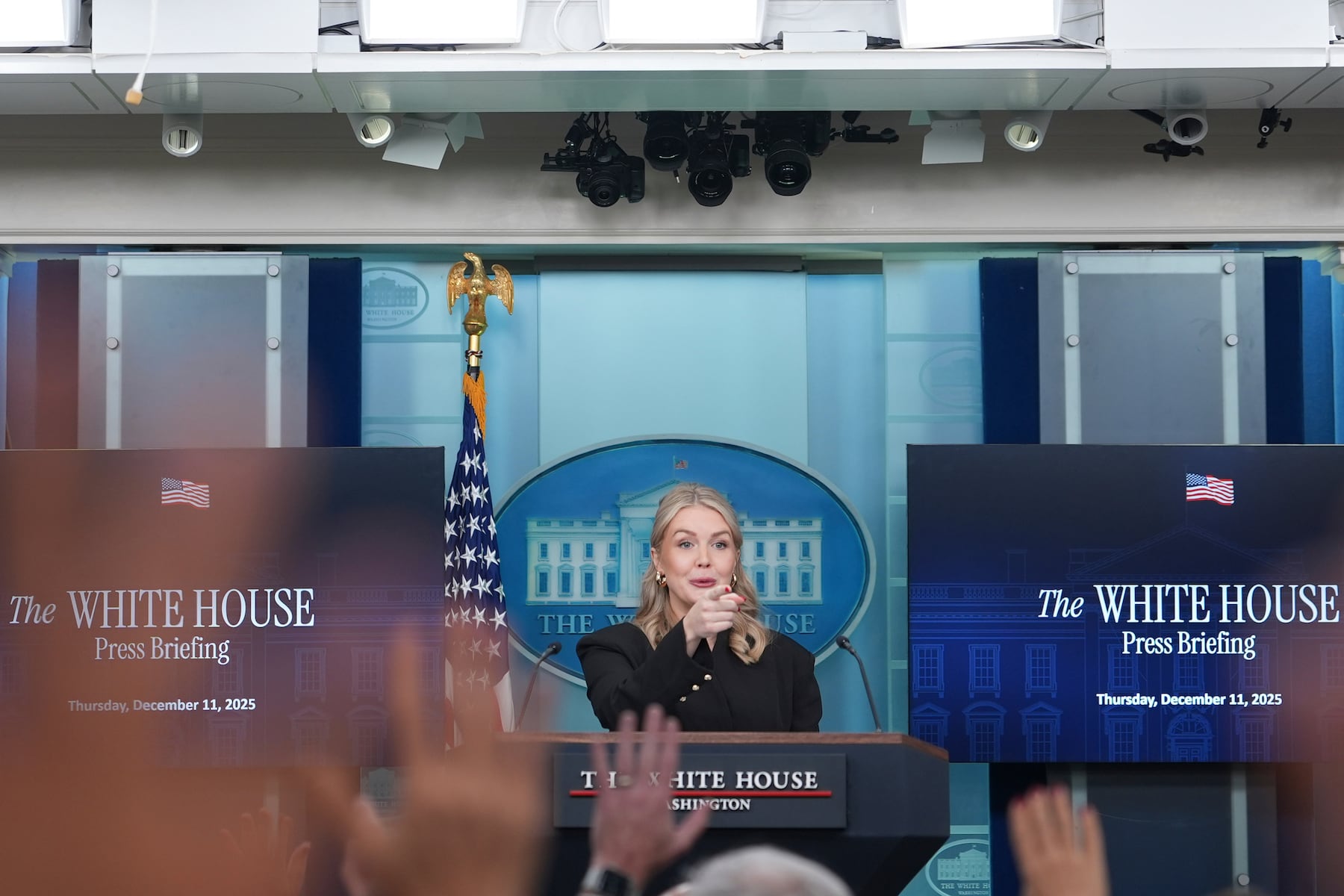
During a press conference on December 11, 2025, White House Press Secretary Karoline Leavitt announced what she described as positive developments in the U.S. economy. “Inflation as measured by the overall CPI has slowed to an average 2.5% pace,” she stated, referring to the consumer price index. Leavitt also claimed that real wages for the average worker had increased by approximately $1,200.
The press briefing took a contentious turn when CNN political correspondent Kaitlan Collins attempted to pose a follow-up question. Instead of addressing Collins’s inquiry, Leavitt launched into a critique of her predecessor, Jen Psaki, accusing her of having disseminated “utter lies” from the same podium just a year earlier. Leavitt insisted, “Everything I’m telling you is the truth backed by real, factual data, and you just don’t want to report on it ’cause you want to push untrue narratives about the president.”
Despite Leavitt’s assertions, the statistics she cited have come under scrutiny. The actual inflation rate for September was reported at 3%, contradicting her claims. Furthermore, CNN business editor David Goldman indicated that U.S. workers have faced “the lowest annual paycheck growth that Americans have had since May 2021.”
Echoes of Orwell in Political Discourse
The stark contrast between Leavitt’s declarations and the lived experiences of many Americans has drawn comparisons to the themes of truth and manipulation found in George Orwell’s novel “1984.” The book’s protagonist, Winston Smith, works in a department responsible for creating misleading statistics, which bear no resemblance to actual conditions. Orwell described a world where “the fabulous statistics continued to pour out of the telescreen,” reflecting a reality that was far removed from the truth.
In contemporary political discourse, Leavitt’s claims of transparency, particularly regarding the administration of Donald Trump, have raised eyebrows. She has repeatedly stated that Trump is the “most transparent president in history,” despite numerous instances that suggest otherwise. This notion of “transparency” has been described as Orwellian doublespeak, a term that refers to the manipulation of language to obscure the truth.
Leavitt’s defense of Trump’s handling of sensitive issues, such as his refusal to release documents related to the late financier Jeffrey Epstein, further exemplifies this phenomenon. She asserted, “This administration has done more with respect to transparency when it comes to Jeffrey Epstein than any administration ever,” a claim that has been met with skepticism.
Political Language and Its Implications
The last year has seen Leavitt making various controversial statements. For instance, she incorrectly claimed that the now-dismantled U.S. Agency for International Development (USAID) provided a grant of $32,000 for a “transgender comic book” in Peru. This assertion has been disproven. Additionally, she mischaracterized the “One Big Beautiful Bill” as eliminating taxes on tips, overtime, and Social Security, despite the fact that deductions for these are capped.
In a notable incident, Leavitt attempted to undermine U.S. Senator Mark Kelly’s appeal to servicemen and women regarding illegal orders, suggesting that “all lawful orders are presumed to be legal by our servicemembers.” This statement, according to critics, could incite confusion and disorder rather than clarity.
The manipulation of political language is not a new phenomenon. In his essay “Politics and the English Language,” Orwell emphasized that political discourse often aims to make lies sound credible and to present falsehoods as solid truths. Over the past ten months, Leavitt has become adept at deploying this kind of language to support her boss, diminish his opponents, and distract from administration controversies.
As the political landscape continues to evolve, the implications of Leavitt’s rhetoric and the broader discourse surrounding transparency and truth in government will likely remain a focal point for both media and public scrutiny.