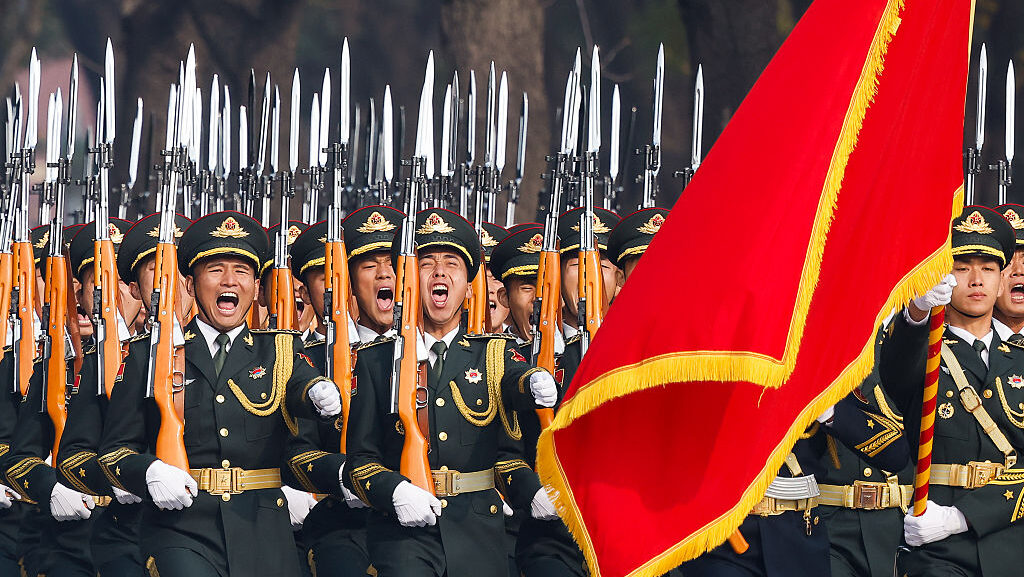
A recent Pentagon report highlights that China’s ongoing military buildup and modernization significantly heighten vulnerabilities for the United States, particularly concerning national security. The report, published on [date], spans 100 pages and serves as the annual assessment mandated by Congress. It underscores the increasing threats posed by China’s military advancements across several strategic domains, including cyber, space, and nuclear capabilities.
The assessment emphasizes that while the current U.S. administration seeks to foster better relations with Beijing, China’s military, specifically the People’s Liberation Army (PLA), is on track to fulfill President Xi Jinping‘s directive. The aim is to achieve a “strategic decisive victory” over Taiwan by the end of 2027, should the situation arise. The report states, “In other words, China expects to be able to fight and win a war on Taiwan by the end of 2027.”
China’s military preparations have intensified, with the report indicating that by 2024, the nation had tested crucial components for potential invasion options concerning Taiwan. This included exercises designed to strike both sea and land targets, engage U.S. forces in the Pacific, and obstruct access to vital ports.
Significant Findings on Military Capabilities
Several key findings from the Pentagon’s report illustrate the extent of China’s military advancements. Notably, China has tripled its Intelligence, Surveillance, and Reconnaissance (ISR) satellite platforms since 2018, significantly enhancing its capabilities to monitor and target U.S. and allied forces.
In terms of nuclear capabilities, China’s stockpile of nuclear weapons remains in the low 600s as of 2024, which reflects a slower production rate compared to previous years. Nonetheless, a substantial expansion of this arsenal is expected, with projections indicating the PLA could possess over 1,000 warheads by 2030. For context, the United States currently holds approximately 3,700 nuclear warheads, while Russia has around 4,300, according to the Federation of American Scientists.
The report also reveals that the Chinese military has likely equipped over 100 solid-propellant intercontinental ballistic missile (ICBM) silos with DF-31 class missiles, which are thought to enhance early warning counterstrike capabilities. Additionally, in September 2024, China launched an unarmed ICBM into the Pacific Ocean, marking the first test of this nature since 1980. While China informed the U.S. of this test, it did not provide similar warnings to neighboring countries such as Japan or the Philippines.
Cybersecurity and Geopolitical Dynamics
The report highlights that in 2024, Chinese cyber actors continued extensive cyberespionage and pre-positioning of cyberattack capabilities aimed at the United States and its allies. This aligns with Beijing’s intentions to assert dominance in the information domain, as evidenced by significant cyber incidents like the Salt Typhoon and Volt Typhoon infections.
Relations between China and Russia are also detailed in the report, noting a combined bomber patrol conducted by both nations in July 2024. This marked a significant development in their strategic relationship, driven by mutual interests in countering U.S. influence, although the two nations have not formed a formal defense alliance.
The Pentagon report emerges at a time when the Trump administration has emphasized a focus on the Western Hemisphere and economic relations with China. In a recently published National Security Strategy, China is only mentioned in passing, suggesting a shift in priorities. When asked about potential adversaries for the newly announced Trump-class battleship, President Donald Trump downplayed concerns regarding China, stating, “We get along great with China. I have a great relationship with President Xi.”
Despite the administration’s diplomatic optimism, the Pentagon report insists on the necessity of maintaining a robust military readiness in the Indo-Pacific region. It underscores the importance of U.S. interests, stating, “We do not seek to strangle, dominate, or humiliate China.” The assessment reflects a nuanced understanding of the complex dynamics between military preparedness and diplomatic engagement in the face of growing threats from China.
As the geopolitical landscape continues to evolve, the insights from this Pentagon report serve as a critical reminder of the challenges that lie ahead for U.S. national security and global stability.