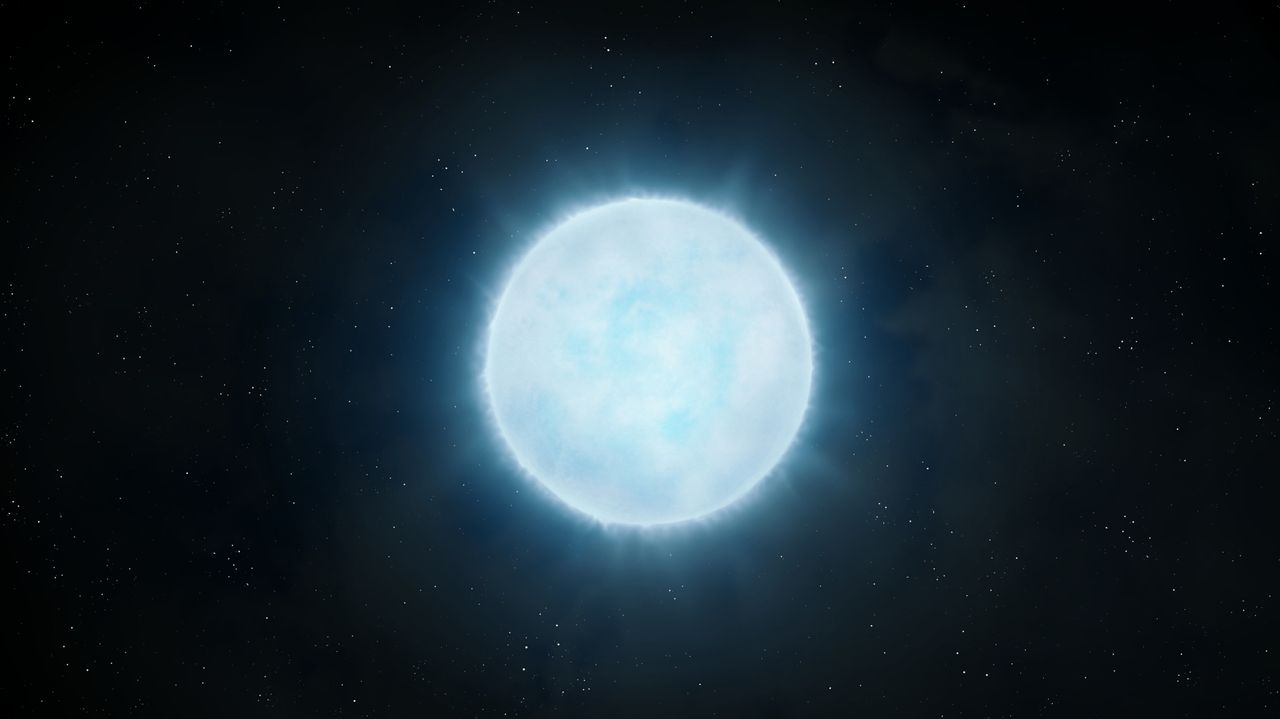
A recent study has shed light on the elusive axion, a hypothetical particle that may hold the key to understanding dark matter, through the examination of white dwarfs—dense remnants of dead stars. Published in November 2025 on the open-access server arXiv, the research employed archival data from the Hubble Space Telescope to explore how these particles might influence the cooling processes of white dwarfs.
Initially proposed decades ago to address complexities in the strong nuclear force, axions were largely overlooked after early attempts to detect them in particle collider experiments yielded no results. However, renewed interest arose when theorists suggested that axions could potentially explain the enigma of dark matter. These particles, while largely invisible, could still have significant interactions within the universe.
Investigating White Dwarfs and Axions
The research team targeted white dwarfs due to their unique characteristics. These stellar remnants can contain a mass comparable to that of the sun compressed into a volume smaller than Earth. Supported by a phenomenon known as electron degeneracy pressure, white dwarfs resist collapse as their electrons occupy distinct quantum states, preventing them from sharing the same energy level.
According to some models, axions could be produced when electrons move at extraordinary speeds, particularly within the confines of a white dwarf. If electrons were to generate axions, these particles would escape the white dwarf, subsequently draining energy and causing the star to cool more rapidly than expected.
To test this hypothesis, the researchers developed a sophisticated software model simulating the evolution of stars, incorporating the predicted effects of axion cooling on white dwarfs. This allowed them to establish expected temperatures for these stars based on their ages, both with and without the influence of axions.
Results from 47 Tucanae
The team then analyzed data from the globular cluster 47 Tucanae, a region where all white dwarfs formed around the same time, providing a substantial dataset for comparison. Despite their rigorous analysis, the researchers found no evidence supporting axion cooling within the white dwarf population of the cluster.
However, their findings established crucial limitations on the efficiency of electron-induced axion production. The results indicated that axions cannot be generated more effectively than once in every trillion interactions. While this does not eliminate the possibility of axions existing, it suggests that the interaction between electrons and axions is unlikely to be direct.
As researchers continue their search for these hypothetical particles, this study emphasizes the need for innovative methods to detect axions and further our understanding of dark matter and the universe’s fundamental structure.