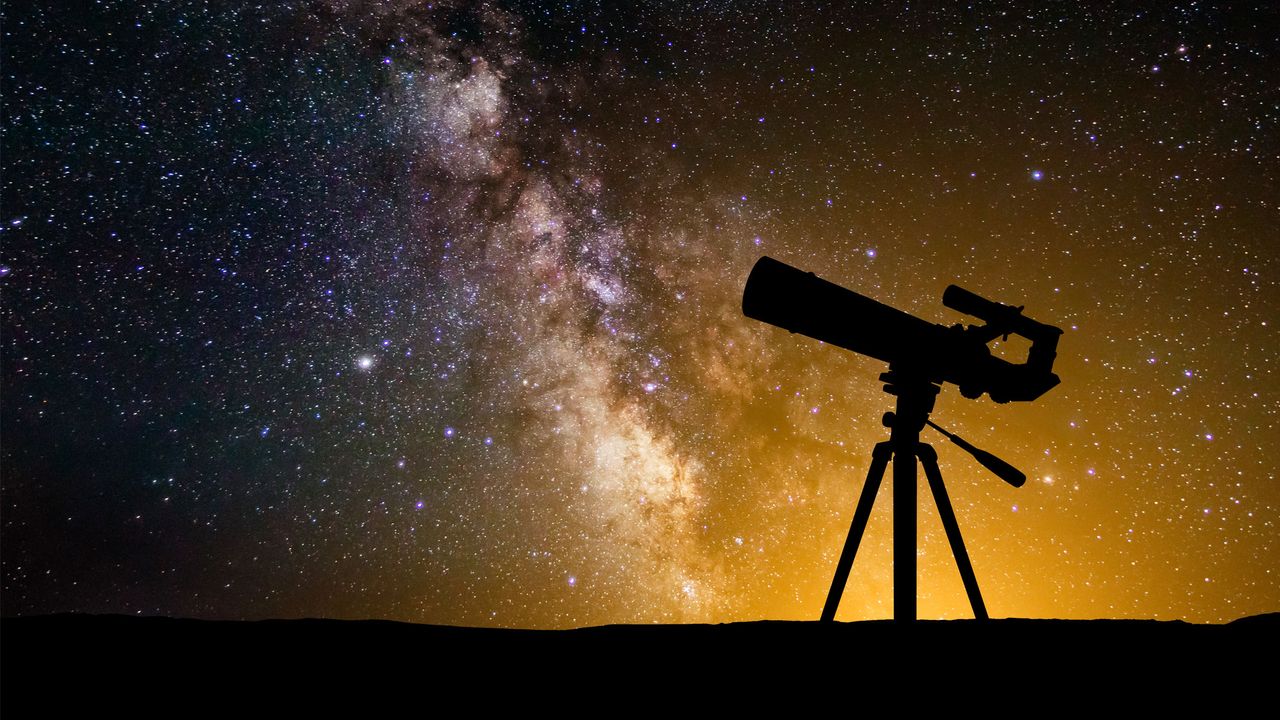
A new telescope opens a world of possibilities for stargazers, especially during the festive season. Between Christmas Day and New Year’s Eve 2025, the sky offers stunning sights, including a waxing crescent moon and the prominent presence of Jupiter, often referred to as the “Christmas Star.” Additionally, the Wolf Supermoon will illuminate the sky in the first week of January 2026, creating an opportune moment for novice astronomers to explore celestial wonders.
Setting up your new telescope is the first step toward an exciting astronomical journey. Before darkness falls, assemble the telescope using the provided instructions. Ensure the tripod is stable and all clamps are tightened. Familiarize yourself with the knobs and levers, and align the finder scope with a distant object, such as a tree. This alignment will help you easily locate celestial bodies when night descends. Setting up during daylight allows the telescope to acclimate to the outside temperature, enhancing your viewing experience.
First Targets: The Moon and Beyond
One of the most rewarding experiences for new telescope owners is observing the moon. The crescent moon will be prominently visible in the evening sky during the last week of December 2025. Start your observation with the low-power 25mm eyepiece, which provides a wider field of view, making it easier to locate the moon. Once centered, switch to the medium-power 10mm eyepiece to see detailed craters and the terminator line, where light meets darkness.
Observing the moon before it reaches the first quarter phase is ideal, as shadows cast by the lunar landscape become less pronounced as it approaches fullness. While a full moon can be visually stunning, the intense brightness can wash out details.
After mastering lunar observations, it’s time to explore the constellations and deep-sky objects. The winter nights of late December and January present an excellent opportunity for this. Constellations such as Orion, Taurus, and Auriga dominate the southeastern sky, serving as a roadmap for beginners to navigate.
Exploring Planets and Deep-Sky Treasures
Identifying planets amidst the stars is straightforward; planets do not twinkle like stars due to their size and proximity. During this period, Jupiter and Saturn are particularly captivating. As Jupiter approaches opposition on January 10, 2026, it reaches its maximum brightness and size, making it an ideal target. Look for Jupiter in the early evening sky, near the Gemini constellation.
With your telescope, begin with the low-power eyepiece, then switch to a higher magnification to observe Jupiter’s cloud bands and its four largest moons: Ganymede, Callisto, Europa, and Io. Saturn, though lower and fainter than Jupiter, can still be seen in the southwestern sky right after sunset. A modest telescope will reveal Saturn’s iconic rings, which are currently seen edge-on.
For those in the Northern Hemisphere, the winter sky is filled with spectacular sights ideal for beginners. Notable targets include the Orion Nebula (M42), the Pleiades open cluster (M45), the Double Cluster in Perseus, and the Andromeda Galaxy (M31).
Southern Hemisphere observers also enjoy a rich selection of celestial objects such as the Carina Nebula and the Large and Small Magellanic Clouds.
Having successfully used your telescope to observe the moon, Jupiter, and various star clusters, it’s essential to continue learning and exploring. Take advantage of clear nights, focusing on dark, moonless evenings for the best visibility. As you gradually familiarize yourself with the night sky, what once seemed overwhelming will transform into a beautiful, navigable landscape of stars and galaxies. This journey into astronomy is not just about seeing; it’s about experiencing the wonder of the universe.