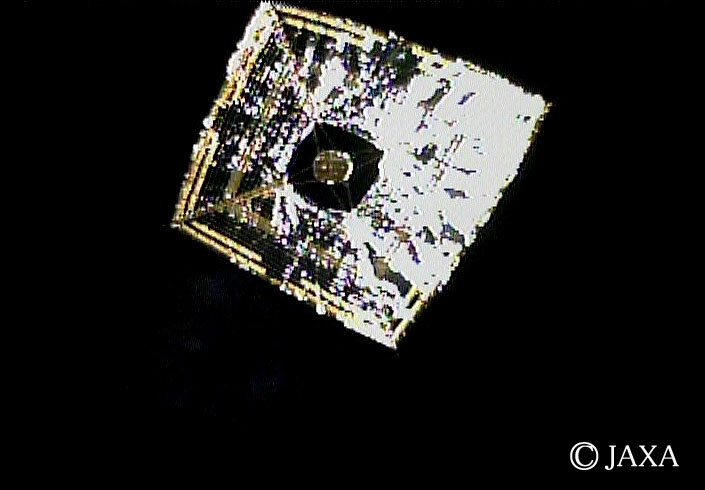
Researchers at the University of Pennsylvania have developed a groundbreaking technique to enhance the maneuverability of solar sails, a propulsion method that relies solely on sunlight. The new approach, detailed in a preprint paper by Gulzhan Aldan and Igor Bargatin, utilizes an ancient Japanese paper-cutting technique called kirigami. This innovation could significantly improve solar sail technology by allowing for more efficient turning without the need for traditional, propellant-based systems.
Solar sails offer several advantages over conventional propulsion methods, primarily their lack of reliance on propellant. In traditional sailing, altering the sail’s angle can change its direction, aided by a rudder. However, solar sails do not have this luxury, presenting a longstanding challenge in space navigation. Aldan and Bargatin’s research introduces kirigami to create a mechanism that enables solar sails to adjust their angle in response to sunlight.
The kirigami technique involves making deliberate cuts in the solar sail material, specifically in a grid pattern on the aluminized polyimide film commonly used for sails. These cuts allow the material to “buckle” when tension is applied, transforming the sail into a three-dimensional surface. This buckling action enables different segments of the sail to tilt at varying angles relative to the light source, functioning like thousands of tiny mirrors. As light reflects off these segments, the conservation of momentum propels the sail in the opposite direction of the reflected light, allowing for controlled navigation.
Traditionally, solar sails have relied on methods like reaction wheels, tip vanes, and Reflectivity Control Devices (RCDs) for maneuvering. Reaction wheels are heavy and consume propellant, while tip vanes can be mechanically complex and prone to failure. RCDs, which switch between reflective and absorptive states, require power even when not in use, draining batteries over time. In contrast, the kirigami sail only requires electrical power from servo motors during operation, making it a more energy-efficient solution.
To validate their technique, Aldan and Bargatin conducted both simulations and physical experiments. Using COMSOL, a widely recognized physics simulation tool, they performed ray tracing experiments to measure the forces on the sail at various buckling angles and solar orientations. Although the measured force was small—approximately 1 nN per watt of sunlight—the cumulative effect is sufficient to turn a small solar sail and its payload over time.
In practical tests, the researchers cut segments of the film and placed them in a test chamber under a laser. By applying tension to the film and observing the laser’s projection on the chamber wall, they confirmed that the results aligned closely with their predicted angles of incidence for each strain level.
The implications of this research could be significant for the future of solar sailing, potentially reducing the energy and propellant costs associated with turning capabilities. However, the field remains competitive, with multiple technologies vying for similar advancements. As a result, it may take time before this innovative kirigami technique is implemented in actual space missions.
Looking ahead, the prospect of solar sails equipped with kirigami technology promises exciting developments in space exploration. While there are challenges ahead, the potential for this technology to revolutionize solar sailing is undeniable, and its eventual deployment could lead to stunning visual displays in the cosmos.
For further reading, the complete research can be accessed in the preprint paper titled, “Low-Power Solar Sail Control using In-Plane Forces from Tunable Buckling of Kirigami Films.”