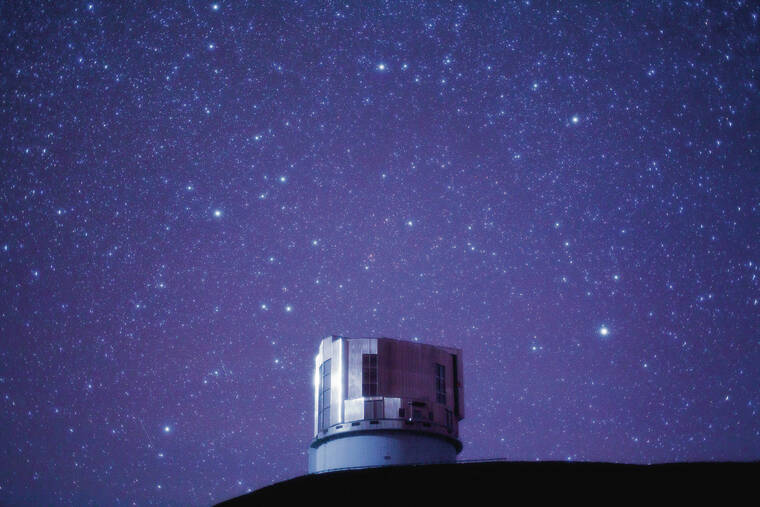
Astronomers have made groundbreaking discoveries at the Mauna Kea observatories, identifying a massive planet and a brown dwarf orbiting distant stars. These findings, resulting from the Observing Accelerators with SCExAO Imaging Survey program (OASIS), enhance our understanding of the formation and evolution of giant planets and substellar objects.
The first discovery, designated as HIP 71618 B, is a brown dwarf with a mass equivalent to 60 times that of Jupiter. Located 169 light-years away in the constellation Bootes, this object is often referred to as a “failed star” because it lacks the mass required to sustain nuclear fusion. The W.M. Keck Observatory and the Subaru Telescope utilized advanced imaging techniques to uncover this companion, taking data within days of each other. Subsequent observations confirmed the brown dwarf’s orbit.
In addition to HIP 71618 B, the astronomers discovered HIP 54515 b, an 18-Jupiter-mass planet orbiting a star located 271 light-years away in the constellation Leo. This planet orbits its star at a distance comparable to that of Neptune from the Sun. Observations reveal that, from Earth, the planet appears remarkably close to its host star, akin to the size of a football viewed from over 320 kilometers away. The Subaru Telescope’s SCExAO system played a crucial role in capturing the high-resolution images necessary for identifying this faint, massive planet.
Advancing Stellar Imaging Techniques
These discoveries mark a significant advancement for the OASIS program, which combines precision data from space-based missions with the unparalleled observational capabilities of Mauna Kea’s facilities. Thayne Currie, a professor at the University of Texas at San Antonio and principal investigator of OASIS, emphasized the importance of these findings. “These discoveries may help advance our abilities to image another Earth with future space-based observatories such as NASA’s Roman Space Telescope,” he stated. He noted that the combination of Mauna Kea’s ideal observing conditions and state-of-the-art instrumentation has yielded impressive results.
The discoveries not only contribute to scientific knowledge but also highlight the potential for future exploration of exoplanets. As imaging technology continues to improve, the prospect of identifying Earth-like planets in distant solar systems becomes increasingly attainable.
Upcoming Celestial Events
In addition to these discoveries, the astronomical community looks forward to the peak of the Quadrantids meteor shower, which will occur from the night of January 3 into the early morning of January 4, 2024. This renowned shower, originating from the asteroid 2003 EH1, can produce up to 40 meteors per hour at its peak. With minimal moonlight expected this year, observers in Hawaii will enjoy favorable viewing conditions, particularly after midnight.
January also sees the star family Kekaomakali‘i, or the “Bailer of Makali‘i,” dominating the night sky. Rising prominently in the eastern sky after sunset, this constellation is crucial for traditional Hawaiian navigation. It includes notable stars such as Hokulei (Capella) and Na Mahoe (Gemini), serving as a celestial guide for Pacific voyagers.
As the month progresses, other celestial bodies, including Jupiter and Hokuloa (Venus), will be visible, providing ample opportunities for stargazers to explore the wonders of the night sky. Through telescopes or even binoculars, observers can appreciate the beauty of the cosmos, reconnecting with the stars that have guided humanity throughout history.
For more information about the OASIS program, visit the official websites of the Keck Observatory and the Subaru Telescope. The discoveries made at Mauna Kea represent an exciting chapter in the field of astronomy, paving the way for future explorations and advancements in understanding our universe.