Research conducted by Dr. Matías Medina and his team has uncovered significant insights into ancient craft production in the Sierras de Córdoba, Argentina. Their study, published on December 28, 2025, in the International Journal of Osteoarchaeology, focuses on the technology behind the manufacturing of bone arrow points from the Late Prehispanic Period, covering approximately 1220 to 330 calendar years before present (cal BP). This work addresses a long-standing gap in understanding how these prehistoric communities organized their daily lives and production practices.
The Sierras de Córdoba during the Late Prehistoric Period was home to communities that practiced flexible mixed economies, combining hunting, gathering, and farming. This versatility allowed them to maintain high mobility and adapt their lifestyles to seasonal changes. Yet, archaeological evidence from this era remained sparse, particularly concerning the bone tools that played a crucial role in their material culture. Dr. Medina emphasized the historical oversight, stating, “Publications dealing specifically with bone technology were, for decades, scarce, especially in South America.”
The current study examined 117 bone artifacts collected from the Museo Arqueológico Numba Charava. These artifacts were gathered non-systematically throughout the 20th century from various locations in the southern Punilla Valley, leading to challenges in determining their exact provenance. The analysis revealed that the primary raw material was obtained from the bones of the guanaco, a species hunted for its meat. Other animal bones, such as those from the pampas deer, were less common.
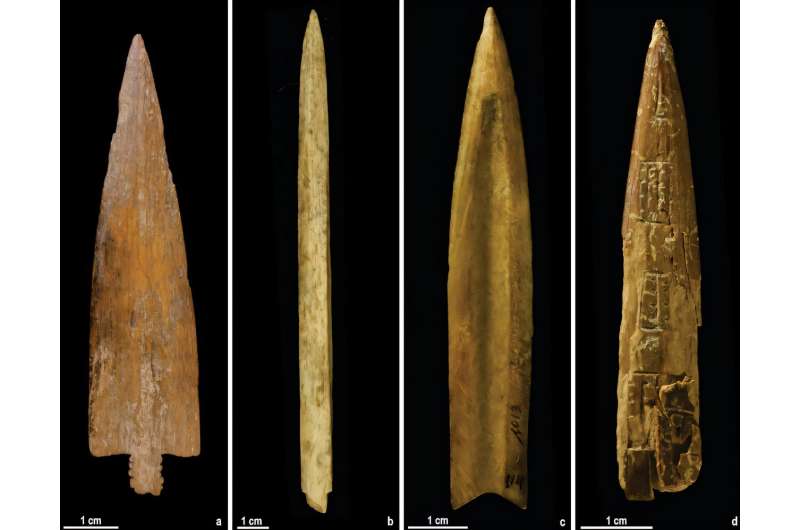
To create the arrow points, the bones were typically sourced from metapodia, the long bones of the limbs. Researchers found that these bones were split lengthwise to form workable blanks, which were then flattened through grinding. The shaping process included scraping and whittling to achieve the final arrowhead design. Some points featured barbs and decorative elements, which were polished to enhance performance and durability.
Dr. Medina noted the rarity of decorative arrow points. “Only three bone arrow points with incised decoration on the blade were reported in the archaeological literature,” he explained. These decorations, composed of lines and small triangles, are similar to designs observed on artifacts from central Argentina. The study suggests that these arrow points were primarily used for warfare, with decorative elements serving to express social identity and cultural affiliation.
The research offers new perspectives on how the communities of the Southern Punilla Valley approached tool-making, suggesting that arrowheads were locally produced and varied in design. Each point was unique, and while the production process was time-consuming, it appears to have been standardized and likely passed down through generations within nuclear families.
According to Dr. Medina, this finding has broader implications. “Comparisons are needed, especially with neighboring regions near the Sierras de Córdoba, such as the Low Paraná and Uruguay River floodplains,” he remarked. These areas, located over 500 kilometers away, developed their own complex bone technologies adapted to different environmental conditions. The insights gained from this study may inform future research efforts in these and other regions.
As the study highlights the intricate relationship between community organization and craft production, it reinforces the notion that nuclear families were fundamental units for both food and tool production during the Late Prehispanic Period. The thorough investigation into the manufacturing of bone arrow points not only enriches the understanding of prehistoric life in Argentina but also sets the stage for future archaeological inquiries into ancient technologies and social structures.