
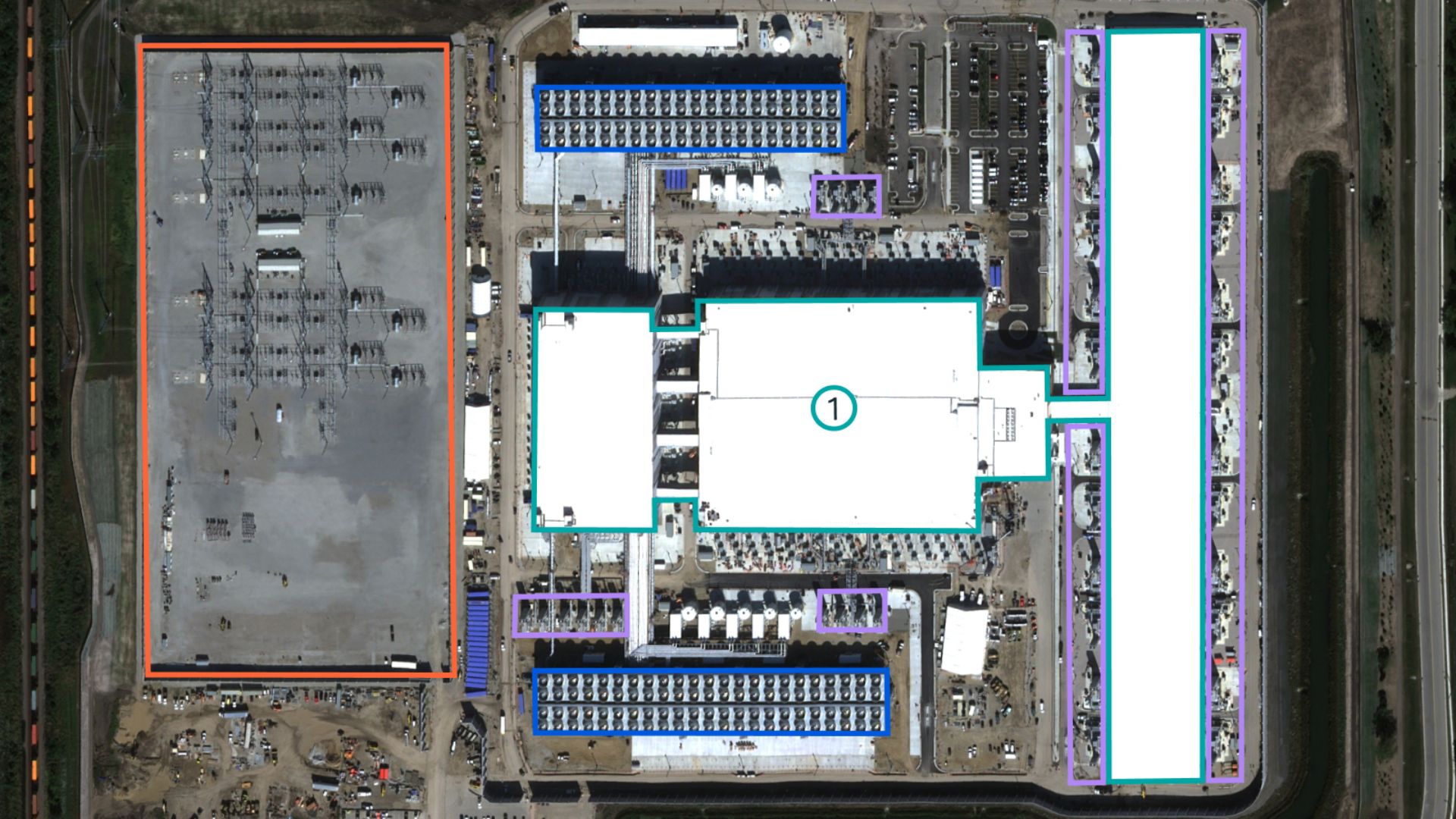
A recent report from 404 Media uncovers the efforts of a small research team at Epoch AI, a non-profit institute, to map the swift expansion of artificial intelligence datacenters across the United States. By utilizing publicly available information and satellite imagery, the team is documenting facilities that often escape public scrutiny. Their work highlights a critical aspect of the growing AI infrastructure, which is expanding rapidly yet remains largely unexamined.
Mapping America’s Datacenter Infrastructure
The construction of datacenters has become a significant issue nationwide, primarily due to their high demands for electricity and water. Many local communities are unaware of these projects until construction has already begun. Epoch AI’s interactive map aims to change that by visually marking these sites, with each marker linking to satellite images and detailed project information. For instance, a green circle on the map indicates Meta’s “Prometheus” datacenter complex located in New Albany, Ohio, which Epoch AI estimates has already cost $18 billion and consumes 691 megawatts of power.
“This datacenter represents Meta’s strategic shift towards AI, combining weatherproof tents, colocation facilities, and traditional datacenter buildings,” the team noted. The map also allows users to view a timeline of the complex’s development, showcasing new buildings and cooling systems added over time.
Estimating Power and Capacity
Epoch AI’s analysis centers on the cooling infrastructure essential for modern AI systems, which generate substantial heat. Datacenters often install cooling units outside buildings or on rooftops to manage this excess heat. “Modern AI datacenters generate so much heat that the cooling equipment extends outside the buildings,” Epoch AI explained on its website.
The research team meticulously counts the number of cooling fans, measures their size, and examines their placement to estimate energy usage. This approach feeds into a custom model that infers compute capacity and construction costs based on power estimates. Jean-Stanislas Denain, a senior researcher at Epoch AI, described the importance of cooling in understanding power consumption, stating, “We focus on cooling because it’s a very useful clue for figuring out the power consumption.”
Yet, the model carries inherent uncertainty; variations in fan speed and configuration can significantly affect actual cooling capacity, meaning real usage could be double or half of the estimates.
Despite its comprehensive approach, the map is not exhaustive. Variations in state and local disclosure laws result in some projects flying under the radar, and smaller facilities often evade detection. Epoch AI estimates that their current dataset represents approximately 15 percent of the global AI compute capacity provided by chipmakers as of November 2025.
Markers scattered across the country indicate various projects, including one near Memphis, Tennessee, associated with xAI’s Colossus 2 project. Epoch AI notes that the company has installed natural gas turbines across the Mississippi border, likely to expedite approval processes. “Based on this, and on earlier tweets from Elon Musk, 110,000 NVIDIA GB200 GPUs are operational,” the organization reported.
Epoch AI acknowledges that even detailed mapping efforts leave significant gaps in understanding. “Even if we have a perfect analysis of a datacenter, we may still be in the dark about who uses it, and how much they use,” the team commented. Looking ahead, Epoch AI plans to broaden its research scope globally, aiming to illuminate the infrastructure that is increasingly shaping the future economy, often without the visibility it warrants.


