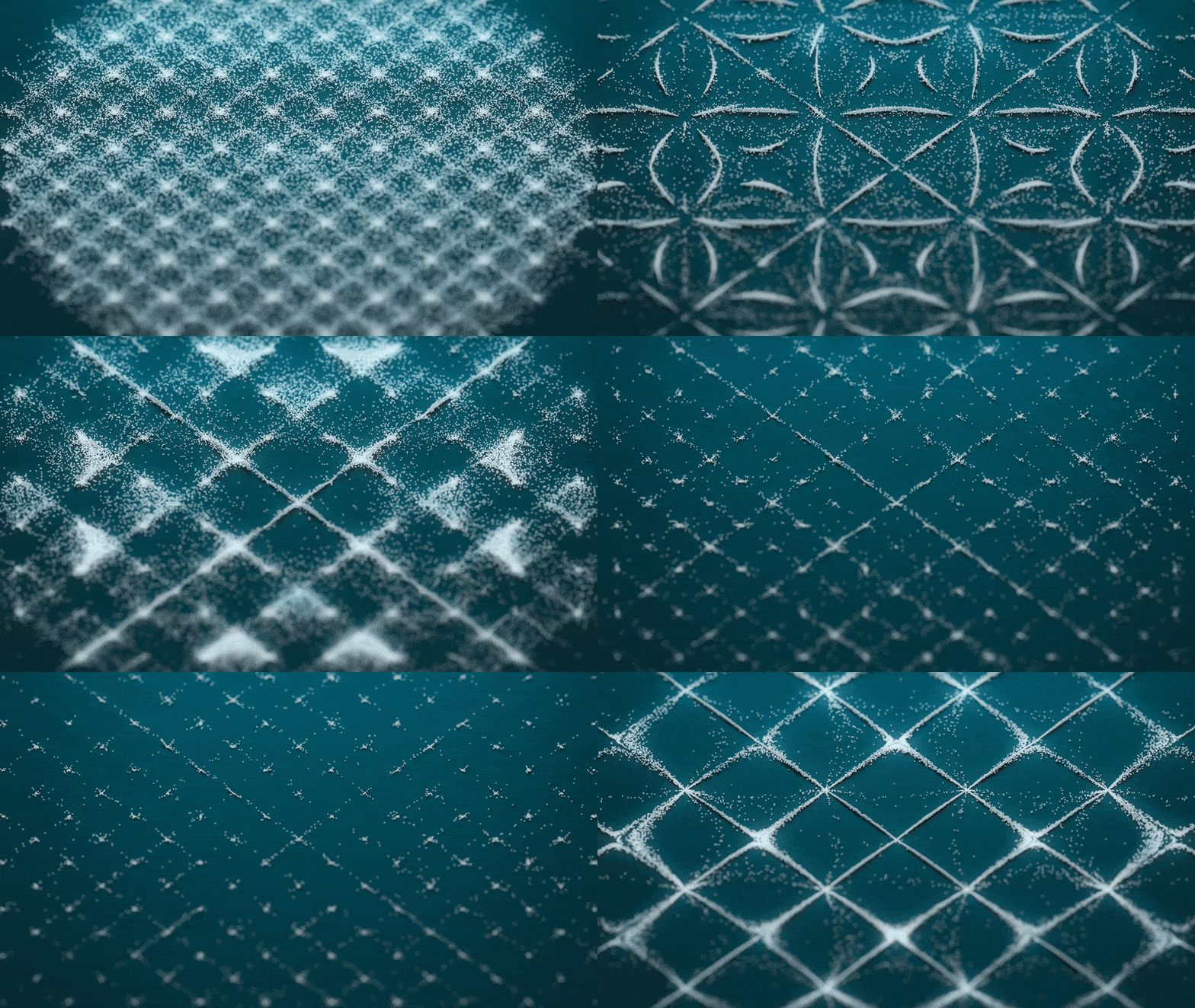
On January 9, 1816, a significant moment in the history of mathematics was overshadowed by an unfortunate incident. Sophie Germain, a pioneering mathematician, was awarded the prestigious Grand Mathematics Prize by the Paris Academy of Sciences for her groundbreaking work on the theory of elastic waves. Despite this accolade, she was unable to attend the award ceremony due to a lack of tickets, which were reportedly “lost in the mail.”
The letter informing Germain of her award was not only devoid of congratulations but also condescendingly noted that she was the sole entrant. It also mentioned the possibility of hastily produced handwritten tickets if necessary. Germain ultimately chose not to attend the ceremony, expressing her disappointment with the committee’s treatment of her accomplishments.
Germain’s Journey in Mathematics
Sophie Germain’s path to this prestigious award was marked by determination and resilience. Born into a wealthy merchant family in Paris, she developed a passion for mathematics while confined to her home during the upheaval of the French Revolution. Her parents disapproved of her scholarly pursuits, attempting to dissuade her by limiting her access to warmth and comfort. Undeterred, Germain continued her studies by candlelight, wrapping herself in quilts to fend off the cold.
When the École Polytechnique opened in 1794, women were prohibited from attending, yet Germain found a way to engage with the academic community. She studied publicly available lecture notes and submitted solutions to problems under the pseudonym Antoine August LeBlanc. This allowed her to communicate with prominent mathematicians, including Carl Friedrich Gauss and Joseph-Louis Lagrange, who recognized her talent and contributions.
A Landmark Achievement in Elastic Theory
Germain’s research culminated in her 1816 submission titled “Research on the Vibrations of Elastic Plates.” This work provided a mathematical explanation for the Chladni figures, a phenomenon studied by the physicist Ernst Chladni. The figures result from sound waves creating distinct geometric patterns in sand sprinkled on vibrating plates. Germain’s innovative approach to understanding these waves was significant, despite the limitations of the mathematics available at that time.
The award ceremony was attended by many who were eager to see the first woman honored with this prize. However, as reported by the Journal des Débats, the audience was left disappointed when Germain did not appear to accept the trophy. The report lamented the absence of a woman who had achieved a milestone that no other female had reached in France.
Despite facing considerable obstacles, Germain’s work laid foundational concepts that would influence future generations. In collaboration with Adrien-Marie Legendre, she made notable contributions toward proving Fermat’s Last Theorem. Germain demonstrated that the theorem held true for a special class of prime numbers now known as Germain primes. This work would ultimately pave the way for the complete proof by Andrew Wiles in 1994.
While Germain’s contributions were often overshadowed during her lifetime, she received recognition from some contemporaries. Gauss acknowledged the unique challenges faced by women in mathematics, stating, “But when a woman, because of her sex, our customs and prejudices, encounters infinitely more obstacles than men… she doubtless has the most noble courage, extraordinary talent, and superior genius.”
In 1831, just weeks before her death from breast cancer, Germain’s achievements were recognized with a push from Gauss for her to receive an honorary degree from the University of Göttingen. Unfortunately, she passed away before this honor could be conferred.
Sophie Germain’s story is a testament to resilience and the pursuit of knowledge against the odds. Her legacy continues to inspire future generations of mathematicians and serves as a reminder of the importance of acknowledging all contributors to the field, regardless of gender.