Last week, significant developments emerged for the East Coast’s offshore wind industry as federal courts ruled in favor of several northeast projects, including Revolution Wind based in New London. This legal victory temporarily counters the Trump administration’s ongoing attempts to halt offshore wind projects, which the former president has criticized as threats to wildlife and economically unviable.
Central to the administration’s recent actions is a classified report from the Pentagon, which allegedly identifies offshore wind turbines as a national security risk. This claim has raised skepticism among lawmakers and industry experts, who question the validity of the security concerns without additional context. The Pentagon has refrained from commenting on the specifics, even in discussions with members of Congress, including U.S. Representative Joe Courtney from Connecticut, who has sought clarification on the matter.
Courtney, who serves as the ranking member of the House Armed Services Committee’s Seapower subcommittee, has publicly expressed frustration. He noted that the Department of Defense directed inquiries regarding national security concerns to the Department of the Interior, stating, “This is crazy if it is a national security issue.”
The Pentagon’s claim appears to hinge on the notion that the large blades of offshore wind turbines may disrupt military radar systems. Industry advocates contend that such concerns were previously addressed and resolved to the Pentagon’s satisfaction. According to the U.S. Department of the Interior, extensive consultations with various military agencies have occurred, leading to the mitigation of any significant issues regarding equipment and operations.
A report from 2023 highlights that developers of Revolution Wind paid substantial sums for software updates to alleviate potential radar interference with U.S. Air Force operations. A subsequent letter from the Department of Defense indicated that the project would not adversely impact military missions in the area.
Despite these assurances, the Pentagon remains tight-lipped when pressed by Congress. Recently, four senior House Democrats, including Courtney, requested briefings from both the Defense and Interior Departments regarding the alleged security risks posed by offshore wind projects.
The stakes are high for the future of the northeast offshore wind industry, particularly for New London. The city stands to benefit from an investment surge attributable to wind energy projects. The Danish multinational company Orsted, which is behind Revolution Wind, has committed significant financial resources to the area, including a $300 million redevelopment of the State Pier into a supply hub for offshore wind operations.
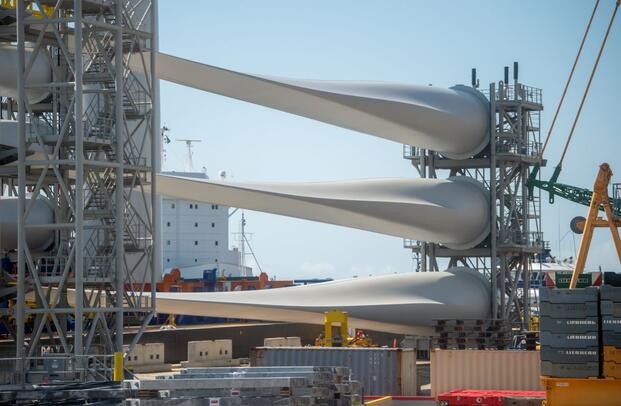
The pier is currently filled with turbine components, some towering nearly as high as the adjacent Gold Star Memorial Bridge, awaiting transportation for installation. Orsted has announced investments exceeding $5 billion in offshore wind development and plans to generate thousands of jobs for local residents.
Revolution Wind is Connecticut’s only offshore wind project and plays a crucial role in the state’s goal of obtaining 2,000 megawatts of energy from offshore sources by 2030. The project is expected to contribute 880 megawatts to the New England electric grid, with Connecticut committed to purchasing 304 megawatts, sufficient to power more than 100,000 homes.
Despite the Trump administration’s attempts to suspend Revolution Wind’s operations, courts have ruled against such efforts. In December 2023, a federal court granted a temporary injunction, indicating that the administration must demonstrate a national emergency to justify halting the project altogether.
U.S. District Court Judge Royce Lamberth stated that the government needed to provide evidence of an immediate threat to national security, which he found lacking in this case. He emphasized the extensive planning and permitting Revolution Wind has undergone over the past decade, which has involved consultations with numerous federal agencies, including the Department of Defense and the U.S. Navy.
Courtney highlighted that both the Navy and the Department of Defense have been engaged with Orsted throughout the project’s development. “The problem is, halt work orders go out and Orsted gets no clue as to what the problem is,” he remarked, underscoring the need for clearer communication regarding any emerging concerns.
With billions of dollars on the line and a robust regulatory history backing Revolution Wind, the urgency for transparency from the Pentagon is becoming increasingly critical. As the legal battles continue, the future of offshore wind development in the northeastern United States remains uncertain, with potential implications for energy production, job creation, and environmental sustainability.