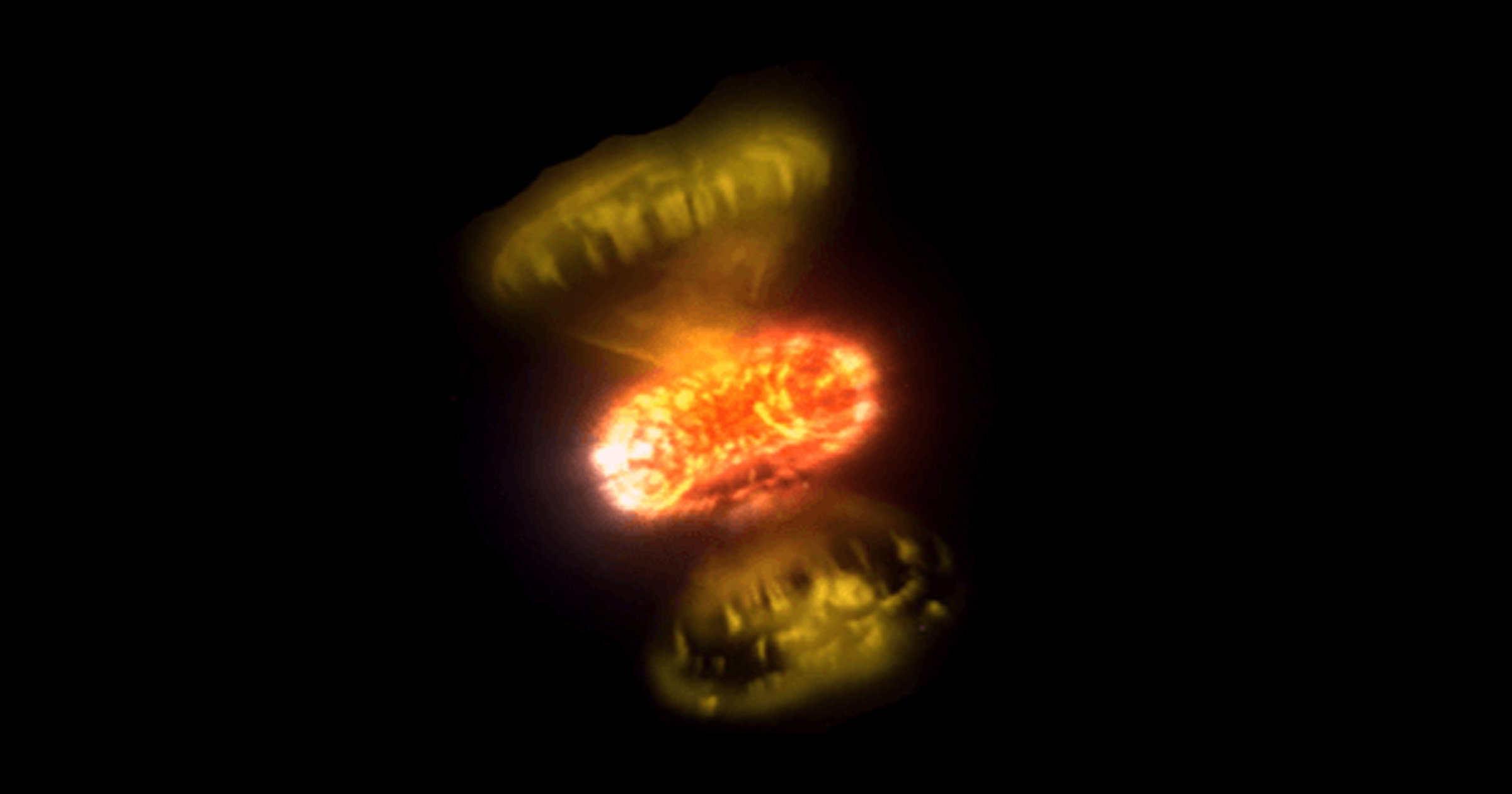
Recent observations have unveiled remarkable images capturing the explosive moments of two novas, offering unprecedented insights into these cosmic events. Utilizing the advanced capabilities of the CHARA Array at Georgia State University, astronomers have documented the dramatic explosions produced by two separate stars, known as novas. These images illustrate the complex processes occurring during stellar detonations, enhancing our understanding of the universe.
A nova occurs when a white dwarf, the remaining core of a star similar to our Sun, siphons material from its companion star. This accumulation of hydrogen leads to a thermonuclear explosion that the white dwarf survives. The energy released in a nova can be equivalent to what our Sun emits over a period of approximately 100,000 years. Until now, astronomers have relied on indirect observations due to the challenges of capturing the early moments of these explosions.
Elias Aydi, a professor of physics and astronomy at Texas Tech University and lead author of a study published in the journal Nature Astronomy, remarked, “These observations allow us to watch a stellar explosion in real time, something that is very complicated and has long been thought to be extremely challenging.” The images reveal a depth of complexity that was previously obscured, moving beyond the simple flash of light typically associated with such events.
Innovative Techniques Reveal Stellar Complexity
The breakthrough came through a technique known as interferometry, which combines light from multiple sources to create detailed interference patterns. The CHARA Array consists of numerous antennas spread over a wide area, allowing astronomers to function as a single large telescope when focused on a common point in the sky. These observations were complemented by data from other instruments, including NASA’s Fermi Telescope, which detects high-energy gamma rays.
One of the novas, designated V1674 Herculis, was identified as one of the fastest on record, achieving peak luminosity within days before rapidly declining. It exhibited two distinct gas outflows, indicating multiple powerful ejections of material. Notably, these ejections produced gamma rays detected by the Fermi Telescope, suggesting that such explosions can generate emissions typically associated with more massive phenomena like black hole-forming supernovas.
In contrast, the second nova, V1405 Cassiopeiae, displayed a slower progression, taking over fifty days to expel its material. Throughout this period, the white dwarf enveloped itself in a sphere of gas, forming a rare structure known as a common envelope. When this envelope eventually dispersed, it also produced gamma rays observed by NASA, underscoring the significance of novas as “laboratories for extreme physics,” as noted by coauthor Laura Chomiuk, a professor at Michigan State University.
Implications for Understanding Cosmic Phenomena
These findings not only showcase the intricate processes involved in novas but also enhance our grasp of the relationship between nuclear reactions on stars and the high-energy radiation emitted into space. The captured images signify a major advancement in observational astronomy, allowing researchers to connect the dots between the geometry of ejected material and the energetic emissions they detect.
As researchers continue to analyze these spectacular events, the potential for new discoveries about the universe grows. The combination of innovative imaging techniques and collaboration across various institutions highlights the ongoing efforts to deepen our understanding of stellar phenomena and the forces that shape our cosmos.