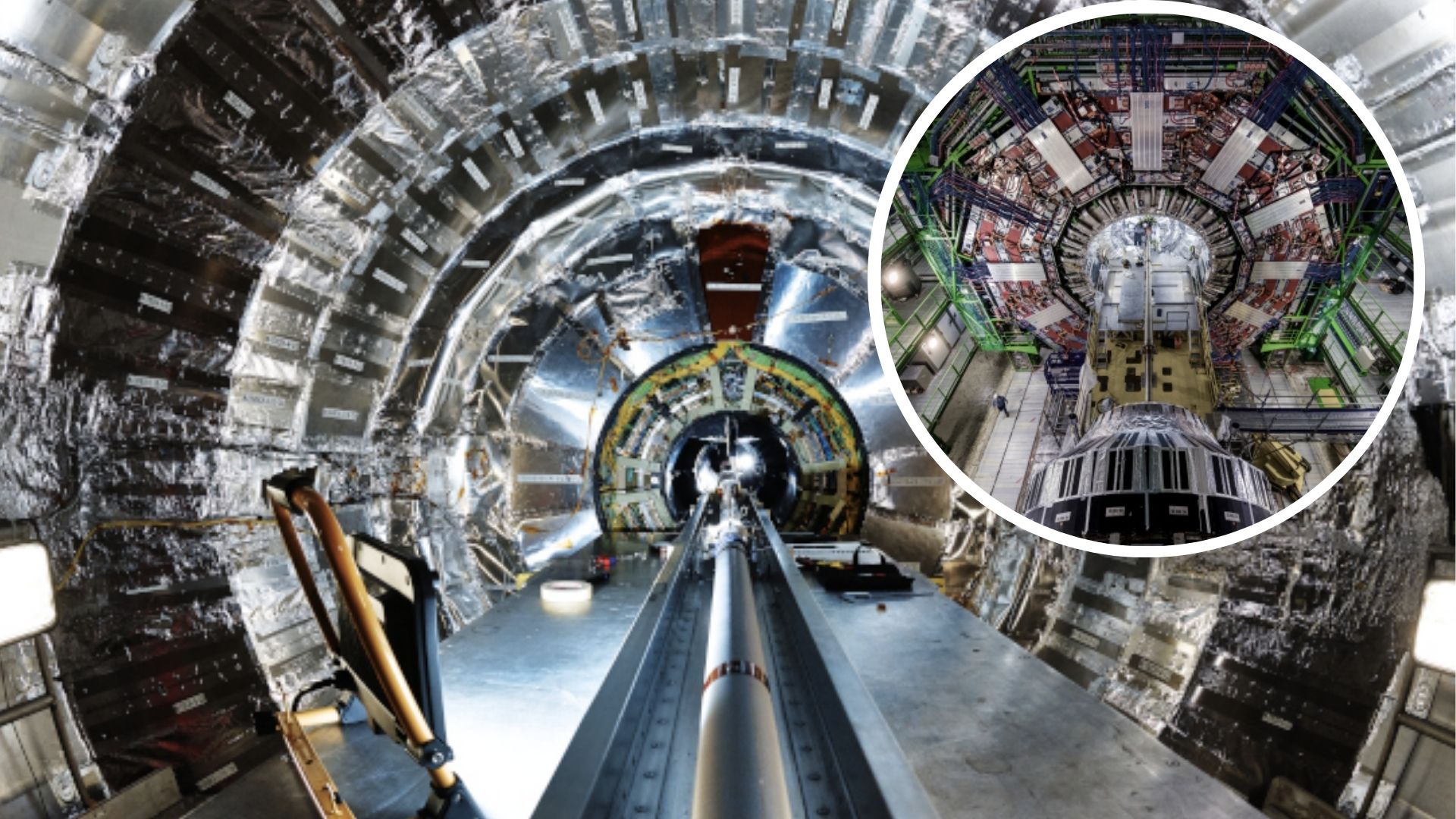
Scientists at the Large Hadron Collider (LHC) have provided new insights into the behavior of particles resulting from heavy ion collisions. This research reveals that a distinctive pattern of “flow” observed in these collisions reflects the collective behavior of particles, driven by pressure gradients created under extreme conditions. These conditions closely resemble the state of the universe shortly after the Big Bang.
The findings confirm earlier observations regarding particle flow from heavy ion collisions and further elaborate on the nature of the quark-gluon plasma (QGP). According to Jiangyong Jia, a physicist at Stony Brook University and Brookhaven National Laboratory, where the Relativistic Heavy Ion Collider (RHIC) operates, the new analysis led by the ATLAS Collaboration highlights a different aspect of flow known as “radial” flow. This type of flow emerges from a geometric origin distinct from the previously studied “elliptic” flow, providing insights into the viscosity of the fluid system.
Collaborative Efforts Enhance Understanding
The ATLAS results are bolstered by complementary measurements taken at ALICE, another experimental detector at the LHC. Both teams have published their findings in the same issue of Physical Review Letters. Peter Steinberg, a physicist at Brookhaven Lab and co-author on the ATLAS paper, remarked, “In some ways, these radial flow measurements are completing a story that started the minute RHIC turned on.”
The earliest data from RHIC, released in 2001, identified directional differences in particle flow from collisions of gold ions, revealing an elliptical pattern. More particles were observed emerging along the reaction plane—the direction of the colliding ions—than in a transverse direction. This phenomenon led scientists to propose that the elliptic flow results from the asymmetric pressure gradients in the collision’s overlapping region, akin to the shape of a football.
Such collective behavior was unexpected, indicating that quarks and gluons continue to interact strongly even after being released from their confined states within protons and neutrons. The extreme elliptic flow observed prompted physicists to characterize the QGP as a nearly frictionless liquid, possessing extremely low shear viscosity.
Implications for Future Research
The research conducted at the LHC and RHIC is crucial for understanding the fundamental properties of matter in conditions akin to those of the early universe. The collaboration between different experimental groups at the LHC enhances the depth of the findings, allowing for a more comprehensive understanding of the dynamics of the quark-gluon plasma.
The ongoing investigation into the characteristics of the QGP is expected to yield further insights into the fundamental forces that govern particle interactions. As physicists continue to analyze the data, the revelations regarding radial flow and its distinct properties may lead to new theoretical frameworks for understanding the universe’s origins.
The collaborative efforts between institutions such as Brookhaven National Laboratory and Stony Brook University exemplify the global pursuit of knowledge in nuclear physics, as researchers strive to unravel the complexities of the universe’s earliest moments.