
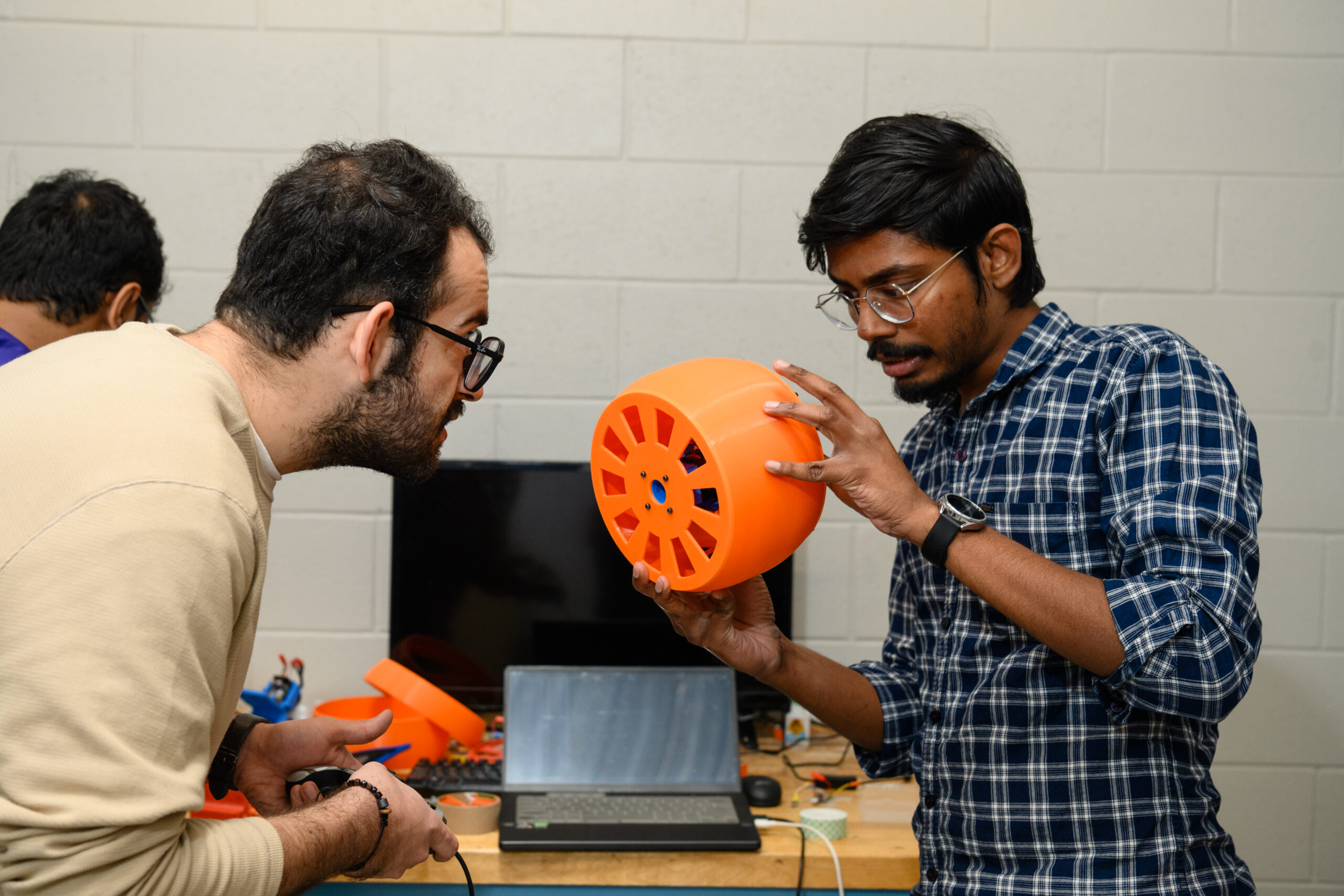
A team at Clemson University is advancing the field of robotics with innovative designs that can jump, swim, and crawl. Under the leadership of professor Phanindra Tallapragada, the group is now setting its sights on developing flying robots inspired by insects. This new initiative aims to broaden the capabilities of robots, potentially enabling them to explore some of the most challenging environments on Earth and beyond.
The robotics program at Clemson showcases a range of remarkable machines. For instance, a unique orange wheel known as the Spin Gyro can leap off the ground due to an unbalanced mass rotating within. This design allows the robot to jump quickly without the need for springs, making it ideal for traversing uneven terrains. Similarly, a fish-like robot utilizes the same principle, employing a spinning mass to propel itself through water, demonstrating remarkable energy efficiency.
Tallapragada’s team has recently relocated to the newly renovated Fluor Daniel Engineering Innovation Building, providing them with modern facilities to enhance their research. The team comprises graduate and postdoctoral researchers eager to push the boundaries of what robots can achieve. Prashanth Chivkula, who began developing the swimming robot during his graduate studies, expresses a strong commitment to robotics, aiming to create machines that serve valuable purposes in the real world.
The robots in Tallapragada’s lab are driven by centripetal force, a concept familiar to anyone who has used a clothes dryer. When the dryer spins, items stick to the side, causing it to vibrate or even lift off the ground if the speed is sufficient. This same principle applies to the robots, allowing them to perform impressive movements.
Innovative Designs for Future Exploration
The Spin Gyro’s mechanism enables it to jump repeatedly, while the swimming robot’s ability to control its movements through varying spin speeds offers significant potential for environmental monitoring. This fish-like robot could one day assist in collecting water samples from lakes and oceans without requiring human operators.
Another notable creation is the pipe robot, which can navigate narrow spaces. It employs a spinning mass that compresses small bristles on its body, allowing it to crawl through pipes as small as one inch in diameter. This capability could revolutionize inspections of tight spaces such as gas lines and ducts.
Tallapragada’s newest project focuses on creating a small flying robot that mimics insect flight. The same spinning mass principles could facilitate rapid wing flapping, essential for flight. This research is supported by a three-year grant from the National Science Foundation, highlighting the project’s significance in advancing robotics.
Beyond Earth, Tallapragada envisions a future where robots powered by centripetal force could explore icy moons on other planets. These machines could leap through volcanic vents and dive into subsurface oceans, searching for signs of life. Tallapragada emphasizes his passion for developing unique ideas that differ from conventional approaches, motivating him to continue innovating.
Enhancing Student Experience and Research
The work conducted in Tallapragada’s lab aligns with Alexander Leonessa, chair of the Department of Mechanical Engineering, who noted the importance of providing students with hands-on learning opportunities. He stated, “Projects like the ones in Dr. Tallapragada’s lab provide our students with an opportunity to innovate on the cutting-edge and help shape the future of robotics.”
As the team continues to push the boundaries of robotic capabilities, they remain dedicated to applying rigorous science and creativity. With successful implementations of their designs, Tallapragada and his team are eager to return to the drawing board, further developing models that could lead to groundbreaking advancements in robotics.


