Tensions in the Middle East escalated on January 21, 2024, as Iran’s supreme leader, Ayatollah Ali Khamenei, issued a stark warning that any military action by the United States would result in a “regional war.” This declaration comes amidst heightened military presence in the region, with the USS Abraham Lincoln aircraft carrier and associated warships deployed to the Arabian Sea at the direction of President Donald Trump.
Khamenei’s comments mark a significant escalation in rhetoric, particularly in response to recent nationwide protests in Iran, which have been met with a violent government crackdown. Thousands have reportedly died, and the protests, which began on December 28, 2023, over economic issues, evolved into a direct challenge to the regime. The Iranian government has characterized these protests as an attempted coup, with Khamenei asserting that the demonstrators aimed to destabilize key governmental institutions.
During a speech at his compound in Tehran, Khamenei stated, “The Americans must be aware that if they wage a war this time, it will be a regional war.” He emphasized that Iran does not seek conflict but will respond decisively to any perceived threats. He also acknowledged the economic grievances that fueled the protests but reiterated the government’s stance that the unrest was orchestrated to undermine the state.
The Human Rights Activists News Agency, which gathers information from inside Iran, reports that over 49,500 people have been detained since the protests began, with at least 6,713 fatalities attributed to the violence, primarily among demonstrators. In contrast, the Iranian government claims the death toll stands at 3,117, describing a portion of the deceased as “terrorists.”
As the Iranian government prepares for a live-fire military drill in the strategically vital Strait of Hormuz, the U.S. military’s Central Command has cautioned against any threats to American vessels or interference with commercial shipping. This waterway is crucial for global oil transportation, accounting for approximately a fifth of all oil traded worldwide.
Khamenei’s remarks were made during a commemorative event marking the anniversary of the 1979 Islamic Revolution. He accused the U.S. of aiming to control Iran’s vast oil and mineral resources, stating, “They want to seize this country, just as they controlled it before.” His comments reflect a broader narrative within Iran that positions external forces as threats to national sovereignty.
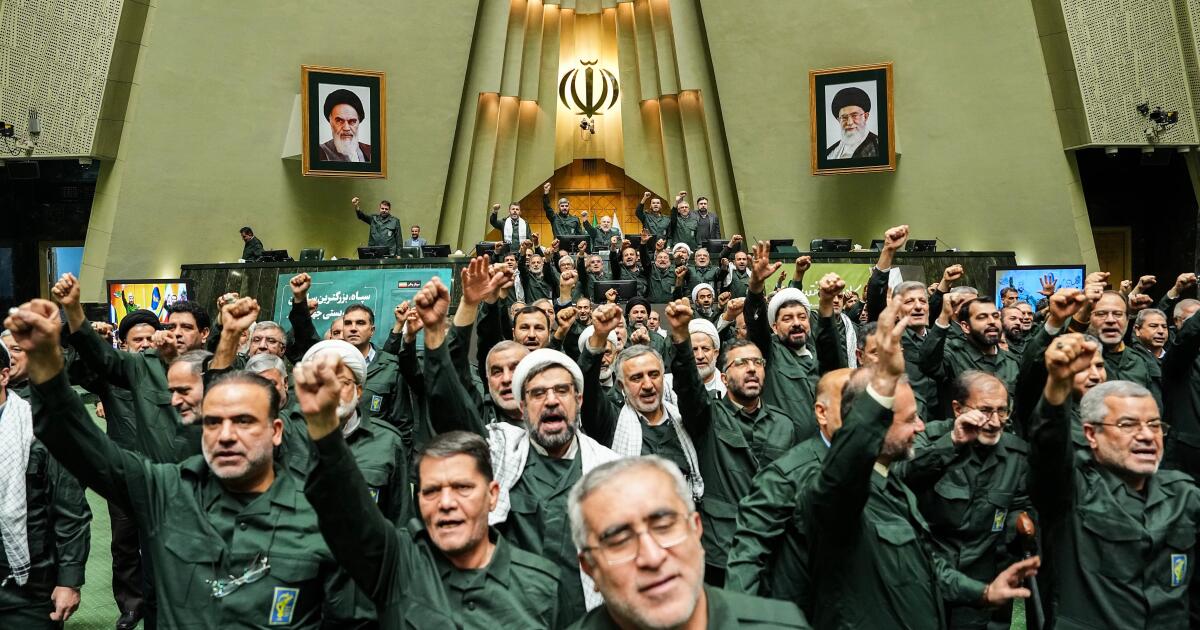
In a further development, the speaker of Iran’s parliament, Mohammad Bagher Qalibaf, declared that the Islamic Republic now regards all European Union militaries as terrorist organizations. This declaration followed the EU’s designation of Iran’s paramilitary Revolutionary Guard as a terrorist group due to its involvement in suppressing protests. Qalibaf’s announcement was delivered with support from other parliament members, who wore Revolutionary Guard uniforms during the session.
President Trump has outlined specific red lines regarding military intervention, focusing on the protection of peaceful demonstrators and the prevention of mass executions of detainees. He has also expressed interest in negotiating terms related to Iran’s nuclear program, a significant issue in U.S.-Iran relations.
As the situation unfolds, the potential for conflict remains a pressing concern. The international community watches closely, given the historical significance of the current unrest and the implications of military action in the region. The stakes are high, with both sides signaling a readiness to engage in a confrontation that could reshape the geopolitical landscape of the Middle East.