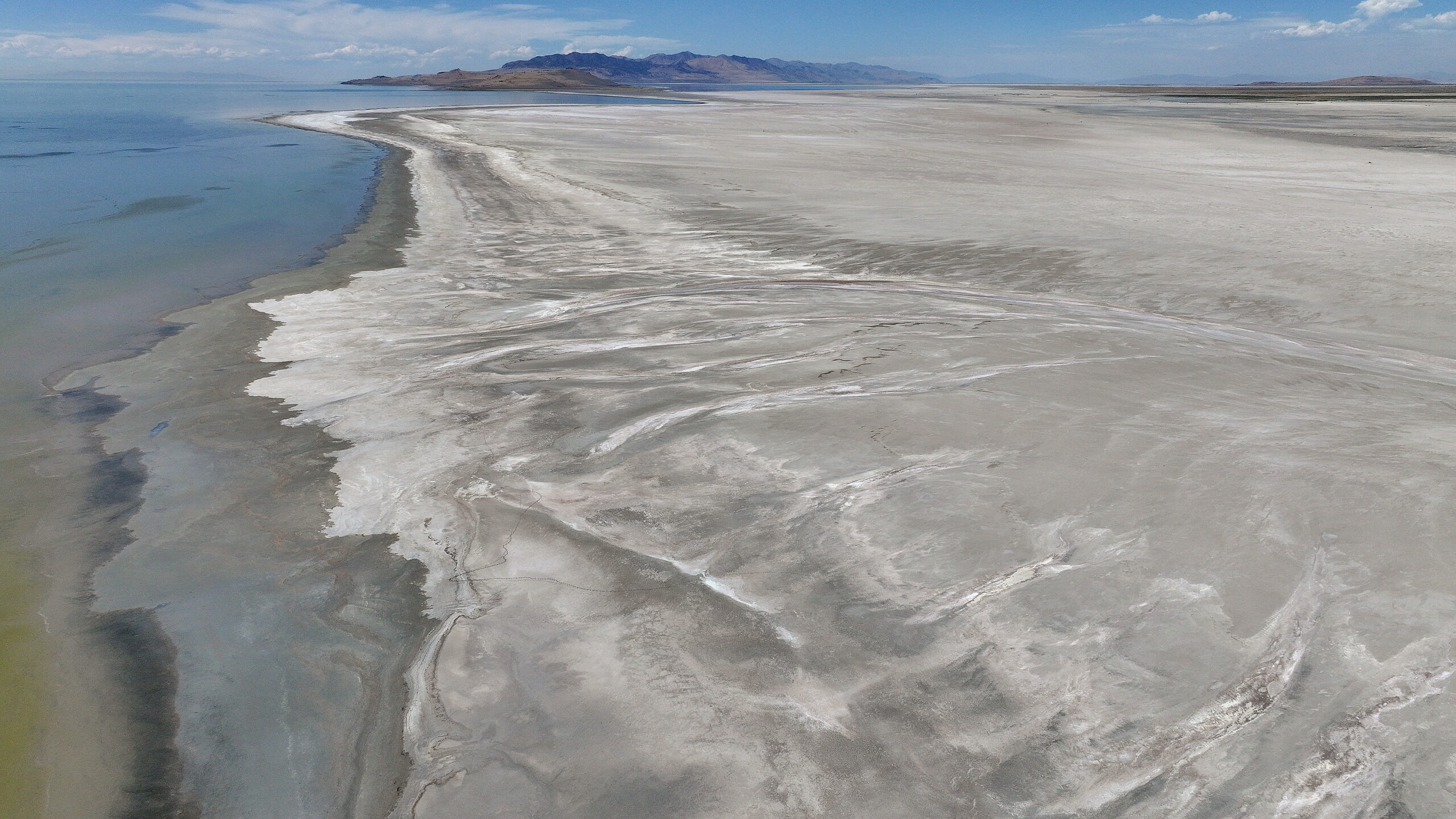
The Great Salt Lake, the largest saltwater lake in the Western Hemisphere, has been experiencing a troubling decline over the past few decades. Utah Governor Spencer Cox has committed to reversing this trend, asserting that “the Great Salt Lake will be full” by the time the 2034 Winter Olympic Games are held in Utah. This ambitious goal comes as the lake has shrunk from approximately 2,300 square miles in 1986 to an average of 1,700 square miles today.
To restore the lake and alleviate its current status of “serious adverse effects,” the state must add an estimated 261 billion gallons (or 800,000 acre-feet) of water, according to Great Salt Lake Commissioner Brian Steed. The lake’s decline has primarily stemmed from excessive municipal and industrial water use, which diverts water from crucial rivers and reservoirs before it can reach the lake. Contributing factors include rising temperatures that accelerate evaporation and the region’s low precipitation levels.
As the urgency to address the lake’s shrinking continues, the Utah Legislature is taking significant steps. Lawmakers have dedicated considerable time to discussing the lake’s preservation, with key legislative proposals aimed at mitigating further decline. In particular, the 2026 session has introduced several bills targeting water conservation and management.
One notable proposal is HB76, which mandates that data centers report their water usage or incur penalties of $10,000 per day until compliance. Another bill, HB348, simplifies the process for farmers to temporarily redirect their water, allowing them to apply to dedicate part of their water rights for storage in reservoirs. Additionally, HB155 proposes to increase the rates for excess lawn watering, providing a financial incentive for reduced water consumption.
Another significant initiative is SB250, sponsored by Senator Nate Blouin, which seeks to divert $200 million from the Bear River Development project to support efforts for the Great Salt Lake. Initially initiated in the early 1990s, the Bear River Development aimed to provide municipal water to the Wasatch Front.
Utah’s potential acquisition of water rights from US Magnesium, a mining company that recently declared bankruptcy, could further bolster the lake’s recovery. Utah successfully bid $30 million for the company’s land, water rights, and mining agreements. US Magnesium had previously pumped over 52,000 acre-feet of lake brine and groundwater, significantly impacting the lake’s health. The state anticipates retaining nearly 17 billion gallons of water in the lake as part of its revitalization efforts.
Public health concerns related to the exposed lakebed persist, with scientists identifying harmful contaminants such as arsenic and mercury. Professor Kevin Perry of the University of Utah has indicated that while these contaminants exist, there is no direct evidence linking them to increased arsenic levels in surrounding communities. Notably, only six dust monitors currently operate in northern Utah, which limits the ability to assess the health risks accurately.
To address the limitations of current monitoring, there is a growing call for more dust monitors in at-risk areas, particularly cities northeast of Farmington Bay. This includes communities like Syracuse, Layton, and Clearfield, which lack adequate monitoring systems.
In addition to legislative measures, Utah is exploring innovative solutions such as cloud seeding technology to enhance precipitation levels. In 2023, the state allocated $12 million for a one-time payment and an ongoing $5 million per year to study cloud seeding, a technique that has shown to increase precipitation by 5-15% in seeded areas. This weather modification approach disperses substances like silver iodide into clouds, promoting increased rainfall and snowfall.
Upcoming advancements include a drone-based cloud seeding program in the Bear River Range, developed in collaboration with Idaho. Joel Ferry, executive director of Utah’s Department of Natural Resources, has noted the success of this program, particularly with the transition to remote generators located at higher elevations for better effectiveness.
Despite the challenges posed by the Salt Lake Valley’s temperature inversions, which trap pollutants close to the ground, experts assert that dust is not a primary concern during this period. Perry emphasized that the inversion conditions typically prevent dust from being a significant issue due to the lack of wind and the lake’s usual wetness during the winter months.
The comprehensive approach taken by Utah’s leaders and communities reflects a strong commitment to addressing the challenges facing the Great Salt Lake. As efforts continue to restore this vital natural resource, the focus on innovative solutions and responsible water management will be crucial in ensuring the lake’s future health and sustainability.