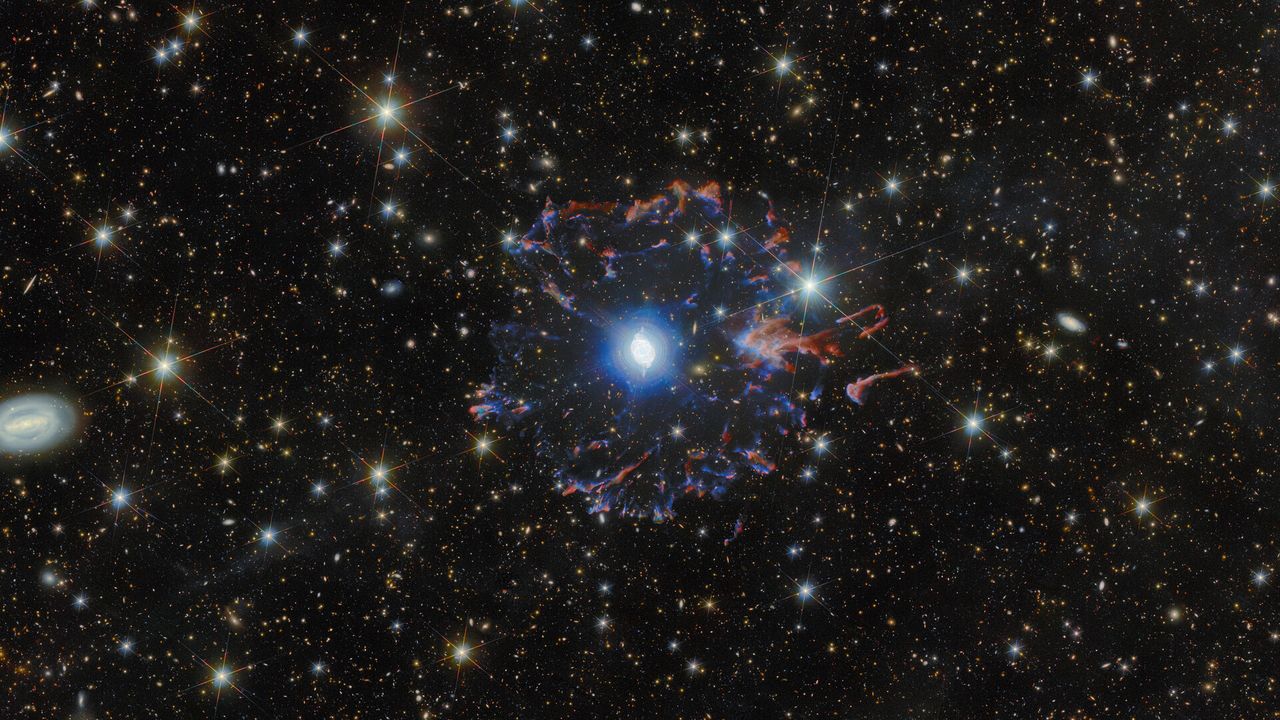
A stunning collaboration between the Hubble Space Telescope and the Euclid Space Telescope has unveiled breathtaking images of the Cat’s Eye Nebula (NGC 6543), showcasing the intricate beauty of a dying star’s final act. These observations highlight the nebula’s vibrant colors, with glowing rings of blue, orange, and red gas, as they are expelled into the cosmos.
Located approximately 4,300 light-years from Earth in the constellation Draco, the Cat’s Eye Nebula is a planetary nebula, which forms when a star of low to medium mass sheds its outer layers. Unlike more massive stars that end their lives in explosive supernovae, the central star of this nebula has gently released its material, creating a visually stunning cloud of gas.
Unveiling Cosmic Complexity
The captivating images reflect a complex interplay between the intense winds of the dying star and its outer layers, leading to the formation of the nebula’s eye-like structure. The bright central region, captured in detail by Hubble’s Advanced Camera for Surveys, reveals a vibrant star surrounded by billowing gas bubbles and intricate blue loops. These features serve as a record of the star’s mass loss during its life cycle, with each bubble indicating a different stage of material ejection.
“These finer details serve as a ‘fossil record’ of the nebula,” noted a statement from the European Space Agency (ESA).
The data collected highlights not only the star’s remnants but also energetic jets of gas, depicted in striking pink hues. These jets, propelled from the nebula’s poles, interact with surrounding material, forming dense knots that contribute to the nebula’s dynamic appearance. The overall effect presents a vivid snapshot of the star’s dramatic last moments.
Euclid’s wide-field observations complement Hubble’s close-up views by showcasing delicate filaments and faint arcs of gas that surround the bright central area. This broader perspective provides context, revealing the nebula’s place within a cosmic landscape filled with distant galaxies.
A Cinematic Finale
Together, the images from Hubble and Euclid create an almost cinematic portrayal of the Cat’s Eye Nebula, illustrating the beauty and complexity of stellar death. As these cosmic phenomena unfold, they remind humanity of the intricate processes that govern the lifecycle of stars, contributing to our understanding of the universe.
These remarkable observations were shared with the public on March 3, 2026, further fueling interest in astronomical studies and the technologies that enable such breathtaking discoveries. With ongoing advancements in space observation, the mysteries of the universe continue to unfold, inviting both scientists and enthusiasts to explore the wonders beyond our planet.