California Governor Gavin Newsom is navigating a contentious political landscape as he seeks to balance his ambitions for a presidential bid with the realities of immigrant health care in the state. For the second consecutive year, Newsom has urged state lawmakers to reduce health coverage for certain immigrant groups, a move that has drawn ire from both Democrats and Republicans.
As federal Medicaid spending cuts loom and California grapples with a budget deficit of approximately $3 billion, Newsom’s proposal would result in the loss of health coverage for an estimated 200,000 legal residents, including asylees and refugees, starting in October 2023. This decision is framed as a necessary step to save $786 million this fiscal year and potentially $1.1 billion annually in a proposed budget of $349 billion, according to the state’s Department of Finance.
Critics, including progressive legislators and activists, argue that this shift contradicts Newsom’s earlier commitment to “health for all.” State Senator Caroline Menjivar, one of two Senate Democrats who opposed the immigrant health cuts last year, expressed concern that Newsom’s aspirations may overshadow the needs of Californians. “You’re clouded by what Arkansas is going to think, or Tennessee is going to think, when what California thinks is something completely different,” Menjivar stated, reflecting on her experience of being temporarily removed from a key budget subcommittee following previous criticisms.
On the other side, Republican state Senator Tony Strickland has condemned Newsom for neglecting the state’s structural deficit, which could expand to $27 billion next year. Strickland accused the governor of mismanaging taxpayer funds by continuing to provide health care for undocumented residents. “He just wants to reinvent himself,” he remarked in response to the proposed budget cuts.
The political landscape surrounding immigrant health care is increasingly complex. Guian McKee, co-chair of the Health Care Policy Project at the University of Virginia’s Miller Center of Public Affairs, described Newsom’s position as a political tightrope, emphasizing that public opinion on health coverage for immigrants without legal status is deeply divided across the nation. A poll by the Kaiser Family Foundation (KFF) last year found that just over half of Americans opposed penalizing states that use their own funds for immigrant health care.
In California, support for providing health coverage to undocumented immigrants has declined significantly. A May survey by the Public Policy Institute of California indicated that only 41% of adults favored such coverage, a decline from 55% in 2023. This shift reflects broader challenges faced by state leaders in addressing budget constraints while maintaining health care access for vulnerable populations.
The federal government’s approach to health care funding has also come under scrutiny. Mehmet Oz, Administrator of the Centers for Medicare & Medicaid Services, accused California of “gaming the system” to secure more federal funds, which critics argue allows the state to allocate resources to its Medicaid program, known as Medi-Cal, which currently serves roughly 1.6 million undocumented immigrants. In response, California officials have maintained that only state funds are used for health services for undocumented individuals, adhering to legal restrictions against federal funding for these services.
As Newsom grapples with these challenges, he has positioned himself as a proponent of expanded health care access. “No administration has done more to expand full coverage under Medicaid than this administration for our diverse communities, documented and undocumented,” he asserted in January. He has also expressed concerns about federal policies that threaten health coverage for millions, warning that changes could jeopardize care for 1.8 million Californians.
Advocates for immigrant rights have condemned the proposed cuts, particularly for those who have fled violence or trauma. According to Tanya Broder of the National Immigration Law Center, current federal regulations require state Medicaid programs to cover “qualified noncitizens,” yet recent legislative changes threaten to eliminate coverage for approximately 1.4 million legal immigrants nationwide.
The fiscal ramifications of these changes are yet to be fully understood, as many state governors have yet to present their budget proposals. In states like Colorado and Washington, officials are preparing for similar outcomes, estimating that thousands of legal immigrants could lose their health coverage due to the law’s revisions.
In response to rising health care costs and budget challenges, governors in states such as Illinois and Minnesota have already modified or halted coverage for undocumented immigrants. California has similarly voted to reduce benefits, including eliminating dental coverage and implementing monthly premiums for remaining beneficiaries.
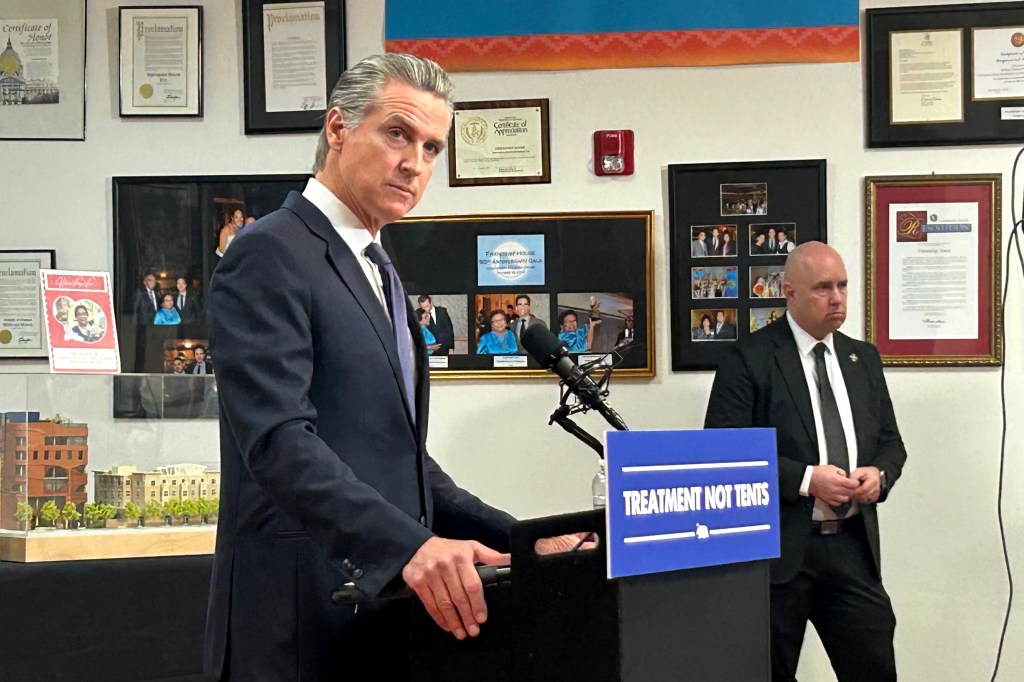
During a press conference in San Francisco, Newsom defended his administration’s fiscal decisions, stating they were crucial for “fiscal prudence.” He suggested that he might adjust his proposals in his upcoming budget update in May, hinting at a potential shift in strategy.
Kiran Savage-Sangwan, executive director of the California Pan-Ethnic Health Network, criticized Newsom’s approach, calling it “arbitrary and cruel.” She emphasized that the governor’s focus on budget constraints overlooks the importance of maintaining health coverage for vulnerable populations.
The evolving dynamics of immigrant health care in California reflect broader national debates about health policy and funding. As Newsom continues to navigate this contentious terrain, the implications for both state residents and his political aspirations remain uncertain.