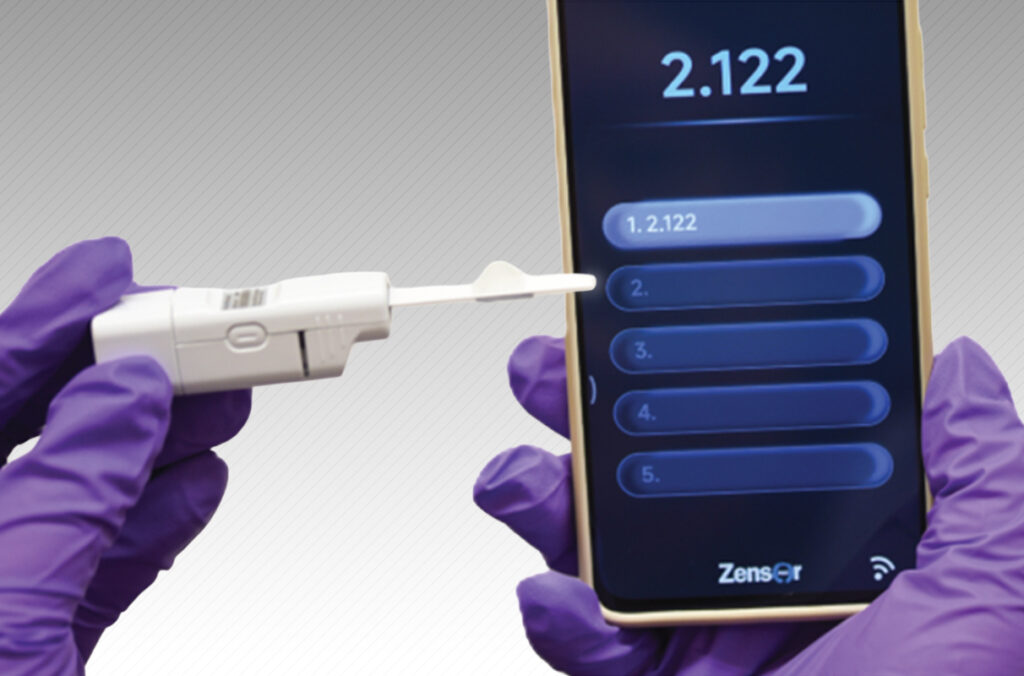
A new wearable biosensor developed by researchers at Washington State University promises to revolutionize glucose monitoring for individuals with diabetes. This innovative technology aims to make monitoring more accurate, cost-effective, and less invasive than existing options. The findings were published in the journal Analyst.
Researchers have designed a user-friendly sensor that utilizes microneedles and advanced sensors to measure glucose levels in the fluid surrounding cells. This approach offers an alternative to traditional continuous glucose monitoring systems, which can be uncomfortable and sometimes unreliable. “We were able to amplify the signal through our new single-atom catalyst and make sensors that are smaller, smarter, and more sensitive,” stated Annie Du, research professor in WSU’s College of Pharmacy and Pharmaceutical Sciences and co-corresponding author of the study.
The importance of accurate glucose measurement cannot be overstated, as it plays a crucial role in managing diabetes and preventing complications. Current continuous glucose monitors often require the insertion of small needles, which can lead to skin irritation and other complications. The WSU researchers leveraged 3D printing technology to create their biosensor, making it relatively inexpensive compared to traditional monitors.
Innovative Design and Enhanced Sensitivity
This novel sensor incorporates a button-activated pump and tiny hollow microneedles to extract interstitial fluid for testing without significant discomfort. Unlike conventional glucose monitors that may cause inflammation, this method minimizes potential toxicity for users. “Ours is much more benign for customers and users,” explained Kaiyan Qiu, Berry Assistant Professor in the School of Mechanical and Materials Engineering at WSU and lead author of the study.
The hollow microneedles measure less than a millimeter in length, significantly shorter than typical glucose monitoring needles. “The hollow microneedles are painless and minimally invasive, making them next-generation medical devices,” Qiu added. The sensor’s heightened sensitivity is attributed to the use of single-atom catalysts and enzymatic reactions known as nanozymes, which enhance the signal strength and allow for the detection of low biomarker levels. “The nanozymes make our signal much stronger and can detect a minimal amount of any biomarker,” Qiu stated.
Researchers have already filed a provisional patent with the Office of Innovation and Entrepreneurship and plan to conduct animal testing soon. They are also exploring the potential of this technology for detecting additional biomarkers.
Market Implications and Future Goals
The continuous glucose monitoring market in the United States is projected to experience substantial growth, increasing from $7.2 billion in 2024 to an anticipated $26.8 billion by 2033. This presents a significant opportunity for innovative technologies like the biosensor developed at WSU. “My goal is to make advanced sensing technology more practical for everyday healthcare,” remarked Yonghao Fu, a PhD student in the School of Mechanical and Materials Engineering and co-first author of the paper. “I enjoy working on a project that can combine different technologies so that we can take advantage of their strengths.”
This research was supported by grants from the National Science Foundation and the Centers for Disease Control and Prevention, highlighting its potential impact on public health.
For more information, contact:
Annie Du, WSU’s School of Mechanical and Materials Engineering, 509-335-3224, [email protected]
Kaiyan Qiu, WSU School of Mechanical and Materials Engineering, 509-335-3223, [email protected]
Tina Hilding, Voiland College of Engineering and Architecture Communications, 509-335-5095, [email protected]