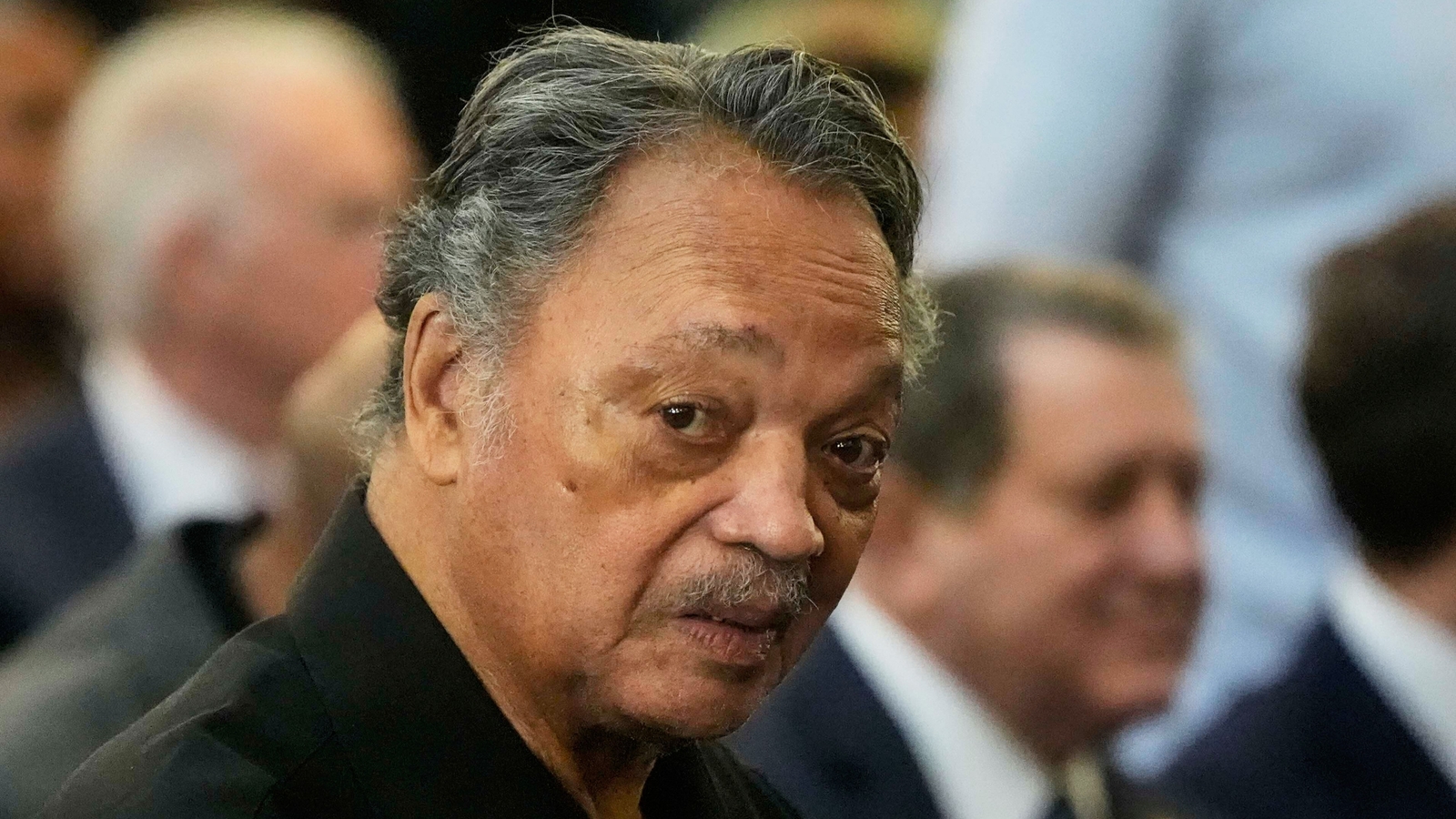
Rev. Jesse Jackson, a towering figure in the civil rights movement, has died at the age of 84. His family announced his passing on Tuesday, confirming that he died peacefully, surrounded by loved ones. In a heartfelt statement, they described him as a “servant leader” who dedicated his life to fighting for justice and equality. “Our father was not only a leader to our family, but to the oppressed, the voiceless, and the overlooked around the world,” they said.
Jackson’s journey as a civil rights champion began in his childhood in South Carolina. Born in the segregated town of Greenville, he experienced the harsh realities of racial discrimination early on. His mother, Helen Burns, was a high school student when he was born. Jackson often recounted being taught to ride at the back of the bus. Despite these challenges, he excelled academically and earned a football scholarship to the University of Illinois.
His commitment to civil rights took shape during a visit to South Carolina, where he joined a demonstration of Black students at a whites-only public library. “Some of my classmates and I were arrested trying to use a public library in Greenville,” Jackson recalled. Following this, he transferred to North Carolina Agricultural and Technical State University, which became a pivotal point in his activism. “I am somebody. I may be poor, but I am somebody,” he famously declared.
In 1965, Jackson joined Dr. Martin Luther King Jr. in the historic marches from Selma to Montgomery, Alabama. He often reflected on the vision shared by Dr. King for a society where character mattered more than skin color. Their relationship, while impactful, was not without its challenges. Jackson was appointed director of Operation Breadbasket in Chicago, focusing on job creation for African Americans and the support of Black-owned businesses.
On April 4, 1968, Jackson was in Memphis, Tennessee, with Dr. King when he was assassinated. “Shot, killed in cold blood, all I can remember is some voice saying, ‘one bullet cannot kill a movement: We must keep going,'” Jackson expressed during a later reflection. Just two months later, he was ordained as a minister, solidifying his commitment to social justice.
In 1971, Jackson founded Operation PUSH, which later evolved into the Rainbow PUSH Coalition. Based in Chicago, this organization became a significant political and religious force advocating for economic development and diversity in hiring practices. Jackson’s activism targeted major corporations, including Coca-Cola and Nike, through strategic boycotts aimed at promoting equal opportunities for Black Americans.
Beyond national issues, Jackson also engaged in international diplomacy. In 1983, he traveled to Syria to negotiate the release of an American Navy pilot and facilitated the return of 22 Americans held in Cuba by Fidel Castro. His efforts in private diplomacy expanded his influence and demonstrated his commitment to humanitarian causes.
Jackson made two notable runs for the presidency, first in 1984 and again in 1988. Although his campaigns faced challenges, including controversy over remarks made in private, he secured a significant following. In 2008, he expressed profound emotion as he watched Barack Obama accept the Democratic Party’s nomination for president. “We went from the balcony in Memphis, Tennessee, where Dr. King was killed, to the balcony of the White House in Washington,” Jackson said, reflecting on the historic moment.
In late 2017, Jackson revealed that he had been diagnosed with Parkinson’s disease, a condition that later evolved to a diagnosis of progressive supranuclear palsy (PSP). Despite his health challenges, he remained active in the civil rights movement, advocating for justice and equality, including protesting against police violence following the shooting of Laquan McDonald.
In July 2023, Jackson stepped down from his leadership role at the Rainbow PUSH Coalition. His contributions were recognized in 2025 when the National Bar Association honored him with a Lifetime Achievement Award. Jackson’s legacy as a passionate advocate for civil rights and social justice remains deeply ingrained in the fabric of American history. His family encourages those who admired him to continue the fight for the values he embodied throughout his life.