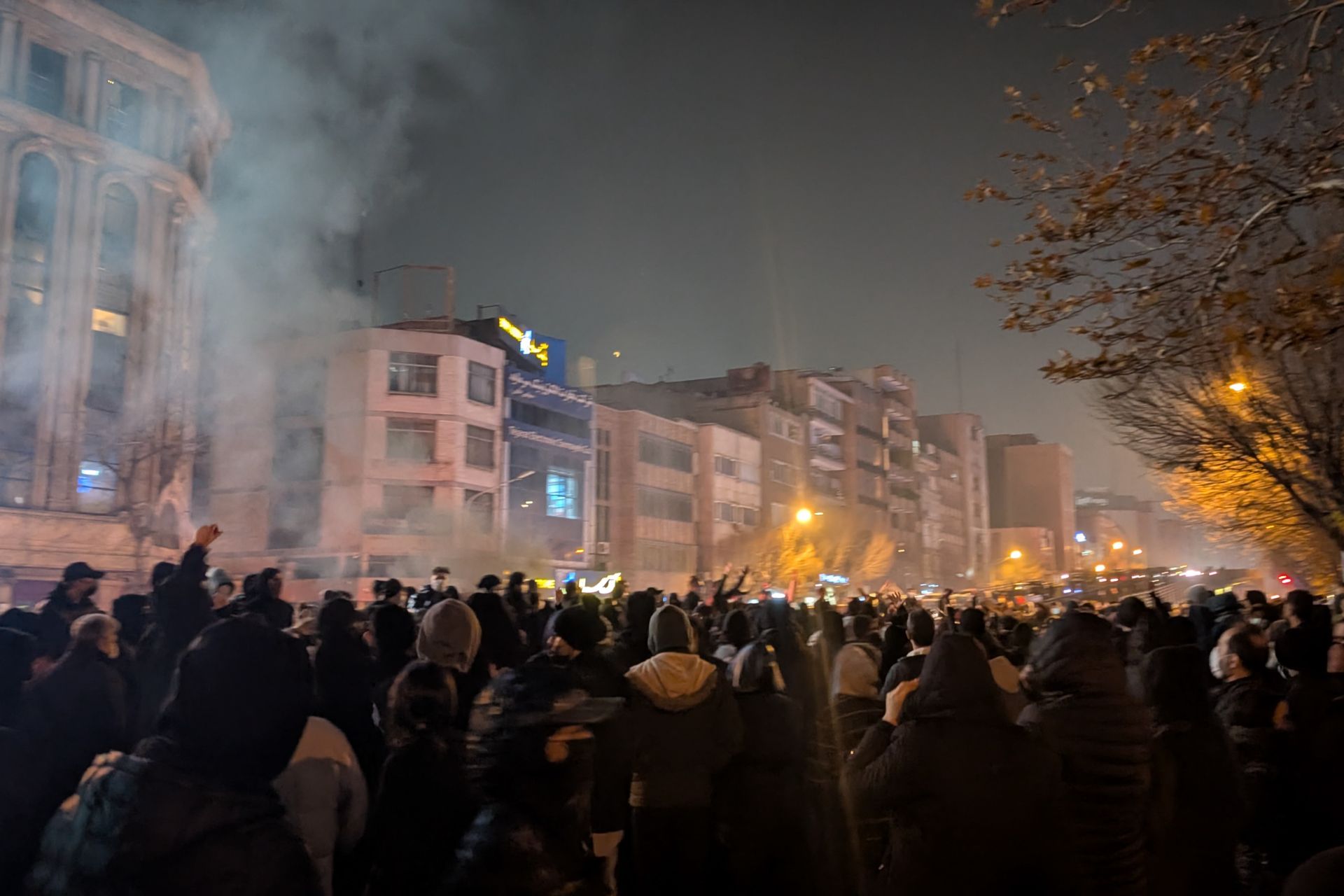
The funerals of anti-government protesters in Iran are evolving into acts of defiance against the regime. A recent example occurred on January 15, 2023, when family and friends gathered at the Bagh-e Rezvan Cemetery in Isfahan to claim the body of 23-year-old Sahba Rashtian, who was killed during protests on January 8. Her death was part of a violent crackdown in which thousands were reportedly killed across the country.
Traditionally, funerals in Iran follow a strict Shiite practice that includes washing the body, a prayer service, and a burial ceremony. However, Rashtian’s family broke from these rituals. Witnesses reported that when a local mullah demanded the recitation of the funeral prayer, her father responded by rejecting the request. Instead of adhering to the customary mourning practices, the family carried her coffin themselves, chanting her name as they made their way to the burial plot.
Rashtian’s father expressed pride in his daughter’s legacy, stating, “Your friend was martyred on the path to freedom. Be happy that you were her friend. Be happy that there was a hero among you.” Her mother’s words echoed this sentiment of resistance: “I want to see the people who shot her in the grave. They should know we’re standing with our country.”
This shift in mourning practices reflects a broader trend among families of victims of the recent protests. Many are opting for expressions of joy rather than sorrow, symbolizing their rejection of the state’s oppressive narrative. Videos circulating on social media depict gatherings that celebrate the lives of those lost. At a ceremony for Arnika Dabbagh, the crowd danced and clapped to a pop song, while at another event, the sister of Sajjad Bayat released doves into the air, proclaiming, “In the memory of my brother, the son of Iran.”
The trend of joyful mourning is a stark contrast to traditional practices, which often involve intense emotional displays. Nahid Siamdoust, an assistant professor at the University of Texas at Austin, noted that these celebratory funerals are a political statement against a regime that has long claimed religious authority. “These joyous celebrations are intentionally mounted to oppose a state that has championed a religion that they are now refusing,” Siamdoust explained.
Security forces have responded with intimidation, warning families against public gatherings. Rashtian’s family faced similar threats when intelligence officers contacted them to prohibit a public ceremony for her.
Historical context reveals the regime’s awareness of the potential power of collective grief. During the last days of the reign of Shah Mohammad Reza Pahlavi, mourning for a popular opposition figure ignited mass protests, ultimately contributing to the revolution that overthrew the monarchy. Today, the Iranian government is wary of similar gatherings that could spark unrest.
In the recent “Woman, Life, Freedom” movement, which reportedly resulted in the deaths of at least 530 protesters, mourning ceremonies also attracted the ire of the authorities. Families faced violent repression from security forces when they gathered to commemorate their loved ones.
As protests continue, the language surrounding the deceased has shifted. Rather than using the term “martyr,” families are adopting the phrase “javid naam,” which translates to “eternal name.” This shift signifies a reclaiming of their loved ones’ identities and a rejection of the state narrative.
Rashtian’s friend shared a poignant memory of her, describing her as a unique individual with dreams of becoming an animator for Disney. Just days before her death, they discussed their hopes for the future and the impact of the regime on their lives. “We spoke about how we had to free our country,” her friend recalled.
The current climate in Iran is fraught with uncertainty as airstrikes by the U.S. and Israel raise questions about the nation’s future, particularly following the reported death of Ayatollah Ali Khamenei. Many Iranians feel a growing urgency for change, viewing the overthrow of the government as a critical priority.
“In the last few years, protests have occurred, but the state never reformed,” Rashtian’s friend remarked. “Right now, although all of us are worried about the future and the potential power vacuum, there is no alternative, and overthrowing the government is our first and last priority.”
As funerals transform into acts of resistance, they reflect a powerful repudiation of an oppressive regime and a collective yearning for change within Iranian society.