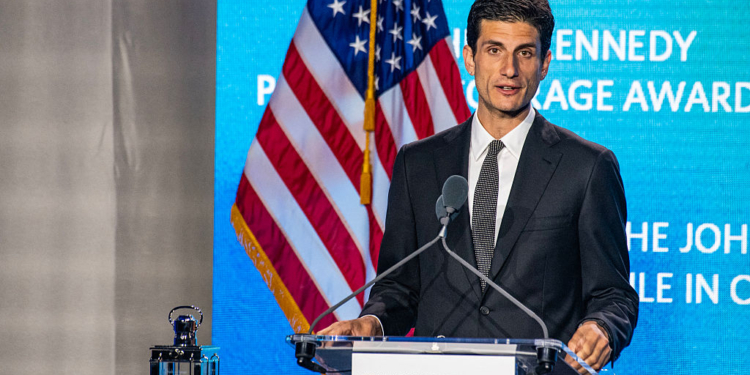
Jack Schlossberg, grandson of former President John F. Kennedy, has publicly criticized a recent decision to add President Donald Trump’s name to the John F. Kennedy Center for the Performing Arts. This announcement, made on December 18, 2025, by White House Press Secretary Karoline Leavitt, claimed that the board had voted unanimously to rename the landmark to the “Trump-Kennedy Center.” Schlossberg’s response suggests that the situation is more complicated than the administration portrayed.
Schlossberg took to social media to dispute the White House’s narrative, stating, “Microphones were muted and the board meeting and vote NOT unanimous.” His comments imply that the decision was not as straightforward as it has been presented and raise questions about the transparency of the voting process. He also suggested that Trump’s involvement may stem from personal motivations related to his own political ambitions.
Ohio Representative Joyce Beatty, who is a member of the Kennedy Center board, echoed Schlossberg’s concerns. Beatty stated that she was muted during the meeting and was not allowed to express her opposition to the renaming. “This was not on the agenda. This was not consensus. This is censorship,” she declared in a video message. Beatty emphasized that the process should involve public discourse, especially since the Kennedy Center was established by Congress.
The controversy surrounding the renaming is not new. Trump has long expressed a desire to imprint his influence on the Kennedy Center. Earlier in 2025, he assumed the role of chairman, replacing existing board members with individuals aligned with his political agenda. In July, Republican Representative Bob Onder introduced legislation to rename the building the “Donald J. Trump Center for Performing Arts,” a proposal that ultimately did not pass.
Schlossberg has raised legal concerns regarding the legitimacy of the renaming. He pointed to Public Law 88-260, which governs the Kennedy Center’s status as a memorial, arguing that the law prohibits the designation of additional memorials within the building. “Plain reading of the statute makes clear — YOU CAN’T DO THAT,” he asserted, highlighting the potential legal implications of the board’s decision.
For Schlossberg, the issue transcends legalities; it is deeply personal. He believes that Trump’s efforts to overshadow historical figures like JFK are misguided. “Trump is obsessed with being bigger than JFK,” he remarked on Instagram, noting that such aspirations do not enhance Trump’s legacy. He stressed that the contributions of JFK and the shared history of the nation cannot be altered or diminished.
As the situation unfolds, many are left wondering about the integrity of the voting process and the extent to which the public will be informed about the events that transpired behind the closed discussions. The fallout from this decision may have lasting implications for both the Kennedy Center and the political landscape surrounding it.