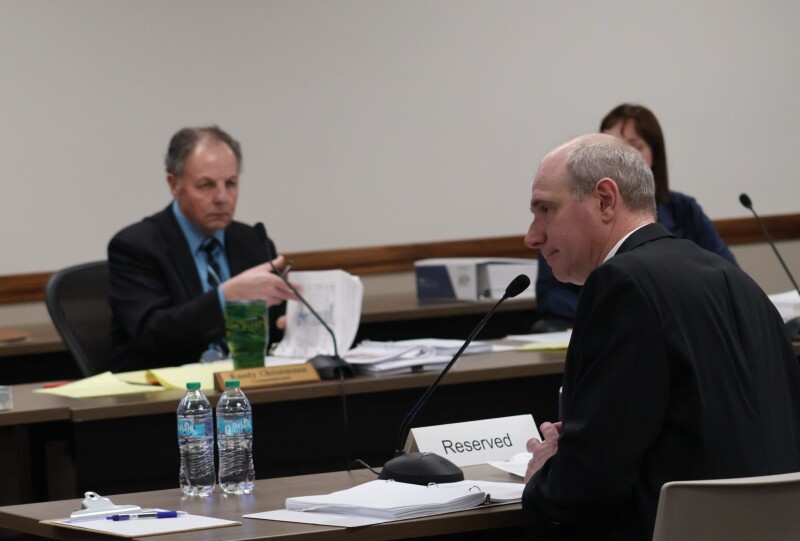
Two power companies, Otter Tail Power and Montana-Dakota Utilities, have formally requested the North Dakota Public Service Commission (PSC) to determine that certain local zoning ordinances along the proposed Jamestown to Ellendale high-voltage powerline project, known as JETx, are overly restrictive. This request, made during a hearing on January 8, 2025, could activate a new law allowing state zoning regulations to take precedence over local ordinances concerning transmission lines.
During the hearing, attorney Jason Weiers, representing the companies, emphasized that the restrictive ordinances in townships along the proposed route threaten the project’s feasibility. Specifically, the companies are seeking a ruling that would establish the state’s standard setback of 500 feet from occupied residences, rather than the 2,640-foot requirement imposed by some local jurisdictions.
In his testimony, Weiers identified Homer and Corwin townships in Stutsman County, along with Willowbank Township in LaMoure County, as having passed ordinances that significantly complicate the routing of the powerline. He described the Homer Township setback as essentially a “ban on the development of high-voltage power lines,” while the restrictions in Corwin and Willowbank make routing “nearly impossible.”
Additionally, Weiers pointed out that three townships in LaMoure County—Russell, Wano, and Willowbank—have enacted moratoriums on high-voltage power lines, which he argued appear to directly target the JETx project. This situation arises under a 2025 law that took effect on August 1, allowing state zoning rules to supersede local ones, a measure linked to the need for infrastructure improvements highlighted in the testimony regarding the JETx project.
The power companies assert that the JETx project is essential for enhancing grid reliability in the Jamestown area, which has faced reliability challenges due to severe weather conditions. Rob Frank, director of electric transmission engineering for Montana-Dakota Utilities, noted that the new line would connect to two existing high-voltage lines, significantly benefiting reliability and improving transmission capacity into South Dakota.
Construction is anticipated to commence later in 2025, with completion projected by 2028. The estimated cost of the project is $406 million, but Weiers warned that routing adjustments necessitated by local ordinances could inflate expenses by as much as $24 million. The project will feature 502 single pole supports, each standing between 120 and 180 feet tall.
The PSC has allocated two days for a technical hearing on the project, during which officials from Otter Tail and Montana-Dakota Utilities will provide detailed information. Following these hearings, the PSC plans to hold public input sessions in Ellendale, Edgeley, and Jamestown. This marks the first instance the PSC has employed a newly established process for conducting separate technical and public hearings to encourage community engagement.
Weiers reported that 134 of the 173 landowners along the proposed route, equating to 77% of the affected landowners, have signed agreements permitting the powerline construction through their properties. This represents approximately 76% of the total length of the 92-mile project.
The PSC previously granted a certificate of need for the JETx project but must still approve a route permit. Commission Chairman Randy Christmann expressed concerns during the hearing, questioning whether the project’s focus was on connecting to renewable energy sources or on enhancing reliability. Weiers clarified that the project aims to improve transmission from wind turbines located west of Ellendale while also bolstering grid reliability.
Christmann also inquired about the level of resistance from local townships and the relatively low rate of easement signings. Frank attributed this to “landowner fatigue” regarding new projects but maintained that the current rate of easement signings is typical for such undertakings.
The developments surrounding the JETx project illustrate the ongoing tension between local regulations and state-level initiatives aimed at improving critical infrastructure.