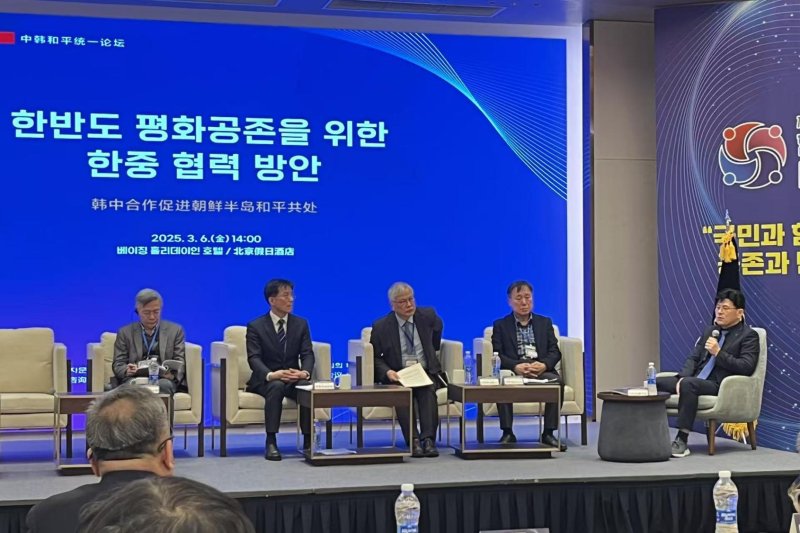
On March 7, 2026, scholars from South Korea and China emphasized the urgent need for improved relations between North and South Korea during the Korea-China Peaceful Unification Forum held in Beijing. They underscored that developing cooperation among these nations is crucial in light of escalating global tensions, particularly following recent military actions by the United States and Israel in Iran.
Proposals for Cooperation
The forum, organized by the Beijing chapter of the National Unification Advisory Council (NUAC) and the Korean Political Science Association, featured a series of discussions focused on restoring trust and enhancing regional collaboration. Lee Hee-ok, an honorary professor of political science at Sungkyunkwan University, stressed the need to confront the existing distrust between the two Koreas. “We must no longer neglect the lack of trust between the two Koreas,” Lee stated. He called for proactive measures that could be implemented to address this issue.
Lee also advocated for South Korea to present concrete proposals to both the United States and China, aiming to elevate the Korean Peninsula situation on the agenda for a proposed U.S.-China summit scheduled for early April 2026. Among his suggestions were a high-speed rail project linking Beijing, Pyongyang, Seoul, and Busan, as well as tourism development in the Wonsan-Kalma coastal area. He also proposed trilateral medical cooperation that would involve the dispatch of doctors and the provision of essential medical supplies to North Korea, and urged for the resumption of humanitarian assistance.
Reassessing Geopolitical Dynamics
Kim Dong-gil, a professor of history at Peking University, highlighted the necessity of reassessing the role of the United States on the Korean Peninsula within the context of current geopolitical challenges. “North Korea’s economy has grown in recent years and economic development remains a central focus,” Kim noted. He pointed out that peaceful coexistence is a priority for North Korea.
Additionally, Chinese scholar Han Xiandong proposed that Northeast Asia may require a new framework for regional cooperation. He cautioned against what he referred to as “Trump-style Monroeism,” suggesting that this could extend into the Asia-Pacific region. Han predicted an intensification of military competition in Northeast Asia, particularly in light of Japan’s expanding defense capabilities and South Korea’s plans to develop nuclear-powered submarines.
The forum was attended by notable figures such as Roh Jae-heon, NUAC vice chairman Seo Man-gyo, and Chung Han-beom, president of the Korean Political Science Association. In his opening remarks, Park Ki-rak emphasized that achieving peace on the Korean Peninsula is not solely the responsibility of South Korea. “It is time to consider how trilateral cooperation among South Korea, North Korea, and China can be expanded,” he concluded, referencing the outcomes of a South Korea-China summit earlier in the year.
The discussions at the forum reflect a growing recognition among scholars and officials that collaboration among North and South Korea, alongside China, is essential for fostering peace and stability in the region.