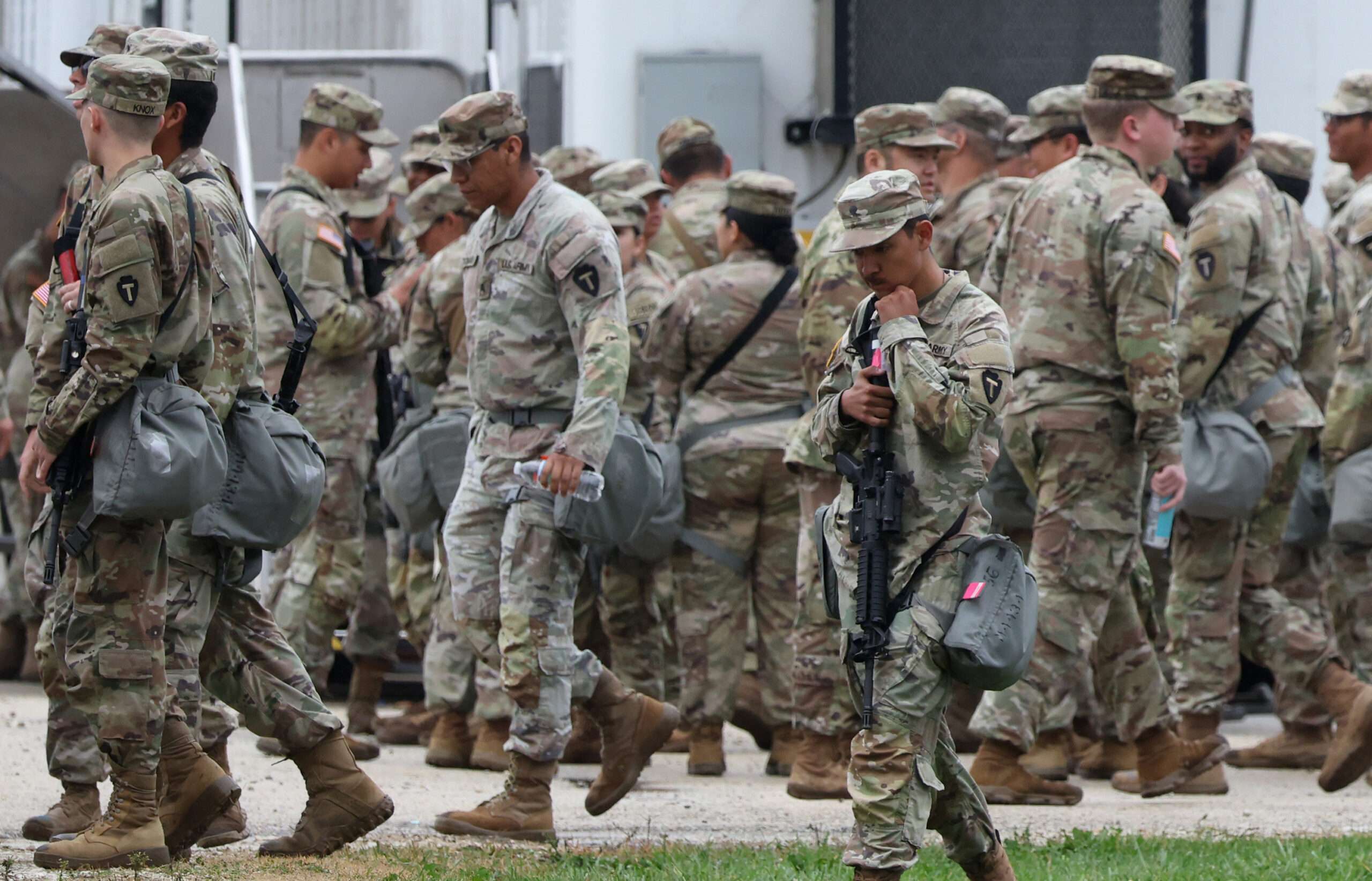
On March 6, 2024, the United States Supreme Court ruled against former President Donald Trump in a significant case related to the deployment of the National Guard for domestic law enforcement in Illinois. The ruling, in the case of Trump v. Illinois, is not a final decision on the matter but a rejection of Trump’s request for a stay on a lower court’s ruling, effectively blocking his plans to use the National Guard to respond to anti-Immigration and Customs Enforcement (ICE) protests in the Chicago area.
The Supreme Court’s decision suggests that the majority believes Trump’s actions may be unlawful. The ruling centers on Trump’s justification for deploying the National Guard under 10 U.S.C. Section 12406, which permits the federalization of state National Guard forces for law enforcement under specific circumstances. These circumstances include an invasion of the United States, rebellion against the federal government, or the President’s inability to execute laws using regular military forces.
In its unsigned per curiam opinion, the Court found that there was no evidence to support Trump’s claim of inability to enforce the laws in Illinois through regular military forces. The Court emphasized that the term “regular forces” likely refers to the United States military, not civilian law enforcement agencies. As such, the ruling indicates that for the President to federalize the National Guard, there must be a clear legal basis for the military’s involvement in law enforcement—which the government failed to establish in this case.
The implications of this decision extend beyond Illinois. Legal experts suggest that it could influence similar cases in states like California and Oregon, where similar issues regarding the deployment of the military for domestic law enforcement are being contested.
Justice Brett Kavanaugh concurred with the majority but expressed concerns that the reasoning might overreach, while Justice Samuel Alito, joined by Justice Clarence Thomas, dissented, arguing that the Court did not adequately consider the “party presentation” rule which limits the issues to those raised by the parties involved. Alito contended that the disturbances from the protests warranted a reconsideration of the facts presented.
The Court’s ruling is seen as a significant victory for those opposing the misuse of military power for domestic law enforcement. Legal experts, including Jack Goldsmith, noted that while this decision halts Trump’s current plans, it does not completely eliminate his options, including the potential invocation of the Insurrection Act.
As the legal landscape surrounding Trump’s authority to use military forces for domestic purposes evolves, this ruling underscores the ongoing debate about the balance of power between state and federal authorities, as well as the proper role of the military in civilian law enforcement. The Court’s decision is likely to set a precedent that will influence future cases involving the deployment of the National Guard and the interpretation of federal military authority.