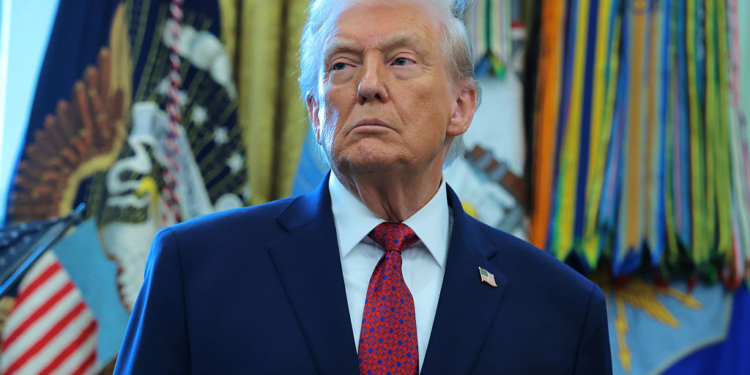
President Donald Trump has adopted an unexpected title, referring to himself as the “Acting President of Venezuela.” This assertion was made in a post on Truth Social, where Trump shared a screenshot from what appears to be a Wikipedia entry, which names him under his photo. The post was made late on January 11, 2026, and has since generated widespread attention across various media platforms.
On January 3, Trump ordered a military operation involving Delta Force, targeting the Venezuelan leadership. This action led to the capture of President Nicolás Maduro, a significant event in the ongoing political turmoil in the country. Following Maduro’s capture, his vice president, Delcy Rodríguez, assumed the role of acting president. This transition of power has raised questions about the future political landscape in Venezuela.
In an interview with Fox News, Trump discussed his plans for Venezuela, indicating that elections would take place “eventually.” He emphasized the need for rebuilding the nation’s oil industry, which he described as critical for the country’s recovery. “We’re gonna rebuild the oil and the oil infrastructure,” Trump stated, suggesting that he had communicated his intentions to oil companies prior to the military operation.
The implications of Trump’s self-appointment as acting president extend beyond mere title claims. As the situation unfolds, many observers are closely monitoring the potential ramifications for Venezuela’s political stability and its relations with other nations. The recent military action, combined with Trump’s statements, highlights a significant shift in U.S. foreign policy regarding Latin America, particularly in relation to the Venezuelan crisis.
While the move has garnered support from some factions, it has also attracted criticism from various political analysts and human rights advocates. Concerns over the legality and ethics of military interventions in sovereign nations remain at the forefront of the discussion. As Venezuela navigates this tumultuous period, the international community watches closely to see how these developments will impact the region’s geopolitical dynamics.
With the backdrop of ongoing economic challenges in Venezuela, the focus now shifts to whether Trump’s plans will materialize and how they will affect the lives of Venezuelan citizens. The unfolding situation poses complex questions about governance, sovereignty, and the role of foreign intervention in domestic affairs.
In the coming weeks, the administration’s actions will likely dictate the pace and direction of change in Venezuela. As Trump asserts his new title, the world awaits clarity on the future of this South American nation and its leadership.