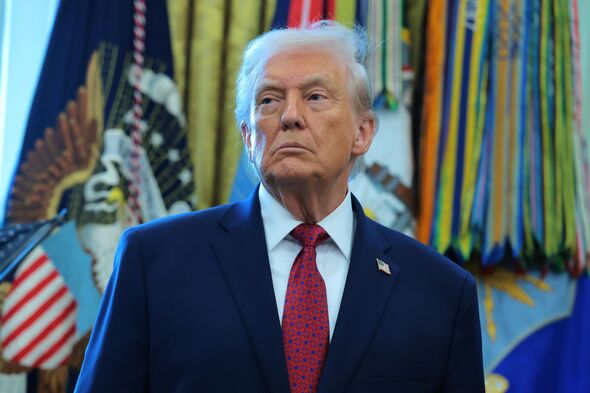
Former U.S. President Donald Trump issued a stark warning regarding Iran’s future leadership, suggesting that the incoming Supreme Leader will face a precarious tenure if he fails to secure approval from the United States. Trump’s comments came in response to reports of a succession plan being developed in Tehran following the death of Ayatollah Ali Khamenei.
On Sunday, Mohsen Heydari, a member of the Assembly of Experts, confirmed that the most suitable candidate for the Supreme Leader position has been identified. This announcement followed escalating concerns about the leadership transition in Iran, particularly after Khamenei’s death in an airstrike campaign attributed to the United States and Israel.
In an interview with ABC, Trump stated, “He’s going to have to get approval from us. If he doesn’t get approval from us, he’s not going to last long.” He emphasized the need for stability, saying, “We want to make sure that we don’t have to go back every 10 years, when you don’t have a president like me that’s not going to do it.”
Iranian officials responded firmly to Trump’s remarks. Abbas Araghchi, the Iranian Foreign Minister, told NBC’s “Meet the Press” that the selection of the new leader is strictly an internal matter. “We allow nobody to interfere in our domestic affairs. This is up to the Iranian people,” he asserted.
Temporary Leadership Structure Established
In light of Khamenei’s passing, Iran has activated a temporary leadership council as outlined in its constitution. This council comprises the sitting president, the head of the judiciary, and a member of the Guardian Council. The council will assume leadership duties until a new Supreme Leader is elected by the Assembly of Experts.
The council includes Masoud Pezeshkian, Iran’s reformist president, and Gholamhossein Mohseni Ejei, the hard-line judiciary chief. Their immediate role is to govern the country while the Assembly of Experts prepares to select a permanent successor.
Potential Candidates for Supreme Leader
The Assembly of Experts, an 88-member body composed entirely of Shiite clerics, is tasked with electing a new Supreme Leader “as soon as possible,” according to Iranian law. This panel is elected every eight years and its candidates are vetted by the Guardian Council, known for disqualifying candidates deemed unsuitable.
Among the potential successors to Khamenei are several prominent figures:
– **Hassan Rouhani**: The former Iranian president is viewed as a relative moderate and played a crucial role in the landmark nuclear agreement with the Obama administration, which Trump later abandoned.
– **Hassan Khomeini**: The grandson of the Islamic Republic’s founder, he has advocated for increased engagement with the West, though he has never held a government position.
– **Mojtaba Khamenei**: The son of the late Supreme Leader, he is considered a frontrunner but lacks formal political experience. He is closely associated with Iran’s paramilitary Revolutionary Guard.
– **Ayatollah Ali Reza Arafi**: A senior cleric and member of the Guardian Council, he has the backing of traditional clerics.
– **Ayatollah Mohammad Mehdi Mirbagheri**: The head of the Islamic Cultural Center in Qom, he is well-regarded by hardliners and serves on the Assembly of Experts.
The political landscape remains fluid as deliberations about succession unfold behind closed doors. Previously, it was speculated that President Ebrahim Raisi might take over, but he tragically lost his life in a helicopter crash in May 2024, leaving the path open for other candidates.
As Iran braces for this critical transition, the international community watches closely, particularly amid ongoing tensions with the United States. The outcome of the leadership selection will undoubtedly impact Iran’s domestic and foreign policies in the years to come.