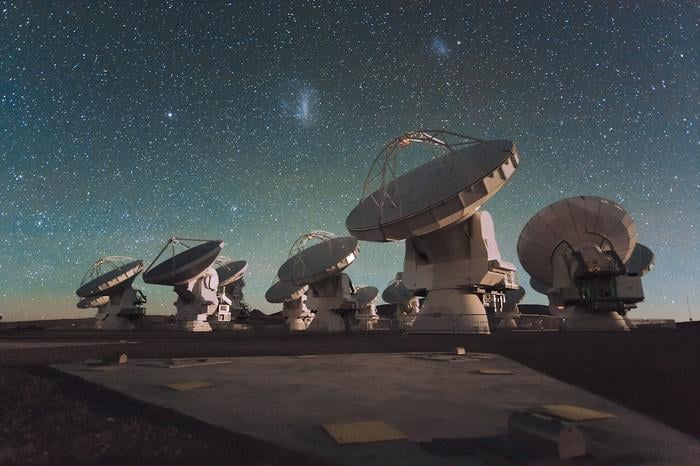
The Atacama Large Millimeter/Submillimeter Array (ALMA) in Chile has significantly enhanced its observational capabilities with the installation of 145 new low-noise amplifiers (LNAs). This upgrade, facilitated by collaboration between the Fraunhofer Institute for Applied Solid State Physics (IAF) and the Max Planck Institute for Radio Astronomy (MPIfR), aims to deepen our understanding of the cosmos.
ALMA, renowned for its power as a radio telescope, employs 66 parabolic antennas to capture millimeter and submillimeter radiation emitted by cold molecular clouds. These clouds are essential for star formation, allowing astronomers to visualize regions of the Universe obscured from view by dust and gas. The newly introduced LNAs significantly improve the facility’s Band 2 coverage, which ranges from 67 to 116 Gigahertz (GHz) on the electromagnetic spectrum.
Dr. Fabian Thome, head of the subproject at Fraunhofer IAF, highlighted the importance of this advancement. The LNAs will enable researchers to examine the “cold interstellar medium,” which comprises the materials—dust, gas, and radiation—critical in star formation. Enhanced sensitivity will also allow for more detailed studies of planet-forming disks and complex organic molecules (COMs), which are seen as precursors to the building blocks of life, such as DNA and RNA.
This upgrade represents a pivotal moment in astronomical research. The addition of the LNAs, which utilize high-frequency receivers, will amplify low-noise signals while minimizing background noise. This technological improvement is expected to dramatically increase the sensitivity of ALMA’s receivers, allowing scientists to capture data with unprecedented clarity.
The development of the LNAs involved advanced technology. Each amplifier integrates monolithic microwave integrated circuits (MMICs) made from indium gallium arsenide (InGaAs). These circuits are based on metamorphic high-electron-mobility transistor (mHEMT) technology, which facilitates high-performance operation in demanding conditions.
The collaboration was commissioned by the European Southern Observatory (ESO), with Fraunhofer IAF responsible for the design, manufacturing, and room-temperature testing of the MMICs. MPIfR assembled and qualified the LNA modules, conducting rigorous testing under cryogenic conditions.
Prof. Dr. Michael Kramer, executive director at MPIfR, expressed pride in the collaboration, stating, “This is a wonderful recognition of our fantastic collaboration with Fraunhofer IAF, which shows that our amplifiers are not only ‘made in Germany’ but also the best in the world.”
As researchers prepare to leverage these new capabilities, the scientific community anticipates groundbreaking insights into the processes governing star and planetary system formation. With a clearer view of the Universe, astronomers aim to unravel the complexities of organic molecule formation and its implications for the emergence of life.
This upgrade not only enhances ALMA’s position as a leader in radio astronomy but also underscores the importance of international cooperation in advancing our understanding of the Universe. The completion of the installation in March 2024 marks a significant milestone in astronomical research, paving the way for discoveries that may reshape our understanding of cosmic phenomena.