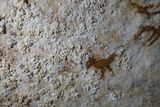
A recently published study in the journal Nature has revealed that a human hand stencil found in a cave on Sulawesi, Indonesia, dates back at least 67,800 years, making it the oldest known rock art reliably dated to date. This stencil, which appears claw-like, provides intriguing insights into the early movements of human populations, potentially linking them to the migration of modern humans into Australia.
The study was conducted by a team including Maxime Aubert from Griffith University, who noted that Sulawesi has been home to one of the world’s most enduring artistic cultures. “This art has origins in the earliest history of human occupation of the island at least 67,800 years ago,” Aubert stated in a press release.
Significance of Sulawesi in Human Migration
Sulawesi is not just a site of artistic heritage; it may also have played a crucial role in the migration of our ancestors. The island could have acted as a stepping stone for Homo sapiens as they transitioned from Asia to Sahul, the ancient landmass that once connected Australia, New Guinea, and Tasmania. The stencil was discovered in the Liang Metanduno cave on the island of Muna, which has yielded several other ancient rock art pieces.
The research team utilized methods such as uranium-series dating and mineral deposit analysis to confirm the age of the stencil, which is believed to have been created by an artist connected to the ancestors of the modern Aboriginal Australians. Adhi Agus Oktaviana, from Indonesia’s National Research and Innovation Agency, emphasized the importance of this discovery, stating that it “strongly supports the idea that the ancestors of the First Australians were in Sahul by 65,000 years ago.”
Insights into Artistic Innovation and Migration Patterns
Previous studies have suggested various timelines for when modern humans arrived in Sahul, with estimates ranging from 65,000 years (long chronology) to 50,000 years (short chronology). Researchers propose that these early migrations occurred via two primary routes: a northern path through Sulawesi and a southern path through Timor.
The Liang Metanduno cave also contains younger artworks, indicating a sustained human presence in the area for at least 35,000 years. Renaud Joannes-Boyau, from the Geoarchaeology and Archaeometry Research Group at Southern Cross University, highlighted that this ancient rock art provides the oldest direct evidence of modern humans along the northern migration corridor into Sahul.
As the research team looks ahead, they aim to continue their exploration of rock art and migration patterns, focusing on other Indonesian islands that lie between Sulawesi and New Guinea. “These discoveries underscore the archaeological significance of the many other Indonesian islands,” Aubert noted, hinting at the potential for further groundbreaking findings in the region.
The implications of this research extend beyond art; they offer a deeper understanding of how our ancestors navigated and populated vast landscapes. This study opens new avenues for examining early human history and the cultural practices that have shaped human civilization.