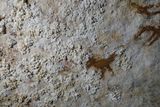
A recent study has unveiled that the oldest known rock art, dating back over 67,000 years, has been discovered in a cave on an island in Sulawesi, Indonesia. This finding significantly predates previous rock art discoveries in the region, offering new insights into the migrations of early humans. The artwork, a stencil resembling a human hand, is believed to represent a population that may have been among the first to migrate to Australia.
According to the research published in the journal Nature, the stencil was found in the Liang Metanduno cave and is approximately 67,800 years old. This discovery reshapes our understanding of early human artistic expression and suggests that Sulawesi hosted one of the world’s oldest artistic cultures. Lead author Maxime Aubert from the Griffith Centre for Social and Cultural Research remarked on the significance of the find, stating, “It is now evident from our new phase of research that Sulawesi was home to one of the world’s richest and most longstanding artistic cultures.”
The rock art of Sulawesi is not just a testament to ancient creativity but also a crucial piece of the puzzle regarding human migration patterns. The archipelago likely served as a stepping stone for early Homo sapiens as they moved from Asia towards the ancient landmass of Sahul, which once connected Australia, New Guinea, and Tasmania. Previous studies suggested that modern humans arrived in Sahul around 65,000 years ago, but this new evidence pushes back that timeline.
This latest research involved identifying various ancient rock art forms, including human hand stencils, across Sulawesi and nearby islands. The claw-like stencil, specifically, was dated using advanced techniques such as uranium-series dating and mineral deposit analysis. The team concluded that it was created by an artist likely connected to the ancestral lineage of Aboriginal Australians. “It is very likely that the people who made these paintings in Sulawesi were part of the broader population that would later spread through the region and ultimately reach Australia,” said study co-author Adhi Agus Oktaviana from Indonesia’s National Research and Innovation Agency.
The research indicates that the Liang Metanduno site also contains younger artworks, suggesting a long period of human occupation, potentially lasting over 35,000 years. Renaud Joannes-Boyau, another author of the study from Southern Cross University, highlighted that this rock art represents the oldest direct evidence for the presence of modern humans along the northern migration route into Sahul.
Exploration into the artistic and migratory history of early humans is ongoing, with the researchers planning to focus on additional sites along the northern route leading into Sahul. “These discoveries underscore the archaeological importance of the many other Indonesian islands between Sulawesi and New Guinea,” Aubert noted, indicating that further investigations may yield more significant findings.
As this research continues to unfold, the implications of these findings extend beyond art. They offer a deeper understanding of the early human experience, including migration patterns, social structures, and cultural expressions that have shaped human history.