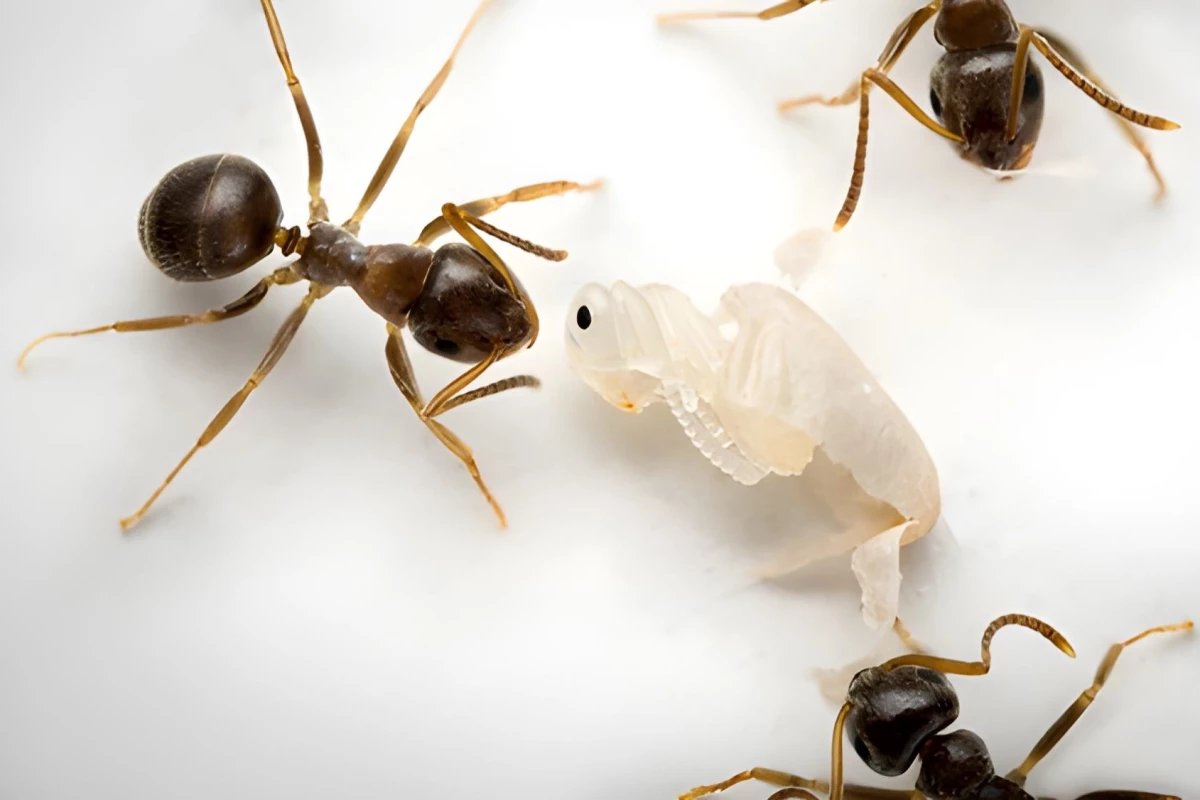
Ant pupae have developed a remarkable survival strategy that involves self-sacrifice for the benefit of their colony. Researchers from the Institute of Science and Technology Austria have discovered that infected ant pupae can emit a specific scent that signals their condition to worker ants. This scent, which is detectable only from outside their cocoons, prompts the worker ants to take action against the infected pupae.
When a pupae is afflicted with an incurable infection, it releases this unique chemical signal. The worker ants, upon detecting the scent, respond by dismantling the cocoon and creating openings in the pupae’s body through biting. They then proceed to disinfect the infected pupae using formic acid, a potent antimicrobial substance produced by the ants themselves. This process not only eliminates the infection but also results in the death of the infected pupae.
Erika Dawson, the first author of the study, explains the significance of this behavior: “What appears to be self-sacrifice at first glance is, in fact, also beneficial to the signaler: it safeguards its nestmates, with whom it shares many genes.” By alerting the colony to their perilous condition, the infected pupae contribute to the overall health of the nest, allowing it to thrive and produce future generations, thus indirectly passing on their own genetic material.
Understanding Ant Behavior and Colony Dynamics
This research underscores the concept of an ant colony functioning as a superorganism, where individual ants perform roles akin to cells in a human body. The worker ants engaged in the disinfection of infected pupae are compared to human immune cells, which are drawn to diseased cells through chemical signals. Immunologists refer to this phenomenon as the “find-me-and-eat-me signal.”
To validate their findings, the ISTA team, in collaboration with Thomas Schmitt from the University of Würzburg, conducted experiments transferring scent molecules from infected pupae to healthy ones. The results confirmed that worker ants would destroy the pupae marked by the disease-scent, demonstrating the effectiveness of this signaling mechanism.
Interestingly, the study revealed that only the pupae of worker ants produce this find-me-and-eat-me scent. The researchers suggest that queen ant pupae may possess stronger immune systems, enabling them to better withstand infections, which explains their lack of this scent.
Linking Findings to Broader Ant Behaviors
These revelations tie into previous research indicating that infected ants exhibit social distancing behaviors. Earlier studies have shown that ants infected with fungal spores tend to separate themselves from the rest of the colony, even constructing different entrances and tunnels in their nests. Additionally, it has long been observed that ants nearing the end of their lives engage in a behavior known as “terminal altruism,” where they leave the nest to die away from their colony.
The study, titled “Altruistic disease signaling in ant colonies,” has been published in the journal Nature Communications and adds to our understanding of the complex social structures and survival strategies within ant colonies. The findings highlight the intricate dynamics of cooperation and sacrifice that characterize these social insects, revealing a fascinating aspect of how they maintain colony health and resilience in the face of disease.