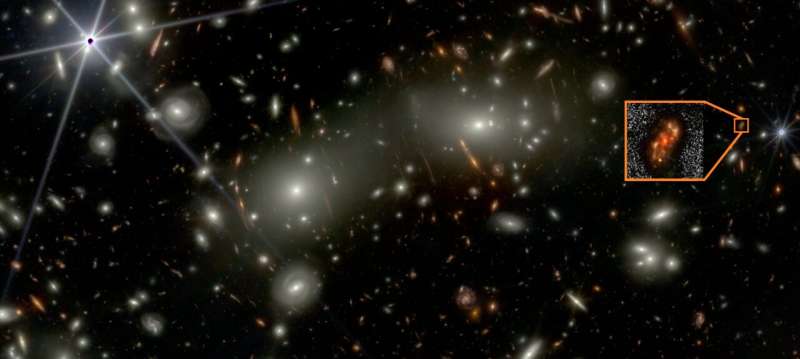
A significant discovery has emerged from the universe’s infancy, with astronomers identifying a well-formed spiral galaxy named Alaknanda. This galaxy, resembling the Milky Way, was formed merely 1.5 billion years after the Big Bang, challenging existing theories regarding the timeline of galaxy formation.
Researchers Rashi Jain and Yogesh Wadadekar, affiliated with the Tata Institute of Fundamental Research (TIFR) in Pune, India, made this groundbreaking find using the James Webb Space Telescope (JWST). Their findings, published in Astronomy & Astrophysics, indicate that Alaknanda possesses a structural maturity previously thought to be exclusive to much older galaxies.
Insights from the Discovery
Traditionally, astronomers believed that classic spiral galaxies like the Milky Way took billions of years to develop into their organized forms. Early galaxies were expected to appear irregular and chaotic, still undergoing the assembly process. However, Alaknanda defies these expectations, showcasing two distinct spiral arms encircling a bright central bulge, with a diameter of approximately 30,000 light-years.
Notably, Alaknanda is producing new stars at an astonishing rate, with its stellar mass equivalent to about 60 times the mass of the sun. This rate of star formation is roughly twenty times that of the present-day Milky Way. About half of the stars in Alaknanda were formed in a rapid 200 million years, a brief span in cosmic terms.
Rashi Jain, the lead author of the study, stated, “Alaknanda has the structural maturity we associate with galaxies that are billions of years older. Finding such a well-organized spiral disk at this epoch tells us that the physical processes driving galaxy formation can operate far more efficiently than current models predict. It’s forcing us to rethink our theoretical framework.”
Gravitational Lensing and Observational Techniques
Alaknanda is situated in the vicinity of a massive galaxy cluster known as Abell 2744, or Pandora’s Cluster. The cluster’s immense gravitational pull bends and magnifies the light from distant objects, a phenomenon known as gravitational lensing. This effect allowed the JWST to capture Alaknanda’s structure in remarkable detail.
Through the analysis of JWST images utilizing up to 21 different filters, Jain and Wadadekar were able to gather extensive data, including precise distance measurements, dust content, star count, and the rate of new star formation. This comprehensive dataset has added significant insights into the galaxy’s characteristics.
The discovery of Alaknanda is part of a growing body of evidence suggesting that the early universe was far more mature than previously thought. It stands out as one of the clearest examples of a textbook “grand-design” spiral galaxy observed at such an early stage in cosmic history.
Yogesh Wadadekar commented, “Alaknanda reveals that the early universe was capable of far more rapid galaxy assembly than we anticipated. Somehow, this galaxy managed to pull together ten billion solar masses of stars and organize them into a beautiful spiral disk in just a few hundred million years. That’s extraordinarily fast by cosmic standards, compelling astronomers to rethink how galaxies form.”
As scientists continue to debate the origins of Alaknanda’s spiral arms, potential explanations include steady growth through cold gas accretion or gravitational interactions with smaller companion galaxies. Upcoming observations using JWST’s spectroscopic instruments or the Atacama Large Millimeter Array (ALMA) in Chile may clarify the galaxy’s dynamics.
The implications of this discovery extend beyond the realm of astronomy. If galaxies like Alaknanda could mature this quickly, it suggests that the early universe was a more dynamic and fertile environment than previously imagined. This could mean that the conditions necessary for forming worlds similar to Earth arose earlier than thought.
As the JWST continues its exploration of the cosmos, more galaxies akin to Alaknanda are likely to be discovered. Each new find provides valuable clues about the universe’s rapid early development and the intricate timeline of cosmic evolution. Alaknanda serves as a compelling piece of evidence that the early universe was capable of forming complex and stable structures at an astonishing pace.