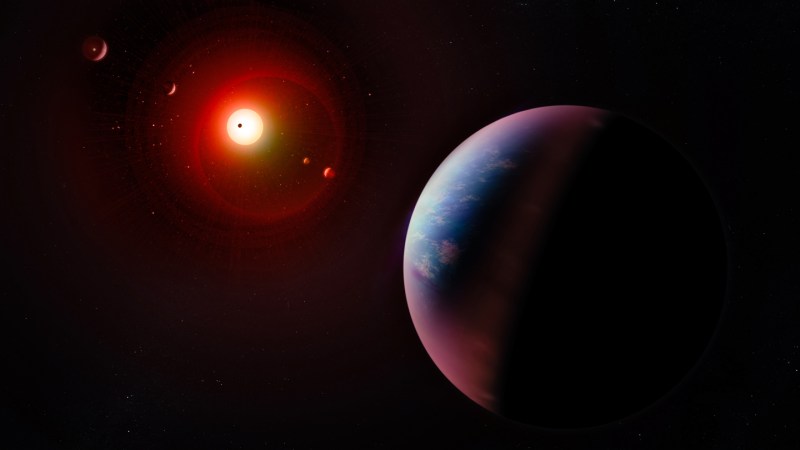
A recent study has introduced a “chemical Goldilocks zone,” a concept that may redefine our understanding of planetary habitability. Researchers, led by Craig Walton from the University of Cambridge, have discovered that a narrow range of planetary conditions is essential for the presence of bioessential nutrients like phosphorus and nitrogen, which are critical for life as we know it. The findings, published on February 9, 2024, in the journal Nature Astronomy, stem from simulations of tens of thousands of exoplanets.
The research indicates that fewer than 10 percent of these simulated planets maintain Earth-like levels of phosphorus and nitrogen, vital elements for life. While the presence of liquid water is often emphasized in discussions about habitability, Walton asserts that “you need nutrients” as well. These elements are fundamental for functions such as assembling cell walls, encoding genetic information, and constructing proteins.
The Role of Chemical Composition in Habitability
Even a planet abundant in water does not guarantee its ability to support life. A significant factor is the fate of phosphorus and nitrogen once a planet begins to form. These elements can potentially sink into a planet’s core, rendering them inaccessible to any lifeforms on the surface. Sebastiaan Krijt, an astrophysicist at the University of Exeter, highlights that the core is isolated, making any phosphorus or nitrogen trapped there useless for surface-dwelling organisms.
The research team found that whether phosphorus and nitrogen remain in the mantle or sink into the core largely depends on the availability of reactable oxygen. Laura Rogers, an astronomer at NOIRLab in Tucson, Arizona, explains that high levels of oxygen can prevent phosphorus from binding with iron, allowing it to stay in the mantle, while it causes nitrogen to bind and sink. Conversely, lower oxygen levels promote the opposite behavior.
This creates a delicate balance, which Walton describes as a “push-pull situation.” The researchers theorized that there must be an optimal level of oxygen — a “chemical Goldilocks zone” — where both phosphorus and nitrogen can coexist in sufficient quantities in a planet’s mantle. Their simulations, which considered the initial quantities of these elements based on the chemistry of various nearby stars, confirmed this hypothesis.
Implications for the Search for Extraterrestrial Life
The implications of this research extend beyond theoretical models. The study suggests that there may be a multitude of planets in the universe that lack adequate phosphorus or nitrogen, thus hindering the development of life. “It looks like there are going to be loads of planets out there that are starved of nitrogen or phosphorus,” Walton states.
As astronomers continue to discover new exoplanets, more than 6,000 have been confirmed to date, it becomes increasingly clear that a combination of factors must align for life to potentially emerge. In addition to the critical need for liquid water, the availability of oxygen must also fall within a specific range. Krijt notes that this new understanding compels scientists to reconsider the prevalence of Earth-like planets in the universe.
The longstanding question posed by physicist Enrico Fermi regarding the absence of extraterrestrial life, known as the Fermi Paradox, may find new context in these findings. As researchers delve deeper into the chemical conditions necessary for life, the search for our cosmic counterparts may take on additional layers of complexity and nuance.