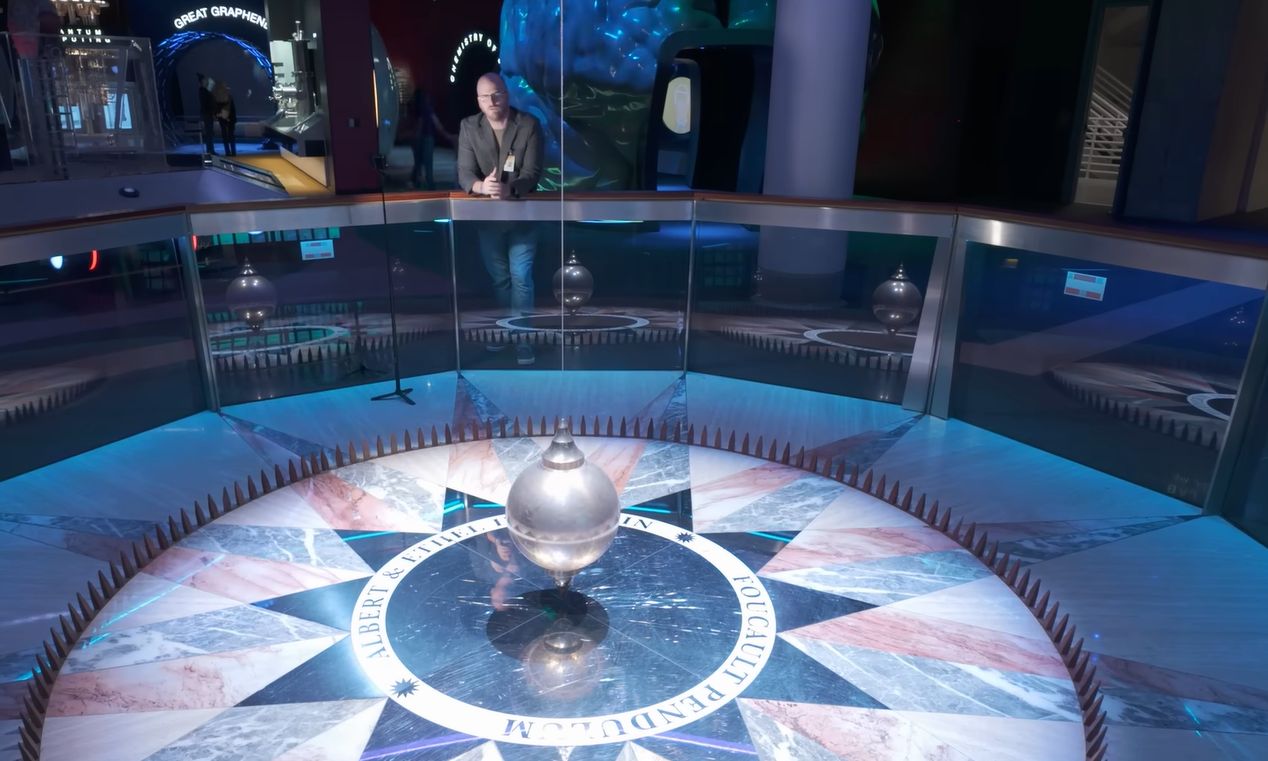
The Houston Museum of Natural Science has reported that its iconic Foucault pendulum has stopped swinging for the first time since its installation in the 1970s. This unexpected halt is attributed to a fault in the electromagnetic system that maintains the pendulum’s motion, necessitating repairs to restore its function.
Understanding the Foucault Pendulum
Invented by Léon Foucault in 1851, the Foucault pendulum serves as a remarkable demonstration of the Earth’s rotation. The pendulum, weighing 81.6 kilograms, operates on a principle that allows it to gradually shift its oscillation plane, creating the illusion that it rotates around its fixed attachment point. This phenomenon varies depending on the pendulum’s location on the Earth’s surface, making it a captivating exhibit for visitors.
At the poles, the pendulum completes a full rotation in exactly 24 hours, while at the equator, it remains stationary in its plane of swing. This variance not only illustrates the rotation of the Earth but also highlights its oblate shape, offering insights into fundamental physical principles.
Repair Plans and Visitor Engagement
Staff at the Houston Museum are currently assessing the issue with the pendulum’s electromagnetic system. While the malfunction has raised concerns, museum officials emphasize that it is a technical problem rather than a catastrophic failure. Measures are being put in place to ensure the pendulum will swing again.
In the meantime, the museum has shared a video explaining the mechanics and physics of the Herzstein Foucault pendulum, which provides an educational overview for those interested in the science behind this iconic exhibit. The video delves into the pendulum’s construction and the principles that allow it to function as a demonstration of both motion and time.
As the museum embarks on the necessary repairs, there is a collective hope among staff and visitors that the pendulum will soon resume its rhythmic dance, continuing to captivate and educate audiences about the wonders of physics and the Earth’s dynamics.