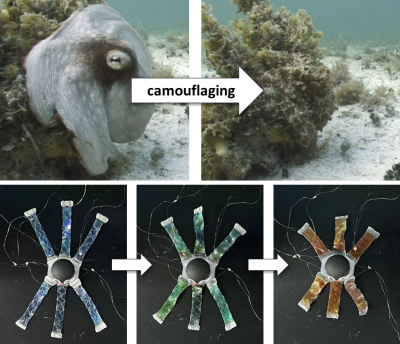
A team of researchers from the Korea Institute of Science and Technology (KIST) has successfully developed an innovative soft robot named ‘OCTOID.’ Led by Dr. Dae-Yoon Kim, this groundbreaking technology mimics the camouflage and movement of octopuses, allowing the robot to change its color and shape dynamically in response to electrical stimuli.
The OCTOID represents a significant advancement in robotics, integrating features that enable it to not only bend and stretch but also adapt its appearance and movements according to its surroundings. This capability positions the robot as a potential game-changer in various applications, from medical devices to environmental monitoring.
Design and Functionality Inspired by Nature
The design of OCTOID draws inspiration from the natural abilities of octopuses, known for their remarkable ability to camouflage and manipulate their bodies. Unlike traditional robots that rely on rigid structures, this soft robot utilizes advanced materials that allow for flexibility and responsiveness.
According to Sangrok Oh, the president of KIST, the robot’s ability to grasp objects while altering its color further enhances its functionality. “OCTOID is not just a soft robot; it’s a versatile tool that can adapt to various environments and tasks,” he stated. The integration of color-changing technology adds an additional layer of adaptability, enabling the robot to blend in with its surroundings or signal its status.
Potential Applications and Future Developments
The capabilities of OCTOID open up a range of potential applications. In the medical field, for instance, it could be used for minimally invasive surgeries or rehabilitation devices that require a gentle touch. Environmental monitoring is another area where this technology could prove beneficial, as the robot can navigate through sensitive ecosystems without causing disruption.
Research on the OCTOID is ongoing, with the team at KIST aiming to enhance its features further. Future iterations may incorporate advanced sensors and artificial intelligence to improve its autonomy and decision-making processes. The development of this soft robot highlights the ongoing trend towards biomimicry in technology, where solutions are inspired by the natural world.
As the field of robotics continues to evolve, innovations like the OCTOID signify a shift towards more adaptable and intuitive machines. This research marks a significant step forward, potentially paving the way for a new generation of robots that can interact more effectively with their environments and perform complex tasks with ease.