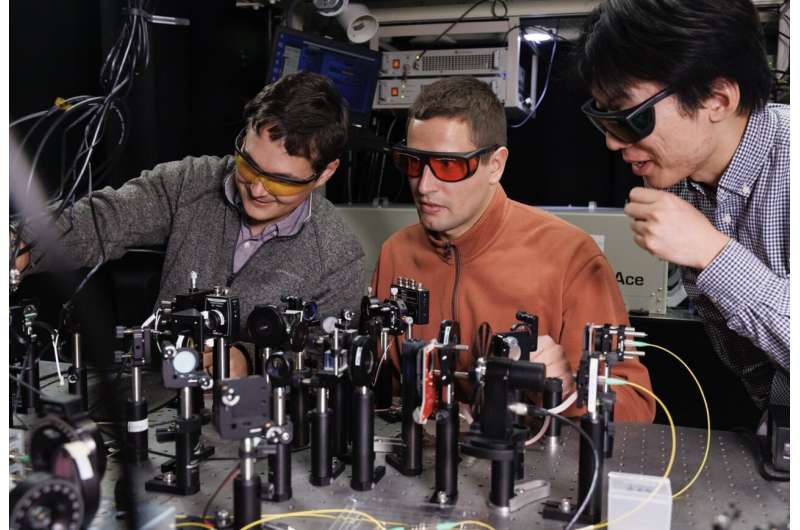
A team of researchers from Purdue University has made a significant breakthrough in optical technology by demonstrating a method for all-optical modulation using silicon. Their approach leverages an electron avalanche process, allowing a single photon to modulate a macroscopic optical beam. This advancement, detailed in a paper published on December 11, 2025, holds promise for enhancing the performance of photonic and quantum systems.
Engineers have long relied on light and its properties to develop technologies that advance imaging, communication, and information processing. However, a major limitation has been the weak optical nonlinearity of most materials, which affects their ability to respond to varying light intensities. Strong optical nonlinearity is critical for developing ultrafast optical switches, which are essential components in fiber optics communication systems, photonic devices, and quantum technologies.
Innovative Approach to All-Optical Modulation
In their research, the Purdue team identified the electron avalanche effect as a viable mechanism for achieving all-optical modulation. This phenomenon involves a chain reaction where an energetic electron, upon gaining sufficient energy, frees additional electrons from atoms, generating a cascading effect. According to Demid V. Sychev, the first author of the study, their goal was to create an ultrafast modulator capable of switching a macroscopic optical beam using just a single photon.
Sychev and his colleagues noted the limitations of existing methods, which typically require high-power beams and fail at the single-photon level. This prompted them to explore the potential of building a modulator that could effectively operate at lower intensities. They found that by shining a beam with single-photon-level intensity onto silicon, they could initiate an electron avalanche, significantly enhancing the material’s optical properties.
Promising Implications for Future Technologies
The researchers’ findings indicate that their optical modulation strategy significantly increases the nonlinear refractive index of silicon, resulting in much higher reflectivity compared to other materials. This ability to facilitate strong interactions between two optical beams, regardless of their power or wavelength, is groundbreaking.
Sychev explained, “While many single-photon-level approaches can mediate interactions between two weak beams, our method allows a single-photon-level beam to reliably control or modulate a high-power, macroscopic beam.” The team’s work is expected to pave the way for ultrafast optical switches, which could be pivotal in scaling up photonic circuits and enhancing quantum information technologies.
The technique operates at room temperature and is compatible with CMOS fabrication, making it accessible for various applications. Future developments could lead to the creation of all-optical circuits suited for both classical and quantum applications, potentially transforming areas such as computing, communication, and bioimaging.
Although the researchers have demonstrated the proof-of-principle for their modulation technique, further work is necessary to optimize it for practical applications. Sychev emphasized the importance of gaining a deeper understanding of the avalanche process and refining device geometry and materials for real-world implementation.
This innovative research marks a critical step towards integrating optical technologies into mainstream applications, with the potential to revolutionize information processing across numerous fields.