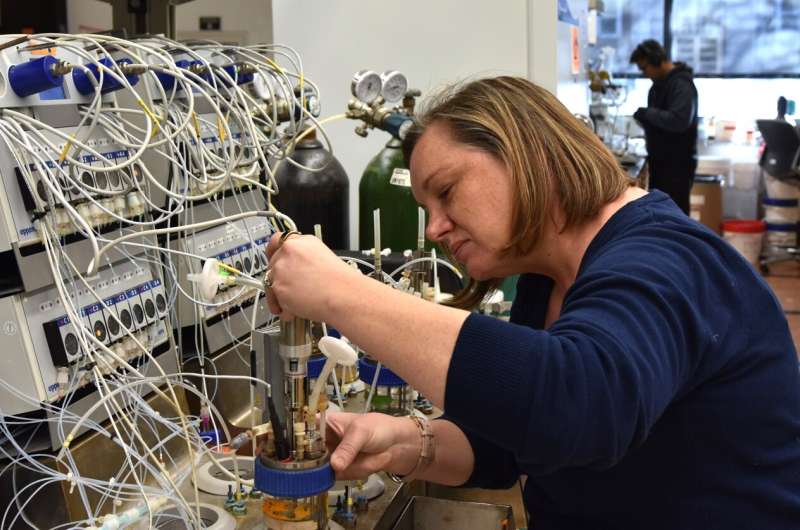
Scientists have made significant strides in biomanufacturing by developing a cost-effective way to produce 3-hydroxypropionic acid (3-HP) using engineered yeast. This advancement could lead to more sustainable production of key industrial chemicals used in products such as disposable diapers, microplastics, and acrylic paint. The breakthrough was achieved by researchers from the University of Illinois at Urbana-Champaign and Penn State University, as detailed in their recent publication in Nature Communications.
Acrylic acid, a critical component in various everyday products, is primarily derived from petroleum through energy-intensive chemical processes. Traditionally, 3-HP, the precursor to acrylic acid, has been produced almost exclusively via these methods. However, the new biomanufacturing process utilizes engineered microbes to ferment plant sugars into 3-HP, offering an environmentally friendly alternative.
The research team, part of the Center for Advanced Bioenergy and Bioproducts Innovation (CABBI), focused on improving the yield and concentration of 3-HP produced from renewable resources. They developed a high-yield strain of Issatchenkia orientalis yeast, which thrives in acidic environments, simplifying the fermentation process by eliminating the need for more costly neutral pH conditions required by other organisms.
Huimin Zhao, a Professor in the Department of Chemical and Biomolecular Engineering at Illinois and the lead author of the study, emphasized the economic potential of this innovation. According to the U.S. Department of Energy, the acrylic acid market alone is valued at approximately $20 billion, with a global demand of around 6.6 million tons in 2019.
To enhance 3-HP production, the researchers applied advanced metabolic engineering techniques. They identified the beta-alanine genetic pathway as optimal for maximizing yield while minimizing oxygen requirements. Through genome-scale modeling, the team pinpointed three gene variants that significantly improved production efficiency. The integration of multiple copies of an enzyme known as PAND further boosted 3-HP output.
In laboratory conditions, the researchers achieved an impressive yield of 0.7 grams of 3-HP per gram of glucose consumed, amounting to a titer of 92 grams per liter. These figures surpass previous benchmarks for engineered bacteria and yeast, marking a significant milestone in the field.
Utilizing the BioSTEAM software developed by CABBI, the researchers simulated a biomanufacturing facility to evaluate the economic feasibility of producing 3-HP and upgrading it to acrylic acid. Their techno-economic analysis and life cycle assessment confirmed that the new process is financially viable, paving the way for potential industrial commercialization.
“This work establishes I. orientalis as a next-generation platform for cost-effective 3-HP production,” Zhao stated. The researchers are now focused on scaling up the process and integrating downstream operations while exploring additional renewable feedstocks to enhance economic viability.
In parallel, CABBI scientists are investigating further applications of 3-HP. For instance, George Huber, a Professor of Chemical and Biological Engineering at the University of Wisconsin-Madison, is working on converting 3-HP into malonic acid, a valuable industrial chemical used in pharmaceuticals, biodegradable plastics, and agrochemicals.
As the team continues to refine their methods, the implications for sustainable production in the chemical industry are significant, potentially transforming how essential materials are sourced and manufactured.