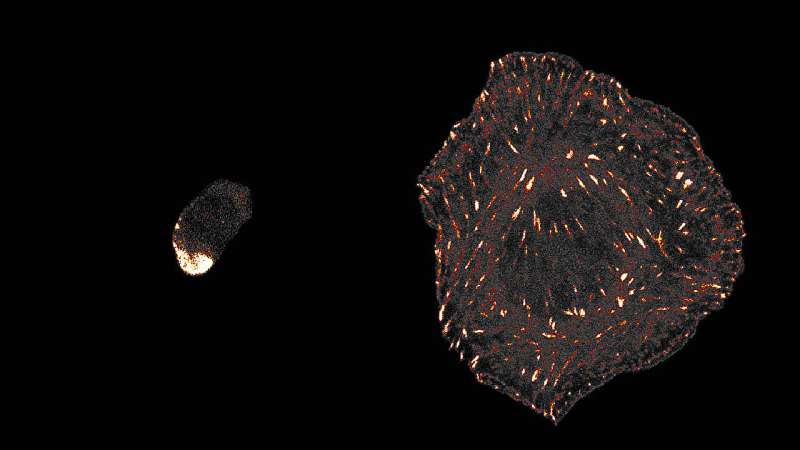
Researchers at the University of Münster in Germany have identified a fundamental protein that plays a crucial role in cell adhesion, tracing its evolutionary significance. The team, led by Prof Carsten Grashoff and doctoral student Srishti Rangarajan, found that the protein talin is vital for how cells, including those of animals and humans, stick to surfaces. Their findings were published in the journal Nature Communications on December 14, 2025.
Cell adhesion is essential for the formation of complex tissues and organs, and it relies on specific surface receptors known as integrins. Interestingly, many single-celled organisms lack these integrin receptors, raising questions about how this form of adhesion evolved. The researchers demonstrated that talin, which is present in various eukaryotic single-celled organisms, serves as a key connector between integrins and the cell’s interior, facilitating stronger mechanical attachment.
Through experiments involving amoebae and animal cells, the team revealed that talin transmits mechanical forces during cell adhesion, a function that is critical even at the microscopic level. Although each talin molecule transmits a force of only a few trillionths of a newton, this mechanical capability is essential for effective cell adhesion.
Rangarajan emphasized the significance of their findings, stating, “The integrin-mediated adhesion of animal cells is described in all modern textbooks on cell biology. However, it appears to be merely a specialization of a much older cell adhesion mechanism that originated in single-celled organisms and is mediated by talin.”
The research employed a range of innovative methods, including molecular genetics, high-resolution fluorescence microscopy, and molecular force microscopy measurements. These approaches allowed the scientists to gain insights into the ancient evolutionary processes that shaped cell adhesion mechanisms in multicellular life.
The discovery not only clarifies the role of talin in current biological systems but also suggests that the essential mechanical functions of this protein were established long before the advent of complex animal life. This research contributes to a deeper understanding of cell biology and may have implications for various fields, including developmental biology and medicine.
For further details, see the study by Rangarajan et al., titled “Talin force coupling underlies eukaryotic cell-substrate adhesion,” published in Nature Communications. The DOI for the study is 10.1038/s41467-025-67354-8.