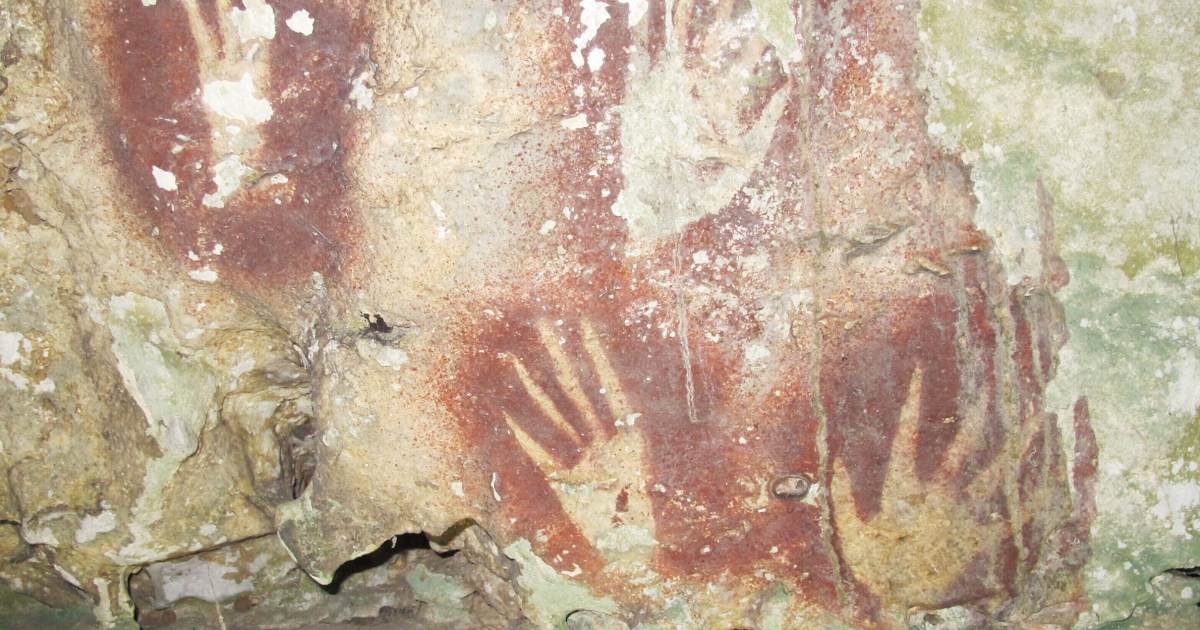
The discovery of the world’s oldest known cave art, estimated to be at least 67,800 years old, has been made by researchers in Indonesia. This significant finding, consisting of hand stencils, was uncovered in the Liang Metanduno limestone cave located on Muna Island, part of the larger eastern Indonesian island of Sulawesi. The research aims to provide insights into when early humans first engaged in artistic expression and how these practices evolved over time.
The hand stencils, which are faint and barely visible, were created by blowing pigment onto a hand pressed against the rocky surface. This method left an outline, indicating that the hands likely belonged to humans connected to the ancestors of the first Australians. The stencils were dated using an analysis of mineral crusts that formed over the years, a process described by Adam Brumm, a professor of archaeology at Griffith University in Brisbane, as “extraordinary,” given the challenges of dating rock art.
This finding surpasses another notable discovery made by the same research team in 2024, which dated a painting in a different cave on Sulawesi at approximately 51,200 years old. This earlier painting depicted three human-like figures interacting with a pig. Brumm expressed astonishment at the new find, stating, “This one image just completely blew that other one away.” He emphasized the significance of this discovery in illustrating the long history of rock art in the region.
Implications for Understanding Early Human Artistry
Researchers are optimistic about uncovering even older forms of art, including narrative depictions, in unexplored areas of Indonesia. Despite being a popular site for tourists, most of the art previously discovered in Liang Metanduno consists of paintings of domesticated animals, believed to be around 4,000 years old. The paper’s lead author, Adhi Oktaviana, first noticed the faint hand stencils in 2015, behind more recent illustrations that had obscured them.
Brumm explained that for many years, researchers focused on Ice Age cave paintings in regions like France and Spain, dating back around 30,000 to 40,000 years. This new evidence from Indonesia challenges previous assumptions about the origins of sophisticated artistic culture, indicating that humans outside Europe were creating remarkably complex cave art tens of thousands of years earlier than previously thought.
Connecting Findings to Ancient Human Migration
The discovery also provides valuable context for understanding the migration of early humans to Australia. While it is widely accepted that Aboriginal peoples have inhabited Australia for at least 50,000 years, one archaeological site there has been dated to 65,000 years. Brumm noted that the findings from Sulawesi, located near Australia, increase the likelihood that modern humans reached the continent around the same time.
The implications of this research extend beyond artistic expression, as it may help elucidate the timeline of human migration and settlement in the region. Brumm concluded by highlighting the importance of these discoveries in reshaping our understanding of early human history, stating, “It does make it considerably more likely that modern humans indeed were in Australia at least 65,000 years ago.”
As researchers continue their work in Indonesia, the potential for uncovering further evidence of ancient artistry and its significance in the narrative of human development remains a tantalizing prospect.