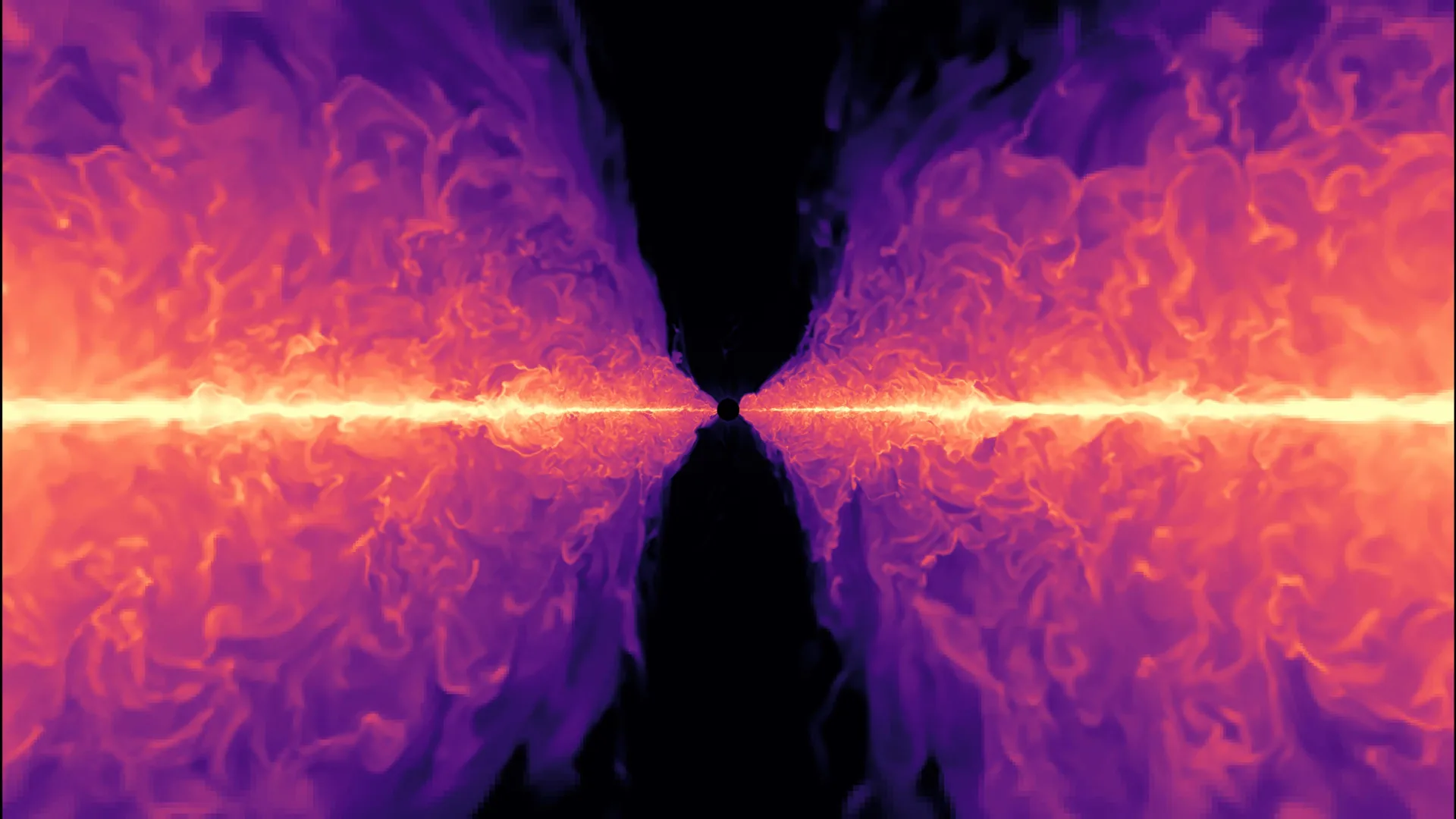
Researchers have achieved a significant breakthrough in understanding black holes, revealing new insights into the processes that occur near these enigmatic cosmic entities. A study published on December 22, 2025, in The Astrophysical Journal, presents detailed simulations that combine Einstein’s theory of gravity with realistic models of light and matter behavior. This work represents the most complete model to date of how black holes interact with their surroundings, illuminating the chaotic behavior of matter as it approaches these powerful gravitational forces.
Breakthrough in Black Hole Research
For decades, computational astrophysicists have sought to accurately simulate the dynamics of black holes. The new study, led by Lizhong Zhang from the Institute for Advanced Study and the Flatiron Institute’s Center for Computational Astrophysics, marks a turning point in this research. The team employed some of the world’s most powerful supercomputers to conduct calculations that fully incorporate both gravity and the effects of radiation, a feat not previously accomplished under conditions dominated by radiation.
“This is the first time we’ve been able to see what happens when the most important physical processes in black hole accretion are included accurately,” Zhang explained. The simulations have shown that matter forms turbulent, glowing disks around black holes, generating intense emissions and powerful outflows. This marks a major step toward understanding these cosmic engines and their role in the universe.
Importance of Accurate Models
Any realistic model of black hole behavior must account for the effects of general relativity due to the intense gravitational forces involved. As matter falls into a black hole, enormous energy is released, primarily in the form of radiation. Prior models often oversimplified these dynamics, treating radiation as a fluid rather than accurately simulating its behavior. As a result, they failed to provide a complete picture of black hole accretion.
By developing new algorithms that solve the underlying equations directly, the researchers have created simulations that reflect the true nature of radiation in curved spacetime. “Ours is the only algorithm that exists at the moment that provides a solution by treating radiation as it really is in general relativity,” said Zhang. This innovation enables researchers to explore black hole environments with unprecedented accuracy.
The study primarily focuses on stellar mass black holes, which typically have around ten times the mass of the Sun. While supermassive black holes, like Sgr A* at the center of our galaxy, have been extensively studied, stellar mass black holes allow for real-time observation of rapid changes over shorter timescales.
The simulations produced by this research align closely with actual observations, enabling scientists to more confidently interpret data from these distant systems. This enhanced understanding could lead to significant advancements in the study of black holes and their influence on galaxy formation.
Supercomputing Power Fuels Innovation
The Institute for Advanced Study has a rich history of leveraging computational modeling to advance scientific knowledge. The current research project utilized two of the world’s most powerful supercomputers, Frontier at Oak Ridge National Laboratory and Aurora at Argonne National Laboratory, which can perform quintillion calculations per second. Such computational power was essential for executing the complex algorithms necessary for these simulations.
According to James Stone, co-author and Professor at the Institute for Advanced Study, “What makes this project unique is the combination of advanced applied mathematics and the extensive computational resources available to us.” The team plans to extend their research to explore various types of black holes, including supermassive ones, which are crucial in shaping galaxies.
As this research progresses, it promises to refine our understanding of how radiation interacts with matter under varying conditions, paving the way for deeper insights into the mechanics of black holes and their broader cosmic implications.