Scientific discoveries this week have highlighted incredible findings ranging from cosmic phenomena to ancient human populations. Researchers have revealed the largest spinning structure in the universe, while investigations in southern Africa have uncovered a unique human lineage that remained isolated for over 100,000 years. Additionally, archaeologists in China have made a striking find of a pit filled with skulls, challenging previous understandings of ancient human sacrifices.
Cosmic Discoveries: The Largest Spinning Structure
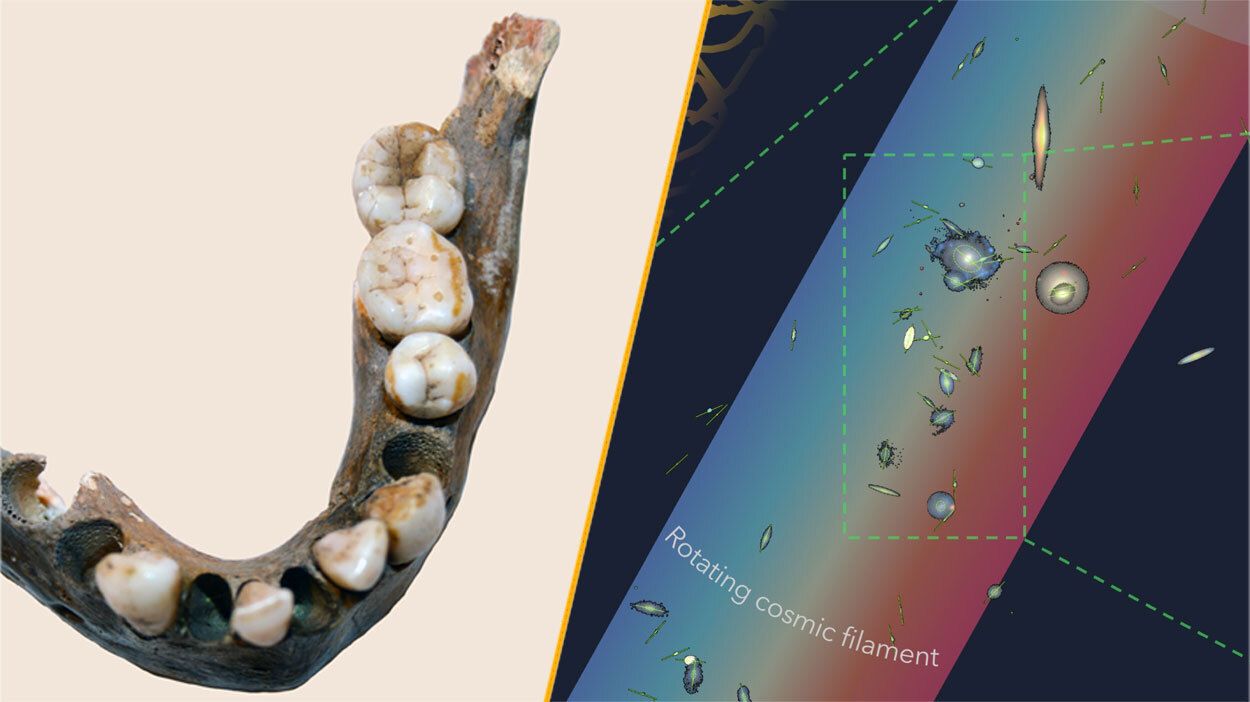
A groundbreaking discovery has been made 140 million light-years away, where scientists identified the largest spinning object known to humanity. This colossal rotating filament, linked to a chain of 14 galaxies, is wider than the Milky Way and rotates at approximately 68 miles per second (110 kilometers per second). The filament’s discovery is a significant addition to our understanding of cosmic structures and their dynamics.
Closer to Earth, researchers have turned their attention to southern Africa, where a recent study examined human skeletons dating back up to 10,000 years. These remains were found south of the Limpopo River, which flows from South Africa into Mozambique. The analysis revealed that individuals who lived more than 1,400 years ago exhibited a genetic makeup vastly different from that of modern humans. According to the researchers, this population “forms an extreme end of human genetic variation.”
Archaeological Insights and Modern Consequences
In a significant archaeological find, excavations in China have uncovered a massive pit filled predominantly with male skulls. This discovery, located outside the gates of a 4,000-year-old city, diverges from the typical sacrificial patterns observed in other nearby settlements. The presence of so many male skulls raises intriguing questions about ancient practices and societal structures.
Meanwhile, a separate investigation in Greece revealed a 2,700-year-old elaborate tomb containing a woman adorned with an upside-down crown. This unusual burial practice has left researchers puzzled, further emphasizing the complex nature of ancient cultures.
In more contemporary news, a major tree-planting initiative in China, part of the Great Green Wall project aimed at combating desertification, has produced unintended consequences. A recent analysis indicates that while the project was initially successful in enhancing vegetation, it inadvertently altered rainfall and evaporation patterns. This change has resulted in lower water levels in densely populated areas of the country, prompting concerns about water scarcity.
Additionally, new research suggests that the record temperature set in Death Valley in 1913 may have been influenced by human error. In Europe, scientists are also warning that the collapse of a key Atlantic current could lead to centuries of drought, highlighting the interconnectedness of climate systems.
Further capturing the world’s attention, the interstellar comet 3I/ATLAS has been exhibiting intriguing activity. Observations from the Joan Oró Telescope in northeastern Spain indicate that the comet is producing spiral jets from its surface, which may be indicative of “ice volcanoes.” As the comet approaches the sun, it heats up and brightens, suggesting that ice is sublimating from its surface, akin to other distant celestial bodies within our solar system.
In technology, researchers from MIT have developed a method to extract drinking water from the air, significantly improving efficiency. This innovative approach, which utilizes ultrasound to extract moisture, is reported to be 45 times more efficient than traditional evaporation methods. This development could have substantial implications for water-scarce regions.
The week in science has also seen myriad other developments, including a law that explains how broken objects shatter, potential treatments for “lazy eye,” and discoveries about ancient anacondas. As research continues to evolve, these findings will undoubtedly shape our understanding of both the past and the future.
Overall, this week’s discoveries underscore the remarkable breadth of scientific inquiry, revealing insights into both our ancient origins and the cosmic wonders that surround us. As researchers continue to explore these areas, the potential for further groundbreaking revelations remains vast.