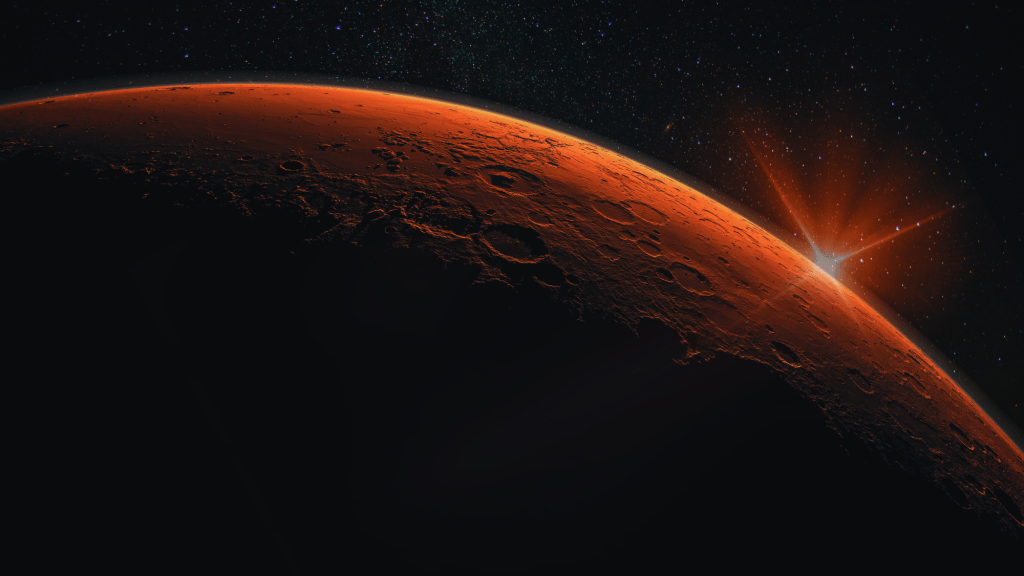
A recent study conducted by the National Institute of Standards and Technology (NIST) has shed light on how time operates on Mars, revealing that it flows differently compared to Earth. Researchers found that an atomic clock on Mars would run approximately 477 microseconds faster per day than one on Earth. This finding, published in The Astronomical Journal, is significant for space agencies and future colonists on Mars. However, the situation is not as straightforward as it may seem.
The discrepancy in time is not fixed. Depending on Mars’ position in its orbit around the sun, the daily difference can vary by as much as 226 microseconds. While this difference may seem trivial, it poses considerable challenges when precise timing is necessary for scientific calculations and navigation systems.
Understanding the Variability of Time on Mars
The variation in time flow on Mars can be attributed to its erratic orbit. Unlike Earth, which has a stable orbit, Mars experiences gravitational influences from multiple celestial bodies, including its own gravity, the sun, and even the Earth’s pull. This interplay creates a complex scenario known as the three-body problem. As NIST physicist Bijunath Patla explained, “A three-body problem is extremely complicated. Now we’re dealing with four.” This complexity makes it challenging to predict the exact flow of time on Mars.
To address the need for synchronization between Martian and Earth-based clocks, the NIST team investigated the various factors influencing time measurement on Mars. As humanity looks toward future colonization, understanding how time behaves on another planet is crucial for developing navigation systems akin to GPS on Earth.
The Implications of Time Dilation
There is an intriguing implication of these findings: living on Mars would result in aging slightly faster than on Earth. After 50 years on Mars, a person would age an additional 9 seconds compared to their Earth counterparts. While this difference is negligible in the grand scheme of life, it raises interesting questions about the experience of time on different planets.
As research continues, scientists aim to develop highly precise clocks that can operate effectively on Mars, paving the way for future exploration and potential colonization. The findings from NIST underscore the intricate relationship between time and gravity, particularly in environments vastly different from our own. Understanding these dynamics is essential as humanity prepares for a future that may include life on Mars.
The research not only informs our scientific pursuits but also adds a layer of fascination to our understanding of the universe. As we venture further into space, grasping the nuances of time on other planets will be vital.