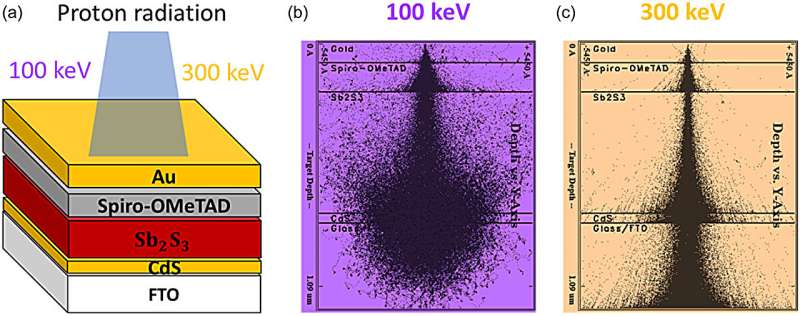
Physicists at the University of Toledo are advancing the development of solar cells specifically designed for use in outer space. This research, conducted at the Wright Center for Photovoltaics Innovation and Commercialization and supported by the Air Force Research Laboratory, addresses the unique challenges posed by the harsh environment of space, which significantly impacts the efficiency and longevity of solar technology.
One notable breakthrough involves the exploration of antimony compounds as light-absorbing semiconductors. A recent publication in the journal Solar RRL features a comprehensive assessment of antimony chalcogenide-based solar cells, marking a significant contribution to the field. The article was prominently displayed on the journal’s front cover, underscoring its importance.
Alisha Adhikari, a doctoral student in physics and co-lead of the research team, emphasized the advantages of these solar cells, stating, “Antimony chalcogenide solar cells exhibit superior radiation robustness compared to the conventional technologies we’re deploying in space.” She noted, however, that these cells must achieve greater efficiency to become viable alternatives for future space missions.
Research Team and Future Directions
The research team, led by Dr. Randall Ellingson, a professor in the Department of Physics and Astronomy, is committed to overcoming the barriers faced by solar energy collection in space. Collaborators on this project include postdoctoral researcher Dr. Vijay Karade, doctoral student Scott Lambright, and faculty members Dr. Yanfa Yan and Dr. Zhaoning Song. Their collective efforts aim to harness solar energy effectively, even in the extremes of temperature and radiation found in space.
The increasing interest in antimony compounds highlights a shift in materials research for solar technology. The team’s findings suggest that antimony chalcogenide solar cells could play a critical role in future space exploration, provided they can enhance their efficiency.
As the research progresses, the team plans to investigate innovative methods to optimize solar energy harvesting under the challenging conditions of outer space. This work could pave the way for more sustainable energy solutions for long-term space missions, contributing to humanity’s exploration of the cosmos.
The study, titled “Assessing Proton Radiation Hardness of Antimony Chalcogenide Solar Cells,” was published in January 2026. For those interested in the details of this pioneering research, the DOI is 10.1002/solr.202500699, confirming the rigorous peer-review process that underpins the findings.
The advancements made by the University of Toledo’s team exemplify the ongoing evolution of solar technology in response to the unique demands of space environments, promising exciting developments in the future of renewable energy beyond Earth.