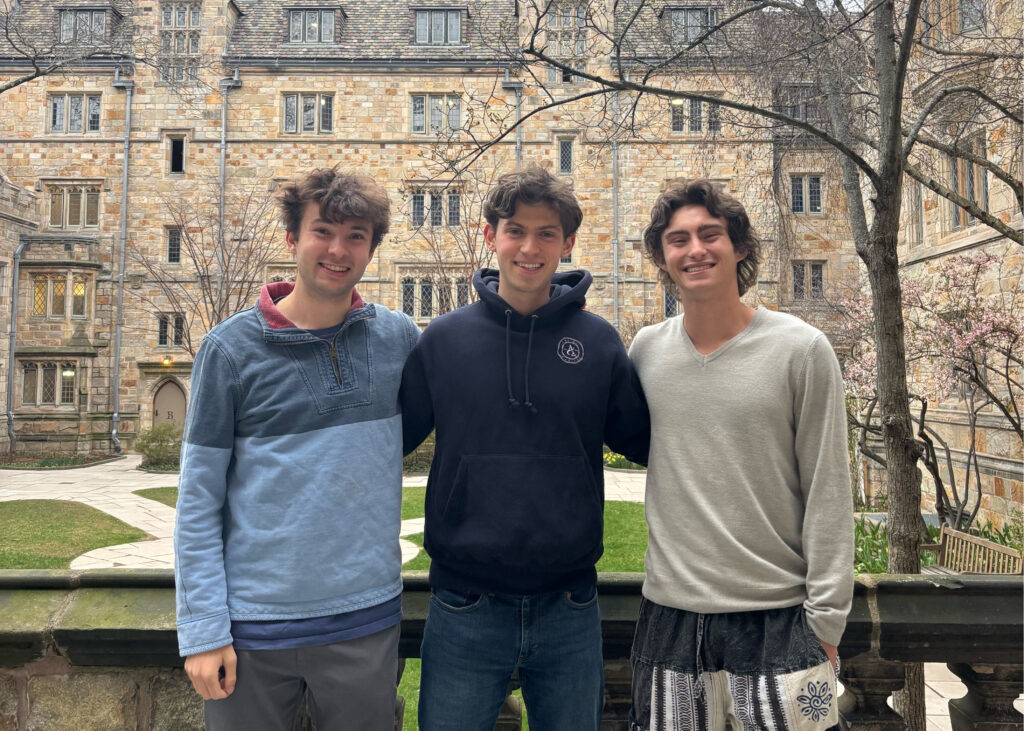
Three students from Yale University have developed a new app called Scroll Toll, designed to help users minimize their screen time while simultaneously encouraging charitable donations. Founded in November 2023 by Asher Barondes, Benjamin Siegel, and Chase Reynders, the app allows users to establish limits on their phone applications. When users exceed these limits, Scroll Toll prompts them to donate to one of the app’s selected charities, creating a financial incentive to reduce screen time.
Barondes, who focuses on the app’s interface and marketing, explained the motivation behind Scroll Toll. “We wanted to add more friction to really get people off their phones. We recognized that one way to do so is by having some money tied to it,” he stated. He emphasized that even if users exceed their screen time limits, they would still contribute to a social good.
Upon downloading the app, users can set time limits for specific applications and select a donation amount for each time they exceed those limits. For instance, a user might choose to donate $0.25 for every additional five minutes spent on Instagram. After establishing these parameters, the app offers users the option to enable “scheduled fulfillment,” allowing for automatic donations to their chosen charity or manual contributions if preferred. This flexibility lets users delay their donations if necessary.
Siegel compared the app’s impact on behavior to congestion pricing in urban areas. He stated, “The only way to actually change behavior is if people have this balance they have to find between money and time.”
The trio’s collaboration began when Barondes and Siegel, who were independently developing similar apps, met through mutual friends during Siegel’s gap year before attending Yale. They soon invited Reynders to join their project. During his gap year, Siegel and his friends created an Instagram and TikTok account called @boys.with.the.bus, which has amassed over two million followers by documenting various adventures. This experience shifted Siegel’s perspective on screen time. “I would look at the stats on the phone after I posted something on it,” he recalled. “You’re like, holy crap. I just wasted 100 years of people’s lives in this few-second video I just posted.”
Despite hoping his content was motivational, Siegel acknowledged that many individuals struggle with their relationship with technology. He believes Scroll Toll can offer users a structure to manage their screen time more effectively.
Since its launch, Scroll Toll has garnered a small but engaged user base. According to Barondes, even among the initial 65 users, there was an average reduction of 20% to 30% in screen time. As of January 2024, the app has expanded to 130 users, with the team actively incorporating feedback to enhance user experience, including developing a weekly report on screen time usage.
Among the users is Evan Daneker, a fellow Yale student who has been donating to American Forests, a non-profit focused on forest restoration. Daneker, who has previously used other screen time management apps, appreciates Scroll Toll’s more flexible approach. “When a screen time minimizer shuts down an app completely, the user is likely to just delete the app blocker,” he explained. “Because I was allowed to set and override my own limits on Scroll Toll, I felt the app was more approachable.”
Another user, Sofia Jacobson, found Scroll Toll beneficial in learning how to set realistic screen time limits. This awareness encouraged her to think critically about her phone usage, especially during moments of mindless scrolling.
The founders are committed to ongoing improvement and are exploring ways to deepen their collaboration with partner charities. They plan to implement monthly challenges that highlight specific causes, such as breast cancer awareness during Breast Cancer Awareness Month in October.
While the founders recognize that not all users may be motivated by a financial incentive to reduce screen time, they believe there is a market for their app. Reynders stated, “At the end of the day, you can always delete the app, and while we would love them to stick with it, we’re really trying to be intentional about our audience.”
Through Scroll Toll, the Yale students aim to strike a balance between screen time management and charitable giving, creating a unique solution in today’s technology-driven landscape.