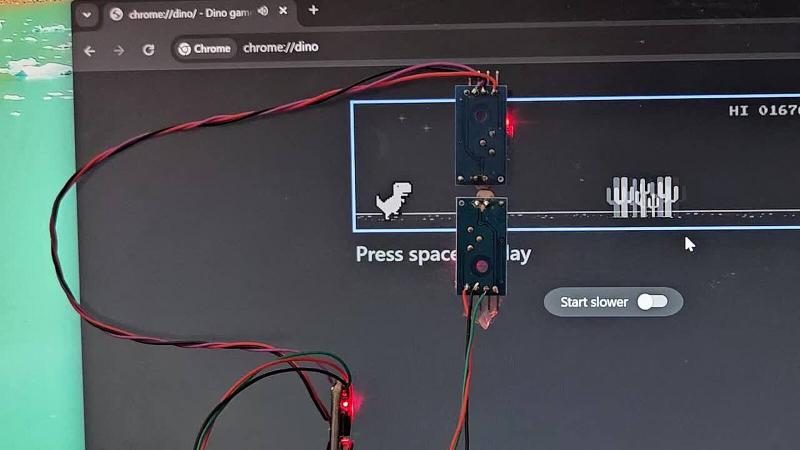
The classic Chrome Dinosaur Game, which appears during internet outages, has been automated by a tech enthusiast using an ATtiny85 microcontroller. This project, led by creator Albert David, showcases an innovative approach to a simple yet entertaining browser feature, transforming the game into an automated challenge.
How the Automation Works
When internet connectivity is lost while using Google Chrome, a small dinosaur appears on the screen, inviting users to engage in a mini-game where they must navigate a T-rex over various obstacles, primarily cacti and flying birds. Understanding the mechanics of this mini-game, Albert David designed a system to play it automatically. This involved using a Digispark ATtiny85 microcontroller board, which connects to a PC as a USB Human Interface Device (HID) and simulates the necessary key presses to control the dinosaur.
To effectively sense the game’s state, the setup employs a pair of LM393 light-dependent resistor comparator modules. The lower sensor is calibrated to detect approaching cacti, while the upper sensor identifies airborne obstacles. By processing this information, the microcontroller can time key presses accurately, allowing the dinosaur to leap over cacti while evading birds.
Calibration and Performance Insights
Albert has documented the project thoroughly, providing insights into the assembly process and offering calibration instructions. These guidelines include optimal placement for the sensors and methods for adjusting their thresholds to ensure reliable performance. This meticulous attention to detail helps users achieve higher scores in the game.
Interestingly, this is not the first instance of a microcontroller tackling the hidden Chrome game. Its growing popularity has inspired various adaptations and even ports to different platforms, showcasing the engaging nature of this simple browser Easter egg.
As technology continues to evolve, projects like this highlight the creativity and resourcefulness of enthusiasts who find new ways to interact with everyday digital experiences. The work of Albert David serves as a reminder of how playful innovation can emerge from the simplest of concepts.