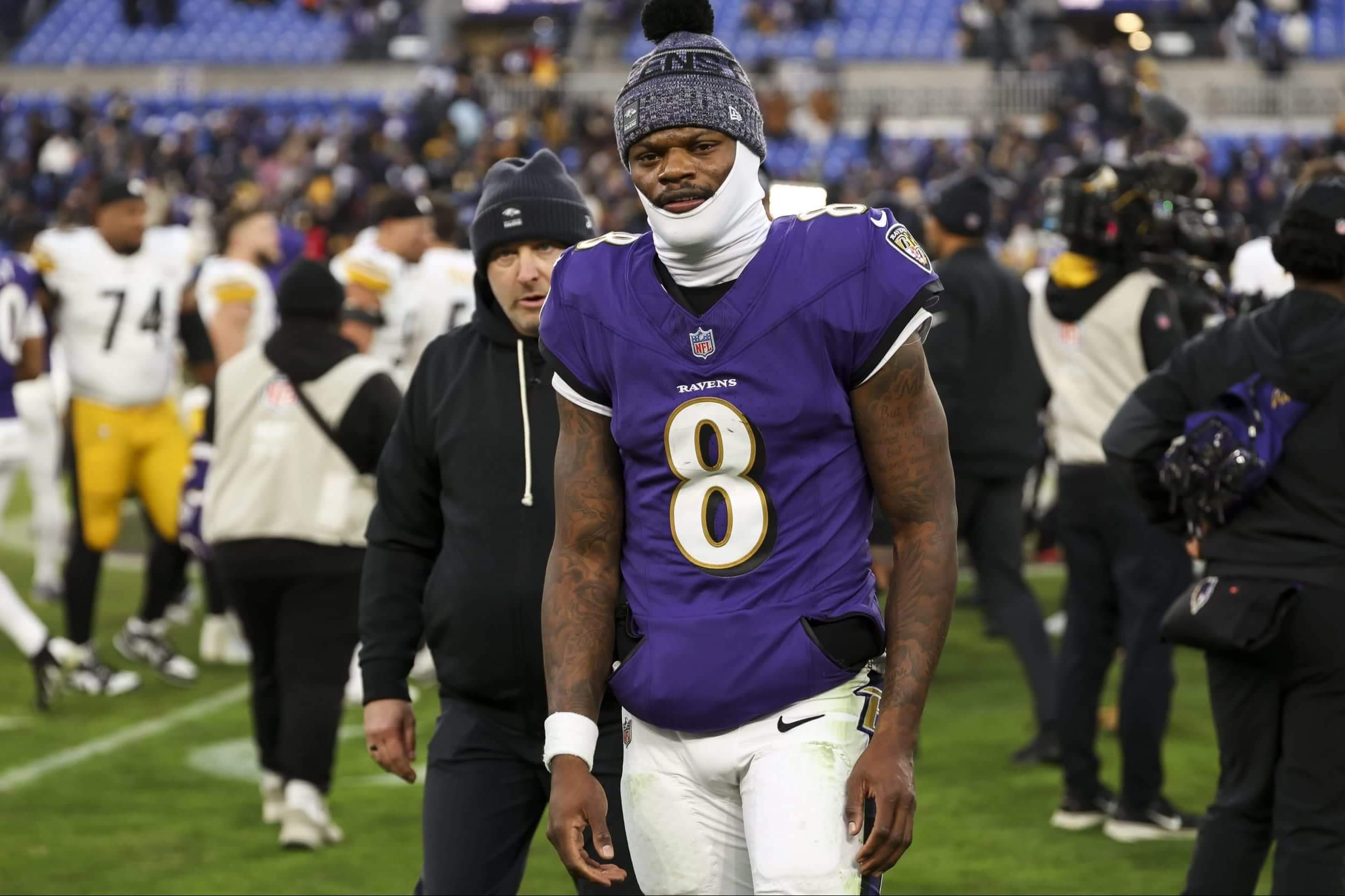
Lamar Jackson, the quarterback for the Baltimore Ravens, is currently facing significant challenges on the field. Despite his previous accolades, including two MVP awards, Jackson’s performance has noticeably declined this season, raising concerns among analysts and fans alike. An NFL executive who spoke anonymously remarked, “He just doesn’t look the same.”
Several factors may contribute to Jackson’s struggles. He has battled various injuries, missing three games earlier this season due to a hamstring issue and recently sitting out practices because of ankle and toe problems. While injuries often play a crucial role in a player’s performance, observers believe that the issues affecting Jackson might extend beyond physical limitations.
Upon returning from his hamstring injury, Jackson had a standout performance against the Miami Dolphins, completing 18 of 23 passes for 204 yards and four touchdowns. However, he has since struggled with consistency, posting five consecutive games with a completion percentage below 60. His average during that stretch has been just 197.4 passing yards, 25.4 rushing yards, two passing touchdowns, one rushing touchdown, four interceptions, and two lost fumbles. He has also been sacked 12 times during these games.
A coach noted that Jackson appears to be off with his timing, which is unusual for a player who has typically thrived in rhythm. Historically, Jackson has not been a timing-based passer, but his previous success relied on precise execution. This season, his throws have been inaccurate and delayed, undermining the offensive rhythm that the Ravens depend on.
In addition to his struggles, Jackson has also seen a reduction in explosive plays, averaging just three plays of at least 20 yards per game—his second-lowest rate since entering the league. Surprisingly, he has not recorded a 20-yard run for the first time in his career. Jackson had previously tallied 55 such runs from 2018 to 2024, including eight in the last season when he was a runner-up for the MVP award.
Jackson’s challenges are compounded by a lack of support from his teammates. Tight end Isaiah Likely recently fumbled a touchdown opportunity, while both Likely and wide receiver Zay Flowers had touchdowns nullified by controversial officiating decisions. The Ravens, who were once viewed as strong Super Bowl contenders, now find themselves outside the playoff picture, and their performance has been one of the season’s disappointments.
The situation is equally concerning for Daniel Jones, the quarterback of the Indianapolis Colts, who is facing an uncertain future after suffering a torn Achilles. This injury not only jeopardizes his immediate playing career but could also significantly impact his financial prospects. Prior to the injury, Jones was expected to command a contract worth between $35 million and $40 million annually in free agency.
With the injury, however, his earning potential may have been severely diminished. The Atlanta Falcons previously signed Kirk Cousins for four years and $180 million after he tore his Achilles, but that deal came with its own set of complications. Jones, at 28 years old, is younger than Cousins and Aaron Rodgers, who also faced similar injuries, which could mean a quicker recovery.
Nevertheless, Jones’s mobility is a critical aspect of his game, and his recent performance has been hindered by the injury. Teams may be uncertain about his ability to regain full strength before 2027, complicating the Colts’ negotiations as they consider his future with the team. They may find themselves bidding against themselves, potentially leading to a contract in the range of Justin Fields’ two-year, $30 million deal or Baker Mayfield’s three-year, $100 million contract.
In a different scenario, rookie quarterback Shedeur Sanders has stepped into the spotlight with the Cleveland Browns. Recently named the starter for the remainder of the season, Sanders has performed admirably despite the team’s struggles. He has completed 52.4 percent of his passes for 769 yards, five touchdowns, and three interceptions while also contributing with his legs.
Sanders’s promotion has been somewhat serendipitous, emerging from a tumultuous period for both the Browns and himself. With the team facing playoff elimination and financial constraints, Sanders’s development is crucial for the future of the franchise. If he continues to show promise, he might secure a more permanent role in the team’s plans moving forward.
As the seasons progress, the futures of Jackson, Jones, and Sanders will undoubtedly shape the landscape of their respective teams in the NFL. The challenges faced by these quarterbacks highlight the unpredictability of professional sports and the impact of injuries on careers.